Department of Psychology, The University of Tulsa, 800 S. Tucker Drive, Tulsa, OK, 74104, USA.
School of Public Health, Department of Social and Behavioural Sciences, College of Health Sciences, University of Ghana, Accra, Ghana.
Arch Womens Ment Health. 2019 Dec;22(6):779-789. doi: 10.1007/s00737-019-00992-2. Epub 2019 Jul 30.
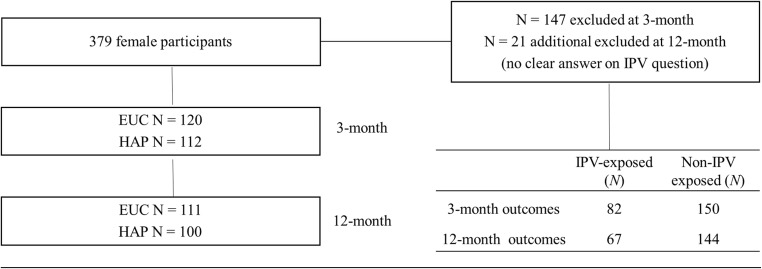
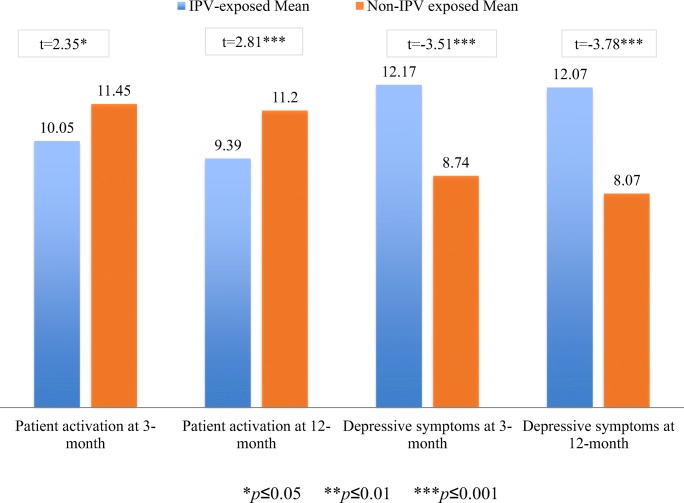
Intimate partner violence (IPV) strongly predicts depression, but it is unknown if women experiencing IPV can benefit from depression treatments in contexts where depression and IPV are prevalent. This study explored whether women experiencing IPV in Goa, India, can benefit from the Healthy Activity Program (HAP), a culturally adapted behavioral activation treatment, compared with enhanced usual care (EUC). Cross-sectional and longitudinal analyses were performed on data from a clinical trial. Measures assessed at baseline and 3 and 12 months included depressive symptoms. Measures assessed at 3 and 12 months included activation and IPV. Independent t tests were conducted to assess if participants experiencing IPV had higher depressive symptoms and lower activation at 3 and 12 months; hierarchical linear regression was conducted to determine if 3-month IPV predicted 12-month depressive symptoms across trial arms (Hypothesis 1). Hierarchical linear regression was then conducted to examine if the relationship between 3-month activation and 12-month depressive symptoms was moderated by 3-month IPV within each trial arm (Hypothesis 2). As expected, participants experiencing IPV had significantly lower activation levels and higher depressive symptoms compared with participants who did not experience IPV at 3 and 12 months in cross-sectional analyses. Similarly, IPV endorsed at 3 months significantly predicted depressive symptoms at 12 months. However, activation was significantly associated with less severe depressive symptoms at 12 months, irrespective of IPV endorsement among HAP participants. For EUC participants, IPV remained the only significant predictor of depressive symptoms at 12 months. Results suggest that women experiencing IPV can still benefit from behavioral activation.
亲密伴侣暴力(IPV)强烈预测抑郁,但在抑郁和 IPV 普遍存在的情况下,经历 IPV 的女性是否可以从抑郁治疗中获益尚不清楚。本研究探讨了在印度果阿,经历 IPV 的女性是否可以从健康活动计划(HAP)中受益,HAP 是一种文化适应的行为激活治疗方法,与增强的常规护理(EUC)相比。对一项临床试验的数据进行了横断面和纵向分析。基线和 3 个月和 12 个月评估的措施包括抑郁症状。在 3 个月和 12 个月评估的措施包括激活和 IPV。进行独立 t 检验以评估在 3 个月和 12 个月时经历 IPV 的参与者是否具有更高的抑郁症状和更低的激活水平;进行分层线性回归以确定在整个试验臂中,3 个月的 IPV 是否预测 12 个月的抑郁症状(假设 1)。然后进行分层线性回归,以检查在每个试验臂中,3 个月的激活与 12 个月的抑郁症状之间的关系是否受 3 个月的 IPV 调节(假设 2)。正如预期的那样,在横断面分析中,与未经历 IPV 的参与者相比,经历 IPV 的参与者在 3 个月和 12 个月时的激活水平显着降低,抑郁症状显着更高。同样,在 3 个月时报告的 IPV 显着预测了 12 个月时的抑郁症状。但是,无论 HAP 参与者是否存在 IPV,激活都与 12 个月时较轻的抑郁症状显着相关。对于 EUC 参与者,在 12 个月时,IPV 仍然是抑郁症状的唯一重要预测因素。结果表明,经历 IPV 的女性仍可以从行为激活中受益。