• 文献检索
  • 文档翻译
  • 深度研究
  • 学术资讯
  • Suppr Zotero 插件Zotero 插件
  • 邀请有礼
  • 套餐&价格
  • 历史记录
应用&插件
Suppr Zotero 插件Zotero 插件浏览器插件Mac 客户端Windows 客户端微信小程序
定价
高级版会员购买积分包购买API积分包
服务
文献检索文档翻译深度研究API 文档MCP 服务
关于我们
关于 Suppr公司介绍联系我们用户协议隐私条款
关注我们

Suppr 超能文献

核心技术专利:CN118964589B侵权必究
粤ICP备2023148730 号-1Suppr @ 2026

文献检索

告别复杂PubMed语法,用中文像聊天一样搜索,搜遍4000万医学文献。AI智能推荐,让科研检索更轻松。

立即免费搜索

文件翻译

保留排版,准确专业,支持PDF/Word/PPT等文件格式,支持 12+语言互译。

免费翻译文档

深度研究

AI帮你快速写综述,25分钟生成高质量综述,智能提取关键信息,辅助科研写作。

立即免费体验

直接报告和回忆的创伤患者大异质样本中的健康相关生活质量的对应关系。

Correspondence of directly reported and recalled health-related quality of life in a large heterogeneous sample of trauma patients.

机构信息

Department of Public Health, Erasmus MC, University Medical Center Rotterdam, P.O. Box 2040, 3000 CA, Rotterdam, The Netherlands.

Association of Dutch Burn Centres, Maasstad Hospital, Rotterdam, The Netherlands.

出版信息

Qual Life Res. 2019 Nov;28(11):3005-3013. doi: 10.1007/s11136-019-02256-z. Epub 2019 Jul 30.

DOI:10.1007/s11136-019-02256-z
PMID:31364035
原文链接:https://pmc.ncbi.nlm.nih.gov/articles/PMC6803580/
Abstract

PURPOSE

To evaluate the correspondence of directly reported and recalled health-related quality of life (HRQL) in a heterogeneous sample of trauma patients.

METHODS

Adult trauma patients who attended the Emergency Department and were admitted between 03/2016 and 11/2016 were invited to participate. Postal surveys were sent 1 week (T1), 3 months (T2), and 12 months (T3) post-trauma. The EQ-5D-3L and Visual Analogue Scale (EQ-VAS) were used to assess directly reported and recalled HRQL.

RESULTS

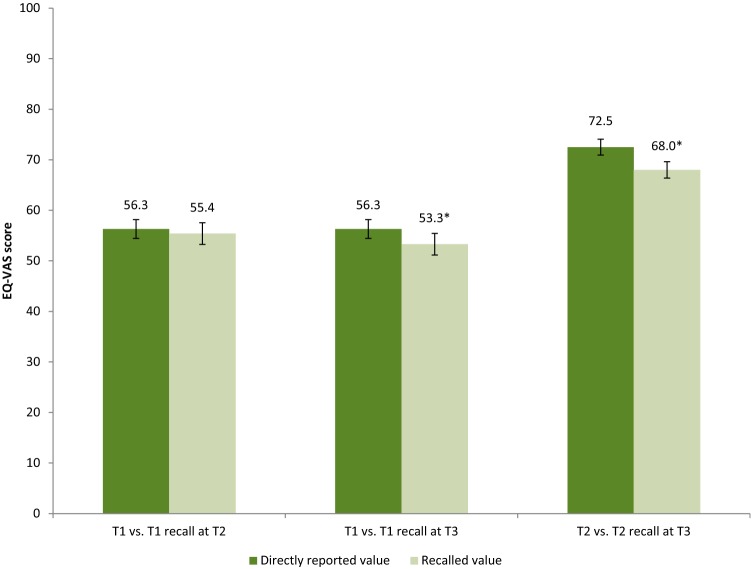
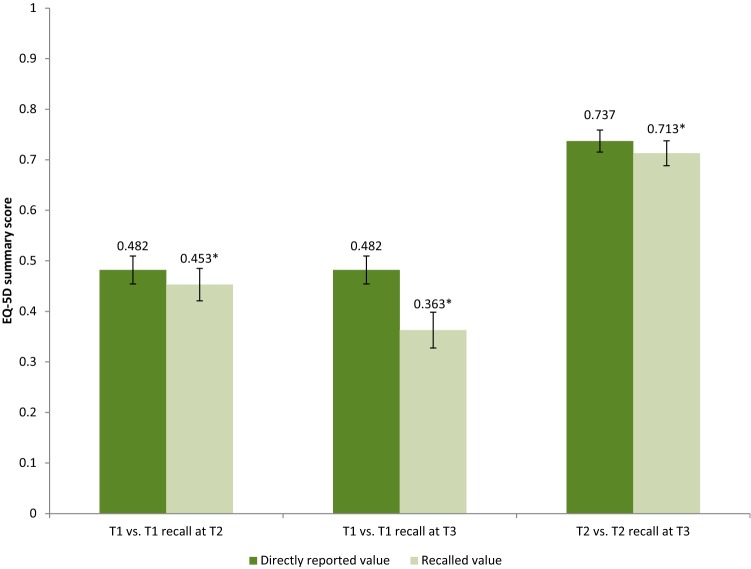
The EQ-5D was completed by 446 patients at T1, T2, and T3. Directly reported mean T1 EQ-5D summary score was 0.482, whereas recalled T1 EQ-5D summary score was 0.453 (p < 0.05) at T2 and 0.363 (p < 0.001) at T3. Directly reported mean T2 EQ-5D summary score was 0.737 and mean recalled T2 EQ-5D summary score was 0.713 (p < 0.05) at T3. Directly reported mean T1 EQ-VAS was 56.3, whereas mean recalled T1 EQ-VAS at T2 and T3 was 55.4 (p = 0.304) and 53.3 (p < 0.05), respectively. Directly reported mean T2 EQ-VAS was 72.5 and recalled T2 EQ-VAS at T3 was 68.0 (p < 0.001). The correspondence between all directly reported and recalled HRQL (both EQ-5D summary and EQ-VAS) was fair (ICC = 0.518-0.598). Lowest correspondence was seen in patients with major trauma (injury severity score ≥ 16) and in patients with middle-level education.

CONCLUSIONS

Recalled HRQL measured by the EQ-5D-3L and EQ-VAS was systematically lower compared to the directly reported HRQL. Patient characteristics, injury severity, subjectivity of the dimension, and time interval appear to influence correspondence between directly reported and recalled HRQL.

摘要

目的

评估异质创伤患者群体中直接报告和回忆的健康相关生活质量(HRQL)的一致性。

方法

2016 年 3 月至 11 月期间,邀请在急诊室就诊并住院的成年创伤患者参加该研究。创伤后 1 周(T1)、3 个月(T2)和 12 个月(T3)时通过邮寄问卷进行调查。使用 EQ-5D-3L 和视觉模拟量表(EQ-VAS)评估直接报告和回忆的 HRQL。

结果

在 T1、T2 和 T3,共有 446 名患者完成了 EQ-5D。直接报告的 T1 EQ-5D 综合评分均值为 0.482,而 T2 的回忆评分均值为 0.453(p<0.05),T3 的回忆评分均值为 0.363(p<0.001)。直接报告的 T2 EQ-5D 综合评分均值为 0.737,T3 的回忆评分均值为 0.713(p<0.05)。直接报告的 T1 EQ-VAS 均值为 56.3,而 T2 和 T3 的回忆评分均值分别为 55.4(p=0.304)和 53.3(p<0.05)。直接报告的 T2 EQ-VAS 均值为 72.5,T3 的回忆评分均值为 68.0(p<0.001)。所有直接报告和回忆的 HRQL(EQ-5D 综合评分和 EQ-VAS)之间的一致性为中等(ICC=0.518-0.598)。在严重创伤(损伤严重程度评分≥16)和中等教育水平的患者中,回忆的 HRQL 与直接报告的 HRQL 相比,一致性最低。

结论

EQ-5D-3L 和 EQ-VAS 测量的回忆 HRQL 明显低于直接报告的 HRQL。患者特征、损伤严重程度、维度的主观性和时间间隔似乎会影响直接报告和回忆的 HRQL 之间的一致性。
https://cdn.ncbi.nlm.nih.gov/pmc/blobs/6e8e/6803580/2bbae7b10515/11136_2019_2256_Fig2_HTML.jpg
https://cdn.ncbi.nlm.nih.gov/pmc/blobs/6e8e/6803580/f6b1dfa744f7/11136_2019_2256_Fig1_HTML.jpg
https://cdn.ncbi.nlm.nih.gov/pmc/blobs/6e8e/6803580/2bbae7b10515/11136_2019_2256_Fig2_HTML.jpg
https://cdn.ncbi.nlm.nih.gov/pmc/blobs/6e8e/6803580/f6b1dfa744f7/11136_2019_2256_Fig1_HTML.jpg
https://cdn.ncbi.nlm.nih.gov/pmc/blobs/6e8e/6803580/2bbae7b10515/11136_2019_2256_Fig2_HTML.jpg

相似文献

1
Correspondence of directly reported and recalled health-related quality of life in a large heterogeneous sample of trauma patients.直接报告和回忆的创伤患者大异质样本中的健康相关生活质量的对应关系。
Qual Life Res. 2019 Nov;28(11):3005-3013. doi: 10.1007/s11136-019-02256-z. Epub 2019 Jul 30.
2
Agreement between retrospectively assessed health-related quality of life collected 1 week and 12 months post-injury: an observational follow-up study.回顾性评估伤后 1 周和 12 个月健康相关生活质量的一致性:一项观察性随访研究。
Health Qual Life Outcomes. 2019 Apr 23;17(1):70. doi: 10.1186/s12955-019-1139-4.
3
Conventional and retrospective change in health-related quality of life of trauma patients: an explorative observational follow-up study.创伤患者健康相关生活质量的常规和回顾性变化:一项探索性观察随访研究。
Health Qual Life Outcomes. 2020 May 27;18(1):157. doi: 10.1186/s12955-020-01404-1.
4
Health-related quality of life in injury patients: the added value of extending the EQ-5D-3L with a cognitive dimension.创伤患者的健康相关生活质量:用认知维度扩展 EQ-5D-3L 的附加值。
Qual Life Res. 2019 Jul;28(7):1941-1949. doi: 10.1007/s11136-019-02156-2. Epub 2019 Mar 18.
5
How does the EQ-5D-5L perform in asthma patients compared with an asthma-specific quality of life questionnaire?EQ-5D-5L 在哮喘患者中的表现与哮喘特异性生活质量问卷相比如何?
BMC Pulm Med. 2020 Jun 13;20(1):168. doi: 10.1186/s12890-020-01205-8.
6
Level of agreement between patient and proxy responses to the EQ-5D health questionnaire 12 months after injury.患者和代理人对 EQ-5D 健康问卷的反应在损伤后 12 个月的一致性水平。
J Trauma Acute Care Surg. 2012 Apr;72(4):1102-5. doi: 10.1097/TA.0b013e3182464503.
7
Influence of psychiatric co-morbidity on health-related quality of life among major trauma patients.精神共病对重大创伤患者健康相关生活质量的影响。
Eur J Trauma Emerg Surg. 2023 Apr;49(2):965-971. doi: 10.1007/s00068-022-02114-7. Epub 2022 Sep 24.
8
Interpreting parental proxy reports of (health-related) quality of life for children with unilateral cochlear implants.解读单侧人工耳蜗植入儿童家长代理报告的(与健康相关的)生活质量
Int J Pediatr Otorhinolaryngol. 2007 Mar;71(3):435-45. doi: 10.1016/j.ijporl.2006.11.011. Epub 2006 Dec 11.
9
Health-related quality of life 24 months after sustaining a minor musculoskeletal injury in a road traffic crash: A prospective cohort study.道路交通事故中发生轻微肌肉骨骼损伤24个月后的健康相关生活质量:一项前瞻性队列研究。
Traffic Inj Prev. 2017 Apr 3;18(3):251-256. doi: 10.1080/15389588.2016.1244335. Epub 2016 Oct 13.
10
The relationship between body mass index and health-related quality of life: comparing the EQ-5D, EuroQol VAS and SF-6D.体重指数与健康相关生活质量的关系:比较EQ-5D、欧洲五维度健康量表视觉模拟量表和SF-6D
Int J Obes (Lond). 2007 Jan;31(1):189-96. doi: 10.1038/sj.ijo.0803365. Epub 2006 May 9.

引用本文的文献

1
Work participation, social roles, and empowerment of Q-fever fatigue syndrome patients ≥10 years after infection.感染后 10 年以上 Q 热疲劳综合征患者的工作参与、社会角色和赋权。
PLoS One. 2024 Apr 30;19(4):e0302573. doi: 10.1371/journal.pone.0302573. eCollection 2024.
2
Cross-sectional and longitudinal comparison of health-related quality of life and mental well-being between persons with and without post COVID-19 condition.新冠后状态患者与非新冠后状态患者在健康相关生活质量和心理健康方面的横断面及纵向比较。
Front Epidemiol. 2023 May 22;3:1144162. doi: 10.3389/fepid.2023.1144162. eCollection 2023.
3
Long-term health outcomes of Q-fever fatigue syndrome patients.

本文引用的文献

1
Prevalence, recovery patterns and predictors of quality of life and costs after non-fatal injury: the Brabant Injury Outcome Surveillance (BIOS) study.非致命性损伤后生活质量和费用的患病率、恢复模式及预测因素:布拉班特损伤结局监测(BIOS)研究
Inj Prev. 2017 Feb;23(1):59. doi: 10.1136/injuryprev-2016-042032. Epub 2016 May 6.
2
Return to Work and Functional Outcomes After Major Trauma: Who Recovers, When, and How Well?重大创伤后的重返工作及功能结局:谁能康复、何时康复以及康复情况如何?
Ann Surg. 2016 Apr;263(4):623-32. doi: 10.1097/SLA.0000000000001564.
3
Measuring change in quality of life: bias in prospective and retrospective evaluation.
Q 热疲劳综合征患者的长期健康结局。
Epidemiol Infect. 2023 Sep 19;151:e179. doi: 10.1017/S0950268823001401.
4
The COVID-19 pandemic and health-related quality of life across 13 high- and low-middle-income countries: A cross-sectional analysis.新冠疫情大流行和 13 个高、中低收入国家的健康相关生活质量:一项横断面分析。
PLoS Med. 2023 Apr 11;20(4):e1004146. doi: 10.1371/journal.pmed.1004146. eCollection 2023 Apr.
5
Post-Covid-19 Syndrome: Improvements in Health-Related Quality of Life Following Psychology-Led Interdisciplinary Virtual Rehabilitation.新冠后综合征:心理主导的跨学科虚拟康复后,健康相关生活质量的改善。
J Prim Care Community Health. 2021 Jan-Dec;12:21501319211067674. doi: 10.1177/21501319211067674.
6
Evaluation of outcome relevance of quality indicators in the emergency department (ENQuIRE): study protocol for a prospective multicentre cohort study.急诊科质量指标的结果相关性评估(ENQuIRE):一项前瞻性多中心队列研究的研究方案
BMJ Open. 2020 Sep 17;10(9):e038776. doi: 10.1136/bmjopen-2020-038776.
7
A vision 'bolt-on' increases the responsiveness of EQ-5D: preliminary evidence from a study of cataract surgery.愿景“附加”提高 EQ-5D 的反应性:白内障手术研究的初步证据。
Eur J Health Econ. 2020 Jun;21(4):501-511. doi: 10.1007/s10198-019-01156-w. Epub 2020 Jan 4.
测量生活质量的变化:前瞻性和回顾性评估中的偏差。
Value Health. 2015 Jan;18(1):110-5. doi: 10.1016/j.jval.2014.10.007.
4
Agreement between pre-post measures of change and transition ratings as well as then-tests.前后变化测量值与转变评分以及随后测试之间的一致性。
BMC Med Res Methodol. 2013 Mar 27;13:52. doi: 10.1186/1471-2288-13-52.
5
Systematic review of health-related quality of life models.健康相关生命质量模型的系统评价。
Health Qual Life Outcomes. 2012 Nov 16;10:134. doi: 10.1186/1477-7525-10-134.
6
Philosophical perspectives on response shift.关于反应转移的哲学观点。
Qual Life Res. 2013 Sep;22(7):1871-8. doi: 10.1007/s11136-012-0300-x. Epub 2012 Oct 28.
7
Response shift, recall bias and their effect on measuring change in health-related quality of life amongst older hospital patients.反应转移、回忆偏倚及其对测量老年住院患者健康相关生活质量变化的影响。
Health Qual Life Outcomes. 2010 Jul 10;8:65. doi: 10.1186/1477-7525-8-65.
8
The reliability and validity of the Disabilities of Arm, Shoulder, and Hand, EuroQol-5D, Health Utilities Index, and Short Form-6D outcome instruments in patients with proximal humeral fractures.肱骨近端骨折患者使用手臂、肩和手残疾问卷、欧洲五维健康量表、健康效用指数和简短 6 项健康量表的信度和效度。
J Shoulder Elbow Surg. 2010 Apr;19(3):342-8. doi: 10.1016/j.jse.2009.10.021. Epub 2010 Mar 1.
9
Guidelines for improving the stringency of response shift research using the thentest.使用理论测试提高反应转移研究严格性的指南。
Qual Life Res. 2010 May;19(4):455-64. doi: 10.1007/s11136-010-9585-9. Epub 2010 Jan 19.
10
Patient recall and recall bias of health state and health status.患者对健康状况和健康状态的回忆和回忆偏倚。
Expert Rev Pharmacoecon Outcomes Res. 2004 Apr;4(2):159-63. doi: 10.1586/14737167.4.2.159.