Division of Enteropathogenic Bacteria and Legionella, National Reference Centre for Salmonella and Other Enteric Bacterial Pathogens, Robert Koch Institute, Wernigerode, Germany.
Department of Infectiology, Bavarian Health and Food Safety Authority, Oberschleissheim, Germany.
J Clin Microbiol. 2019 Sep 24;57(10). doi: 10.1128/JCM.00768-19. Print 2019 Oct.
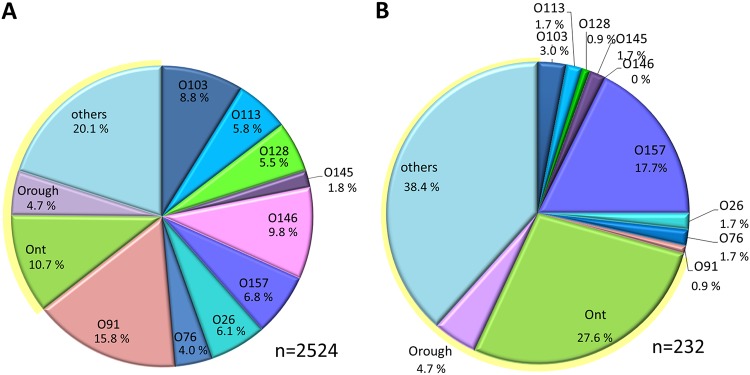
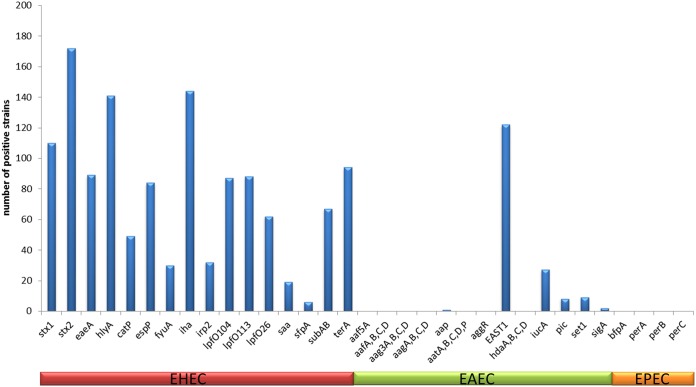
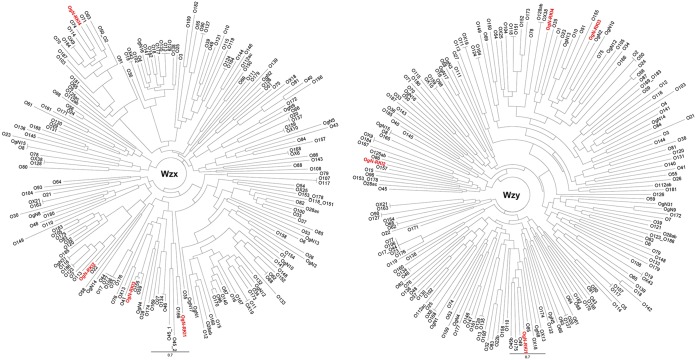
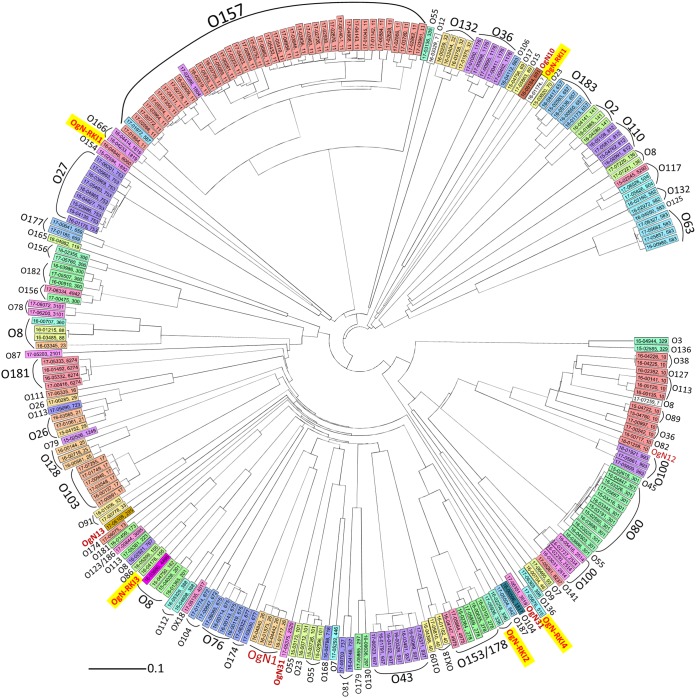
Shiga toxin-producing (STEC) and the STEC subgroup enterohemorrhagic cause intestinal infections with symptoms ranging from watery diarrhea to hemolytic-uremic syndrome (HUS). A key tool for the epidemiological differentiation of STEC is serotyping. The serotype in combination with the main virulence determinants gives important insight into the virulence potential of a strain. However, a large fraction of STEC strains found in human disease, including strains causing HUS, belongs to less frequently detected STEC serovars or their O/H antigens are unknown or even untypeable. Recent implementation of whole-genome sequence (WGS) analysis, in principle, allows the deduction of serovar and virulence gene information. Therefore, here we compared classical serovar and PCR-based virulence marker detection with WGS-based methods for 232 STEC strains, focusing on less frequently detected STEC serovars and nontypeable strains. We found that the results of WGS-based extraction showed a very high degree of overlap with those of the more classical methods. Specifically, the rate of concordance was 97% for O antigens (OAGs) and 99% for H antigens (HAGs) of typeable strains and >99% for , , or for all strains. Ninety-eight percent of nontypeable OAGs and 100% of nontypeable HAGs were defined by WGS analysis. In addition, the novel methods enabled a more complete analysis of strains causing severe clinical symptoms and the description of four novel STEC OAG loci. In conclusion, WGS is a promising tool for gaining serovar and virulence gene information, especially from a public health perspective.
产志贺毒素(STEC)和 STEC 亚群肠出血性大肠杆菌引起的肠道感染,症状从水样腹泻到溶血尿毒综合征(HUS)不等。STEC 的流行病学区分的关键工具是血清分型。血清型结合主要毒力决定因素,可深入了解菌株的毒力潜力。然而,在人类疾病中发现的很大一部分 STEC 菌株,包括引起 HUS 的菌株,属于较少检测到的 STEC 血清型,或者其 O/H 抗原未知甚至无法分型。最近实施的全基因组序列(WGS)分析原则上允许推断血清型和毒力基因信息。因此,我们在这里比较了 232 株 STEC 菌株的经典血清型和基于 PCR 的毒力标志物检测与基于 WGS 的方法,重点是较少检测到的 STEC 血清型和不可分型菌株。我们发现,基于 WGS 的提取结果与更经典方法的结果高度吻合。具体来说,可分型菌株的 O 抗原(OAG)和 H 抗原(HAG)的一致性率分别为 97%和 99%,所有菌株的 、 或 均>99%。98%的不可分型 OAG 和 100%的不可分型 HAG 通过 WGS 分析定义。此外,新方法能够更全面地分析引起严重临床症状的菌株,并描述了四个新的 STEC OAG 基因座。总之,WGS 是一种很有前途的工具,可用于获得血清型和毒力基因信息,特别是从公共卫生的角度来看。