Luo Wenting, Hu Haisheng, Tang Wangbing, Zou Xiangwei, Huang Huimin, Huang Zhifeng, Liu Yong, Sun Baoqing
1Department of Allergy and Clinical Immunology, State Key Laboratory of Respiratory Disease, National Clinical Research Center of Respiratory Disease, Guangzhou Institute of Respiratory Health, First Affiliated Hospital of Guangzhou Medical University, Guangzhou Medical University, 151 Yanjiangxi Road, Guangzhou, 510120 Guangdong China.
Longgang District People's Hospital, Shenzhen, 518172 China.
Allergy Asthma Clin Immunol. 2019 Jul 24;15:42. doi: 10.1186/s13223-019-0357-y. eCollection 2019.
Allergic diseases are increasing yearly. We aimed to evaluate the difference in allergen sensitization pattern between adults and children in southern China by analyzing a large sample size of real-life data, and to provide the evidence for formulating the prevention and management strategies.
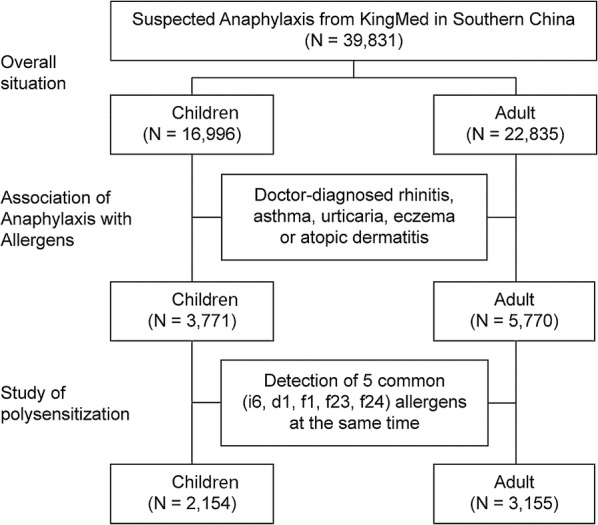
Retrospective analysis was conducted on 39,813 serum allergen-specific IgE (sIgE) results collected in southern China from January to December in 2017. Sensitization patterns and how these allergens could lead to the allergic diseases were analyzed for adults and children respectively. The difference of allergen positive rate between groups was calculated using the Chi square test.
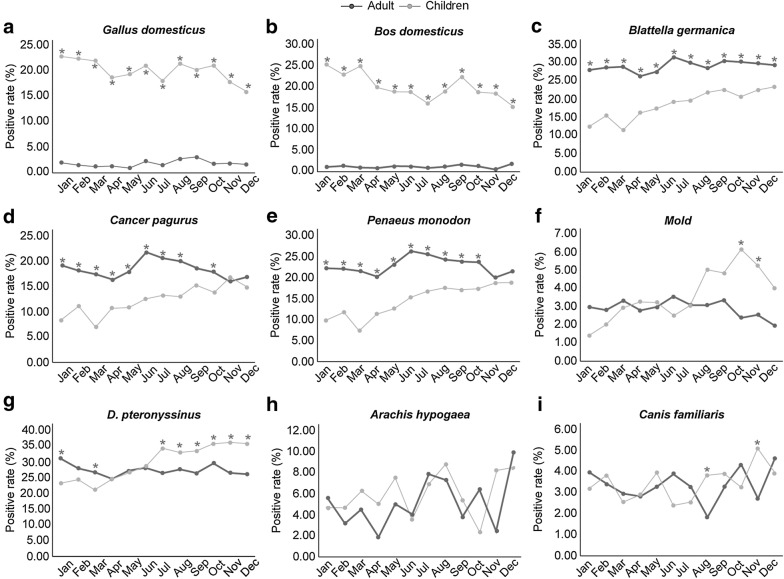
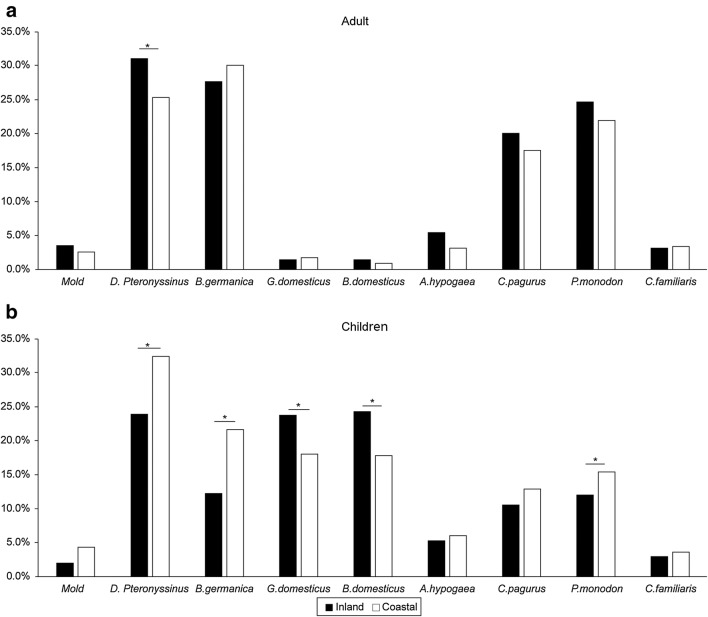
The top five most sensitized allergens in southern China were house dust mite (28.1%), cockroach (24.3%), shrimp (19.2%), crab (15.5%) and egg white (9.9%). While cockroach had the highest positive rate in adults (29.2%), the most sensitized allergen in children was house dust mite (29.7%). The positive rates of egg white and cow's milk in children were higher than in adults for the whole year (p < 0.001); whereas for adults, the positive rate to cockroach, shrimp and crab were higher than in children (p < 0.001). The positive rate of house dust mite in coastal cities (32.4%) was higher than that in landlocked cities (24.0%) in children, but in adults, the rate in landlocked cities (31.1%) was higher than that in coastal cities (25.3%). Optimal scaling analysis showed that the sIgEs of crab and shrimp had the closest correlation with cockroach-sIgE (Cronbach's α = 0.891). The positive rate to mold allergens increased from summer to autumn, reaching its plateau in October (6.2%). Patients with skin diseases were found to receive the highest sIgE prescription from doctors (56.9%).
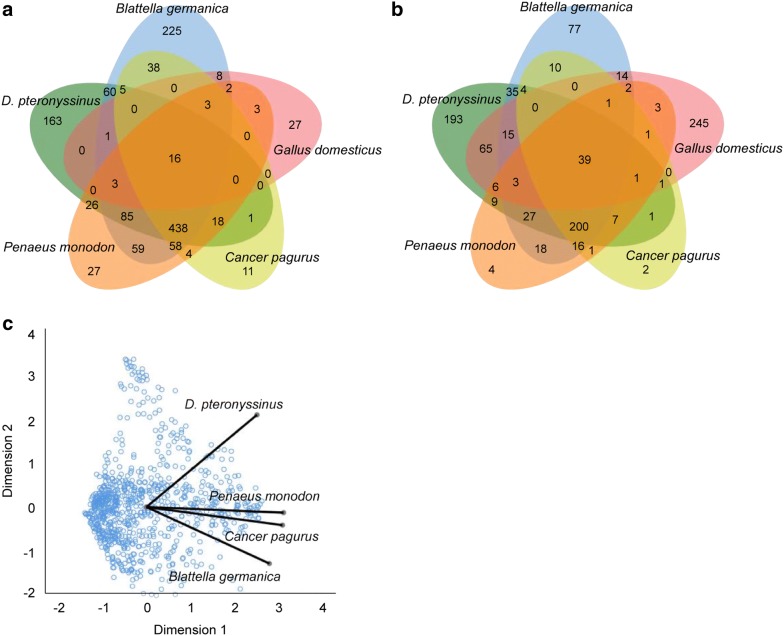
Doctors tend to prescribe more sIgE tests for patients with skin disorders in southern China. In addition to house dust mite, cockroach was found to be another important allergen. Adults with multiple sensitization always showed co-sensitization with shrimp, crab and house dust mite. These should be taken into consideration when giving allergen avoidance advice to patients.
过敏性疾病逐年增加。我们旨在通过分析大量真实数据来评估中国南方成人和儿童过敏原致敏模式的差异,并为制定预防和管理策略提供依据。
对2017年1月至12月在中国南方收集的39813份血清过敏原特异性IgE(sIgE)结果进行回顾性分析。分别分析成人和儿童的致敏模式以及这些过敏原如何导致过敏性疾病。使用卡方检验计算组间过敏原阳性率的差异。
中国南方最常见的五种致敏过敏原是屋尘螨(28.1%)、蟑螂(24.3%)、虾(19.2%)、蟹(15.5%)和蛋清(9.9%)。蟑螂在成人中的阳性率最高(29.2%),而儿童中最常见的致敏过敏原是屋尘螨(29.7%)。全年儿童中蛋清和牛奶的阳性率高于成人(p<0.001);而对于成人,蟑螂、虾和蟹的阳性率高于儿童(p<0.001)。儿童中沿海城市屋尘螨的阳性率(32.4%)高于内陆城市(24.0%),但在成人中,内陆城市的阳性率(31.1%)高于沿海城市(25.3%)。最优尺度分析表明,蟹和虾的sIgE与蟑螂sIgE的相关性最密切(Cronbach's α = 0.891)。霉菌过敏原的阳性率从夏季到秋季增加,10月达到峰值(6.2%)。发现皮肤病患者从医生处接受sIgE检测处方的比例最高(56.9%)。
在中国南方,医生倾向于为皮肤病患者开具更多的sIgE检测。除了屋尘螨,蟑螂是另一种重要的过敏原。多种致敏的成人常表现为对虾、蟹和屋尘螨的共同致敏。在为患者提供避免接触过敏原的建议时应考虑这些因素。