Odai Tamami, Terauchi Masakazu, Okamoto Daisaku, Hirose Asuka, Miyasaka Naoyuki
Department of Obstetrics and Gynecology Tokyo Medical and Dental University Tokyo Japan.
Department of Women's Health Tokyo Medical and Dental University Tokyo Japan.
Food Sci Nutr. 2019 May 15;7(7):2271-2279. doi: 10.1002/fsn3.1066. eCollection 2019 Jul.
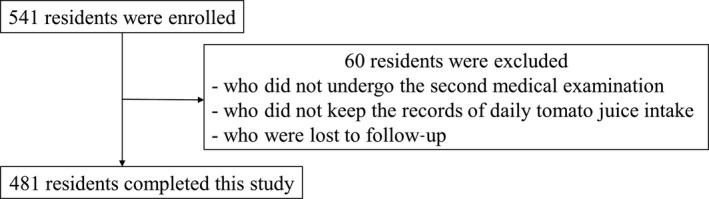
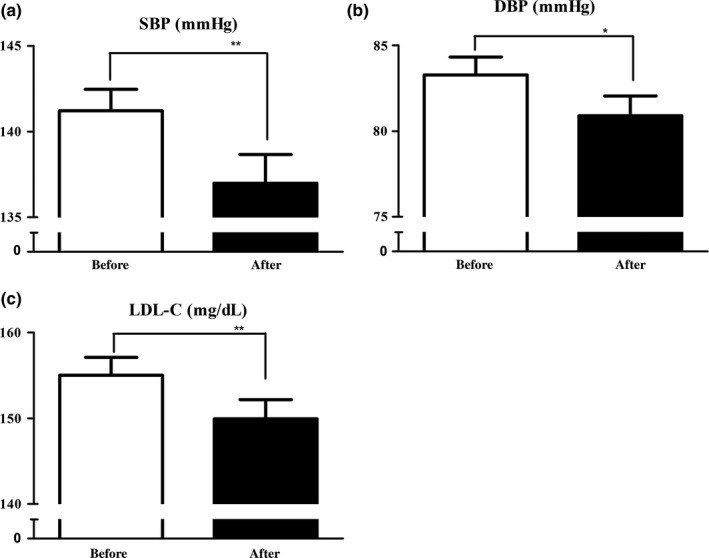
The aim of this study was to investigate the effects of unsalted tomato juice intake on cardiovascular risk markers in local Japanese residents. Four hundred and eighty-one local residents in Kuriyama, Japan, were enrolled in this study. Throughout the year of the study, they were provided with as much unsalted tomato juice as they wanted. Participants were screened for cardiovascular risk markers, such as blood pressure (BP), serum lipid profile, and glucose tolerance, before and after the study period. Of the study participants, 260 participated in a detailed study of their lifestyle factors. The average ages of the 184 male and 297 female participants were 56.3 ± 13.3 (mean ± ) and 58.4 ± 11.7 years, respectively. BP in 94 participants with untreated prehypertension or hypertension was significantly lowered (systolic BP, 141.2 ± 12.1-137.0 ± 16.3 mmHg, = 0.003; diastolic BP, 83.3 ± 10.1-80.9 ± 11.1 mmHg, = 0.012, paired test). Further, the serum low-density lipoprotein cholesterol (LDL-C) level in 125 participants with untreated dyslipidemia significantly decreased (155.0 ± 23.2-149.9 ± 25.0 mg/dl, = 0.005, paired test). These beneficial effects were not different between sexes and among the different age groups. No significant difference in lifestyle was found before and after the study. Unsalted tomato juice intake improved systolic and diastolic BP and serum LDL-C level in local Japanese residents at risk of cardiovascular conditions.
本研究旨在调查摄入无盐番茄汁对日本当地居民心血管风险标志物的影响。日本栗山的481名当地居民参与了本研究。在研究的一整年中,他们可随意饮用无盐番茄汁。在研究前后,对参与者进行心血管风险标志物筛查,如血压(BP)、血脂谱和糖耐量。其中260名研究参与者对其生活方式因素进行了详细研究。184名男性和297名女性参与者的平均年龄分别为56.3±13.3岁(平均值±标准差)和58.4±11.7岁。94名未经治疗的高血压前期或高血压患者的血压显著降低(收缩压,141.2±12.1 - 137.0±16.3 mmHg,P = 0.003;舒张压,83.3±10.1 - 80.9±11.1 mmHg,P = 0.012,配对t检验)。此外,125名未经治疗血脂异常患者的血清低密度脂蛋白胆固醇(LDL-C)水平显著降低(155.0±23.2 - 149.9±25.0 mg/dl,P = 0.005,配对t检验)。这些有益效果在性别和不同年龄组之间没有差异。研究前后生活方式未发现显著差异。摄入无盐番茄汁可改善有心血管疾病风险的日本当地居民的收缩压和舒张压以及血清LDL-C水平。