Hirose Asuka, Terauchi Masakazu, Tamura Moe, Akiyoshi Mihoko, Owa Yoko, Kato Kiyoko, Kubota Toshiro
Department of Obstetrics and Gynecology, Tokyo Medical and Dental University, Yushima 1-5-45, Bunkyo, Tokyo, 113-8510, Japan.
Department of Women's Health, Tokyo Medical and Dental University, Yushima 1-5-45, Bunkyo, Tokyo, 113-8510, Japan.
Nutr J. 2015 Apr 8;14:34. doi: 10.1186/s12937-015-0021-4.
Tomato-based food products have health-promoting and disease-preventing effects. Some tomato juice ingredients may have health benefits for middle-aged women, including women with menopausal symptoms and cardiovascular diseases. We investigated the net effect of tomato juice intake on several health parameters in women in this age group.
An open-label, single-arm study was conducted, involving 95 women (40-60-years-old) who had at least one menopausal symptom. The participants refrained from foods and drinks rich in tomato and tomato-based products for 2 weeks prior to the study and during the 8 weeks of tomato juice consumption. After the run-in period, the women were asked to consume 200 mL of unsalted tomato juice, twice daily for 8 weeks. Their menopausal symptoms were evaluated using the Menopausal Symptom Scale (MSS), Hospital Anxiety and Depression Scale (HADS), and Athens Insomnia Scale (AIS) before the study, and at 4 and 8 weeks after study commencement. At the same times, body composition; blood pressure; heart rate; resting energy expenditures (REEs); and serum levels of triglyceride (TG), cholesterol, glucose, and hemoglobin A1c were measured.
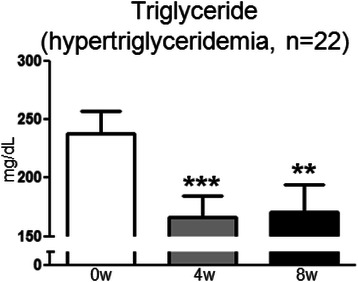
Ninety-three women (98%) completed the study. The following parameters showed significant changes, compared with baseline, at study weeks 4 and 8 (mean ± standard deviation at baseline, week 4, and week 8): (1) the MSS score improved (9.9 ± 5.2, 8.5 ± 5.0, 8.3 ± 5.0; P < 0.0001, repeated measures analysis of variance(ANOVA)), (2) the HADS-anxiety subscale score improved (5.3 ± 2.7, 4.8 ± 2.4, 4.9 ± 2.9; P = 0.041, Friedman test), (3) heart rate increased (62.6 ± 9.4 bpm, 64.4 ± 8.6 bpm, 63.8 ± 8.2 bpm; P = 0.028, Friedman test), (4) REE increased (1980 ± 368 kcal/day, 2108 ± 440 kcal/day, 2149 ± 470 kcal/day; P = 0.0030, repeated measures ANOVA), (5) serum TG level decreased in the subgroup of women (n = 22) who had high TG (150 mg/dL or higher) at baseline (237.8 ± 88.9 mg/dL, 166.7 ± 86.1 mg/dL, 170.9 ± 109.7 mg/dL; P = 0.0002, Friedman test).
Tomato juice intake alleviated menopausal symptoms, including anxiety, increased REEs and heart rate, and lowered high baseline serum TG levels in middle-aged women.
UMIN-CTR UMIN000011877 .
以番茄为基础的食品具有促进健康和预防疾病的作用。一些番茄汁成分可能对中年女性有益,包括有更年期症状和心血管疾病的女性。我们研究了摄入番茄汁对该年龄组女性多项健康参数的净影响。
进行了一项开放标签、单臂研究,纳入95名(40 - 60岁)至少有一项更年期症状的女性。参与者在研究前2周以及饮用番茄汁的8周期间,避免食用富含番茄及番茄制品的食物和饮料。在导入期后,要求这些女性每天饮用200 mL无盐番茄汁,分两次饮用,共8周。在研究前、研究开始后4周和8周,使用更年期症状量表(MSS)、医院焦虑抑郁量表(HADS)和雅典失眠量表(AIS)评估她们的更年期症状。同时,测量身体成分、血压、心率、静息能量消耗(REE)以及血清甘油三酯(TG)、胆固醇、葡萄糖和糖化血红蛋白A1c水平。
93名女性(98%)完成了研究。与基线相比,在研究第4周和第8周时,以下参数有显著变化(基线、第4周和第8周的平均值±标准差):(1)MSS评分改善(9.9±5.2、8.5±5.0、8.3±5.0;P<0.0001,重复测量方差分析),(2)HADS焦虑子量表评分改善(5.3±2.7、4.8±2.4、4.9±2.9;P = 0.041,Friedman检验),(3)心率增加(62.6±9.4次/分钟、64.4±8.6次/分钟、63.8±8.2次/分钟;P = 0.028,Friedman检验),(4)REE增加(1980±368千卡/天、2108±440千卡/天、2149±470千卡/天;P = 0.0030,重复测量方差分析),(5)基线时TG水平高(150毫克/分升或更高)的女性亚组(n = 22)的血清TG水平下降(237.8±88.9毫克/分升、166.7±86.1毫克/分升、170.9±109.7毫克/分升;P = 0.0002,Friedman检验)。
摄入番茄汁可缓解中年女性的更年期症状,包括焦虑,增加REE和心率,并降低高基线血清TG水平。
UMIN - CTR UMIN000011877