Curbani Flávio, de Oliveira Busato Fernanda, Marcarini do Nascimento Maynara, Olivieri David Nicholas, Tadokoro Carlos Eduardo
Programa de Pós-Graduação em Ecologia de Ecossistemas, Universidade Vila Velha, Rua Comissário José Dantas de Melo, 21, Boa Vista, CEP 29102-920, Vila Velha, ES, Brazil.
Departamento de Tecnologia Industrial, Centro Tecnológico, Universidade Federal do Espírito Santo, Av. Fernando Ferrari, 514, Goiabeiras, CEP 29060-970, Vitória, ES, Brazil.
Data Brief. 2019 Jul 8;25:104237. doi: 10.1016/j.dib.2019.104237. eCollection 2019 Aug.
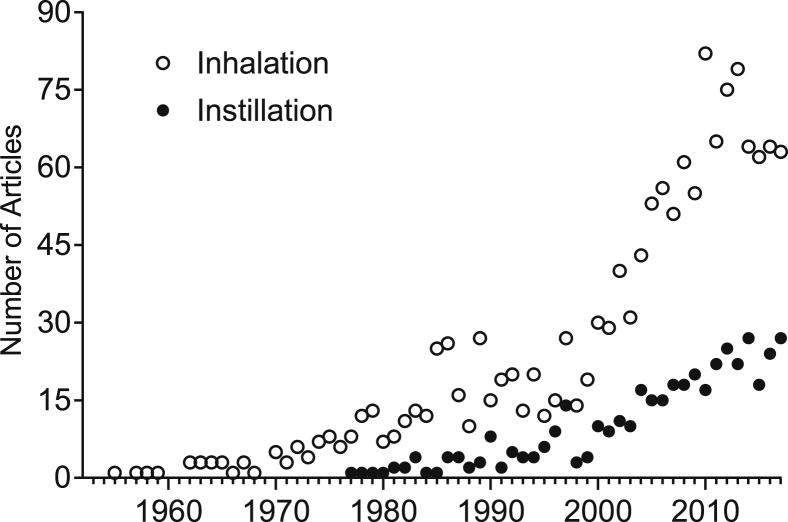
We present a dataset obtained by extracting information from an extensive literature search of toxicological experiments using mice and rat animal models to study the effects of exposure to airborne particulate matter (PM). Our dataset covers results reported from 75 research articles considering paper published in 2017 and seminal papers from previous years. The compiled data and normalization were processed with an equation based on a PM dosimetry model. This equation allows the comparison of different toxicological experiments using instillation and inhalation as PM exposure protocols with respect to inhalation rates, concentrations and PM exposure doses of the toxicological experiments performed by different protocols using instillation and inhalation PM as exposure methods. This data complements the discussions and interpretations presented in the research article "Inhale, exhale: why particulate matter exposure in animal models are so acute?" Curbani et al., 2019.
我们展示了一个数据集,该数据集是通过对使用小鼠和大鼠动物模型进行的毒理学实验的广泛文献搜索提取信息而获得的,以研究暴露于空气中颗粒物(PM)的影响。我们的数据集涵盖了75篇研究文章报告的结果,这些文章考虑了2017年发表的论文以及前几年的重要论文。编译后的数据和归一化处理是使用基于PM剂量学模型的方程式进行的。该方程式允许比较使用滴注和吸入作为PM暴露方案的不同毒理学实验,这些实验涉及不同方案(使用滴注和吸入PM作为暴露方法)进行的毒理学实验的吸入率、浓度和PM暴露剂量。这些数据补充了研究文章《吸气,呼气:为何动物模型中颗粒物暴露如此严重?》(Curbani等人,2019年)中的讨论和解释。