Zhou Long, Mai Jin-Zhuang, Li Ying, Wu Yong, Guo Min, Gao Xiang-Min, Wu Yang-Feng, Zhao Lian-Cheng, Liu Xiao-Qing
Division of Prevention and Community Health, National Center for Cardiovascular Disease, Fuwai Hospital, Chinese Academy of Medical Sciences and Peking Union Medical College, Beijing 100037, China.
Division of Epidemiology, Guangdong Provincial Cardiovascular Institute, Guangdong General Hospital, Guangzhou, Guangdong 510100, China.
Chronic Dis Transl Med. 2018 Sep 25;5(2):89-96. doi: 10.1016/j.cdtm.2018.08.001. eCollection 2019 Jun.
The aim of this study was to explore the relationship between fasting glucose levels and all-cause and cause-specific mortality in Chinese population.
The role of fasting blood glucose levels as a predictor of all-cause and cause-specific mortality was estimated in 9930 participants from four Chinese general populations with a 20-year follow-up. Multivariate Cox proportional hazard models were used to identify the relationship between fasting glucose and mortality.
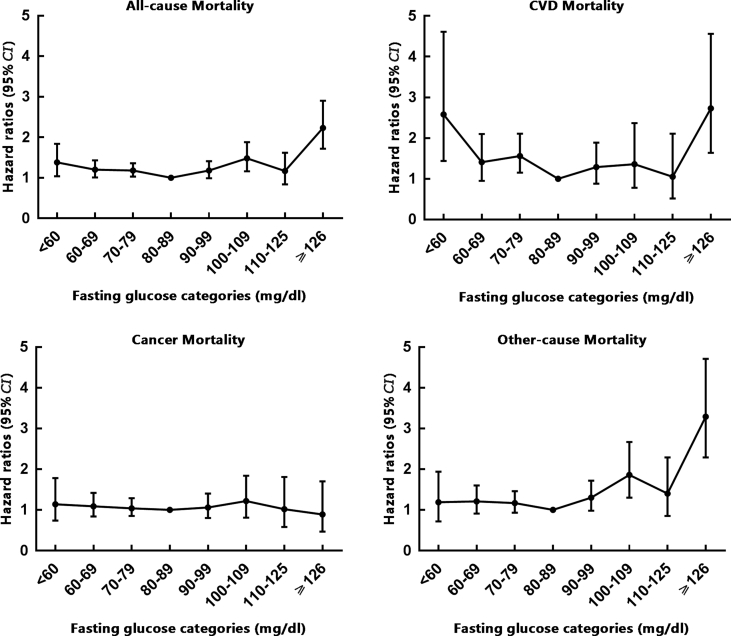
There were 1471 deaths after a median follow-up of 20.2 years (a total of 187,374 person-years), including 310 cardiovascular deaths, 581 cancer deaths, and 580 other-cause deaths. After adjustment for age, sex, urban or rural, northern or southern of China, types of work, education level, physical exercise, smoking status, drinking status, body mass index, systolic blood pressure, and serum total cholesterol at baseline, the hazard ratios (s) and 95% confidence intervals (s) for all-cause mortality in the fasting blood glucose categories of <60, 60-69, 70-79, 90-99, 100-109, 110-125, and ≥126 mg/dl were 1.38 (1.04-1.84), 1.20 (1.01-1.43), 1.18 (1.03-1.36), 1.18 (0.99-1.41), 1.48 (1.16-1.88), 1.17 (0.84-1.62), and 2.23 (1.72-2.90), respectively, in contrast to the reference group (80-89 mg/dl). The s and 95% s for cardiovascular disease mortality in these groups were 2.58 (1.44-4.61), 1.41 (0.95-2.10), 1.56 (1.15-2.11), 1.29 (0.88-1.89), 1.36 (0.78-2.37), 1.05 (0.52-2.11), and 2.73 (1.64-4.56), respectively.
Both low and high fasting glucose were significantly associated with increased risk of all-cause and cardiovascular mortality in Chinese general population.
本研究旨在探讨中国人群空腹血糖水平与全因死亡率及特定病因死亡率之间的关系。
在来自中国四个普通人群的9930名参与者中评估空腹血糖水平作为全因死亡率及特定病因死亡率预测指标的作用,并进行了20年的随访。采用多变量Cox比例风险模型来确定空腹血糖与死亡率之间的关系。
在中位随访20.2年(总计187374人年)后,有1471人死亡,其中包括310例心血管疾病死亡、581例癌症死亡和580例其他原因死亡。在对年龄、性别、城乡、中国北方或南方、工作类型、教育水平、体育锻炼、吸烟状况、饮酒状况、体重指数、收缩压和基线血清总胆固醇进行调整后,空腹血糖类别<60、60 - 69、70 - 79、90 - 99、100 - 109、110 - 125和≥126 mg/dl的全因死亡率的风险比(及95%置信区间)分别为1.38(1.04 - 1.84)、1.20(1.01 - 1.43)、1.18(1.03 - 1.36)、1.18(0.99 - 1.41)、1.48(1.16 - 1.88)、1.