Department of Experimental Medicine, University of Campania 'Luigi Vanvitelli', Naples, Italy.
Department of Mental and Physical Health and Preventive Medicine, University of Campania 'Luigi Vanvitelli', Naples, Italy.
J Cell Mol Med. 2019 Oct;23(10):6635-6645. doi: 10.1111/jcmm.14534. Epub 2019 Aug 1.
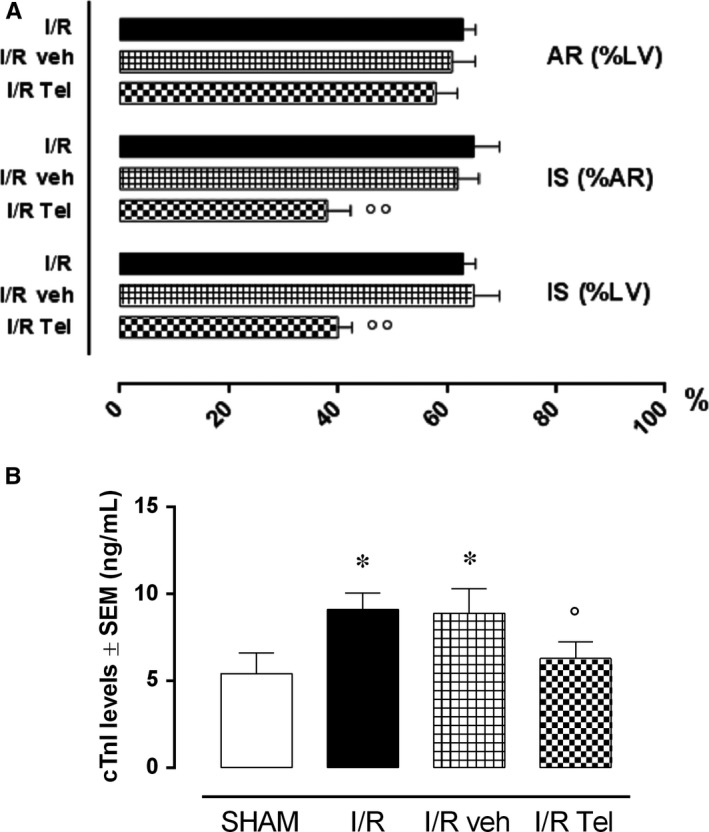
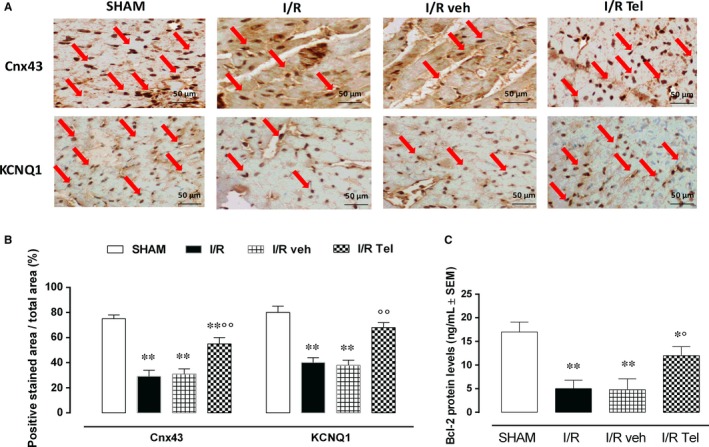
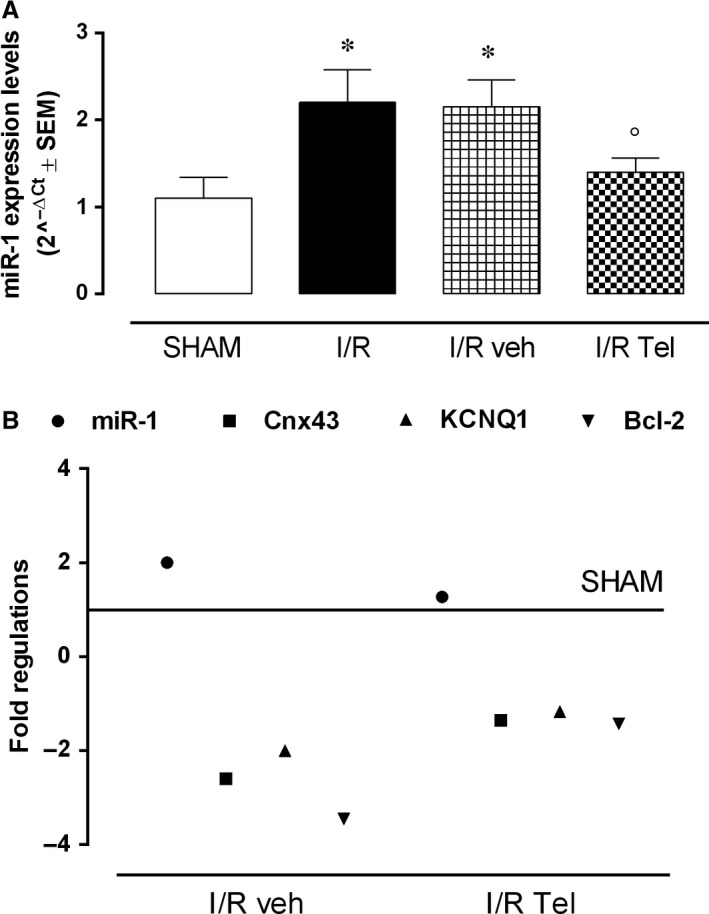
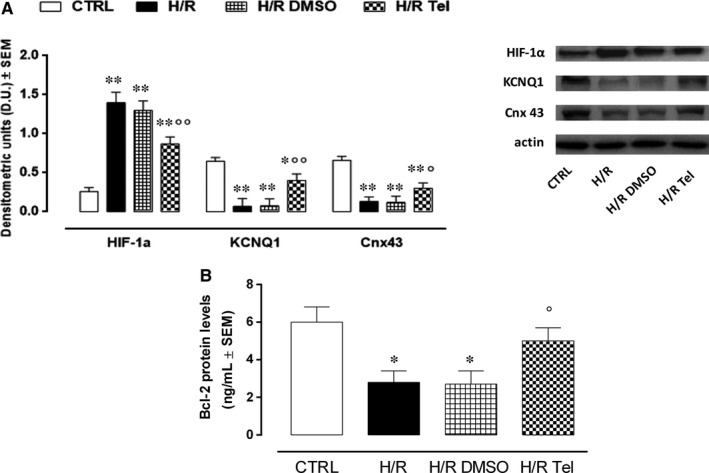
The aim of this study was to investigate whether telmisartan protects the heart from the ischaemia/reperfusion damage through a local microRNA-1 modulation. Studies on the myocardial ischaemia/reperfusion injury in vivo and on the cardiomyocyte hypoxia/reoxygenation damage in vitro were done. In vivo, male Sprague-Dawley rats administered for 3 weeks with telmisartan 12 mg/kg/d by gastric gavage underwent ischaemia/reperfusion of the left descending coronary artery. In these rats, infarct size measurement, ELISA, immunohistochemistry (IHC) and reverse transcriptase real-time polymerase chain reaction showed that expressions of connexin 43, potassium voltage-gated channel subfamily Q member 1 and the protein Bcl-2 were significantly increased by telmisartan in the reperfused myocardium, paralleled by microRNA-1 down-regulation. In vitro, the transfection of cardiomyocytes with microRNA-1 reduced the expressions of connexin 43, potassium voltage-gated channel subfamily Q member 1 and Bcl-2 in the cells. Telmisartan (50 µmol/L) 60 minutes before hypoxia/reoxygenation, while not affecting the levels of miR-1 in transfected cells in normoxic condition, almost abolished the increment of miR-1 induced by the hypoxia/reoxygenation to transfected cells. All together, telmisartan cardioprotected against the myocardial damage through the microRNA-1 modulation, and consequent modifications of its downstream target connexin 43, potassium voltage-gated channel subfamily Q member 1 and Bcl-2.
本研究旨在探讨替米沙坦是否通过局部 microRNA-1 调节来保护心脏免受缺血/再灌注损伤。进行了体内心肌缺血/再灌注损伤和体外心肌细胞缺氧/复氧损伤研究。在体内,给予替米沙坦 12mg/kg/d 灌胃 3 周的雄性 Sprague-Dawley 大鼠进行左冠状动脉前降支缺血/再灌注。在这些大鼠中,通过梗死面积测量、ELISA、免疫组织化学(IHC)和逆转录实时聚合酶链反应显示,替米沙坦在再灌注心肌中显著增加了连接蛋白 43、钾电压门控通道亚家族 Q 成员 1 和蛋白 Bcl-2 的表达,同时下调了 microRNA-1 的表达。在体外,microRNA-1 转染降低了细胞中连接蛋白 43、钾电压门控通道亚家族 Q 成员 1 和 Bcl-2 的表达。替米沙坦在缺氧/复氧前 60 分钟(50µmol/L)给药,在正常氧条件下不影响转染细胞中 miR-1 的水平,但几乎完全消除了缺氧/复氧对转染细胞中 miR-1 诱导的增加。总之,替米沙坦通过 microRNA-1 调节,继而对其下游靶标连接蛋白 43、钾电压门控通道亚家族 Q 成员 1 和 Bcl-2 进行修饰,对心肌损伤起到保护作用。