Dang Hongxing, Li Jing, Liu Chengjun, Xu Feng
Department of Pediatric Intensive Care Unit, Ministry of Education Key Laboratory of Child Development and Disorders, Children's Hospital of Chongqing Medical University, Chongqing, China.
National Clinical Research Center for Child Health and Disorders, China International Science and Technology Cooperation Base of Child Development and Critical Disorders, Chongqing, China.
Front Nutr. 2021 Jun 16;8:648442. doi: 10.3389/fnut.2021.648442. eCollection 2021.
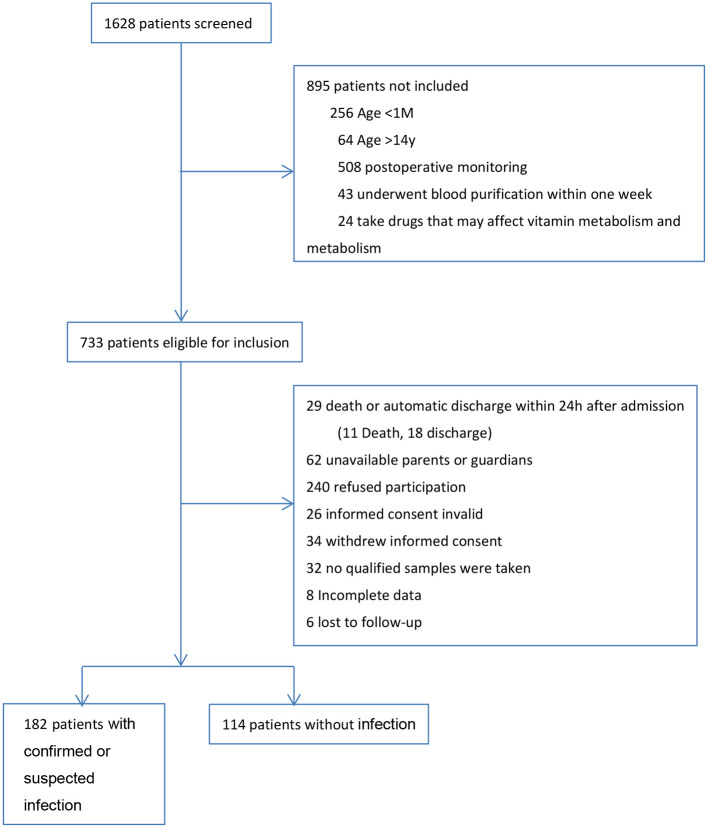
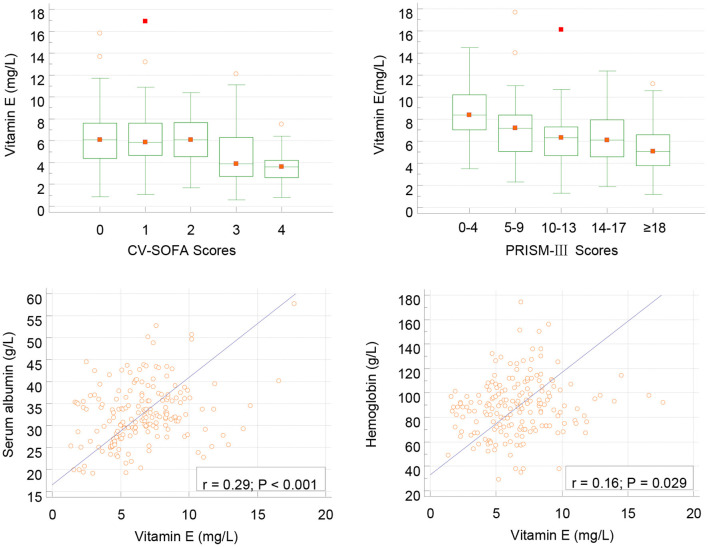
Literature is scarce on the assessment of vitamin E status in septic children. We aim to investigate the prevalence of vitamin E deficiency in critically ill children with sepsis and septic shock and its association with clinical features and outcomes. We compared serum vitamin E status between the confirmed or suspected infection and no infection groups, the sepsis shock and no sepsis shock groups upon pediatric intensive care unit admission. Clinical characteristics were compared in subgroup patients with and without vitamin E deficiency. The association between vitamin E deficiency and septic shock were evaluated using univariate and multivariable methods. 182 critically ill children with confirmed or suspected infection and 114 without infection were enrolled. The incidence of vitamin E deficiency was 30.2% in the infection group and 61.9% in the septic shock subgroup ( < 0.001). Thirty-days mortality in critically ill children with vitamin E deficiency was significantly higher than that without vitamin E deficiency (27.3 vs. 14.2%, < 0.05). Vitamin E levels were inversely associated with higher pediatric risk of mortality ( = - 0.238, = 0.001) and cardiovascular sequential organ failure assessment ( = -0.249, < 0.001) scores in critically ill children with infection. In multivariable logistic regression, vitamin E deficiency showed an independent effect on septic shock (adjusted OR: 6.749, 95%CI: 2.449-18.60, < 0.001). Vitamin E deficiency is highly prevalent in critically ill children with sepsis and contributed to the septic shock.
关于脓毒症患儿维生素E状况评估的文献较少。我们旨在调查重症脓毒症和脓毒症休克患儿维生素E缺乏的患病率及其与临床特征和预后的关系。我们比较了儿科重症监护病房入院时确诊或疑似感染组与未感染组、脓毒症休克组与非脓毒症休克组的血清维生素E状况。对有和没有维生素E缺乏的亚组患者的临床特征进行了比较。使用单变量和多变量方法评估维生素E缺乏与脓毒症休克之间的关联。纳入了182例确诊或疑似感染的重症患儿和114例未感染的患儿。感染组维生素E缺乏的发生率为30.2%,脓毒症休克亚组为61.9%(<0.001)。维生素E缺乏的重症患儿30天死亡率显著高于无维生素E缺乏的患儿(27.3%对14.2%,<0.05)。在感染的重症患儿中,维生素E水平与较高的儿科死亡风险(=-0.238,=0.001)和心血管系统序贯器官衰竭评估(=-0.249,<0.001)评分呈负相关。在多变量逻辑回归中,维生素E缺乏对脓毒症休克有独立影响(调整后的OR:6.749,95%CI:2.449-18.60,<0.001)。维生素E缺乏在重症脓毒症患儿中非常普遍,并导致了脓毒症休克。