Antimicrobial Resistance Special Program, Communicable Diseases and Environmental Determinants of Health, Pan American Health Organization, Washington, DC, United States of America.
Health Analyses Metrics and Evidence (EIH/HA), Evidence and Intelligence for Action in Health (EIH), Pan American Health Organization, Washington, DC, United States of America.
PLoS One. 2019 Aug 2;14(8):e0220445. doi: 10.1371/journal.pone.0220445. eCollection 2019.
Shigellosis is the second leading cause of diarrheal death globally. The global burden has been complicated by the emergence of Shigella strains resistant to first line antibiotic treatments such as ciprofloxacin. This study aims to describe the epidemiologic distribution of the most common Shigella species, and their antimicrobial susceptibility patterns to ciprofloxacin and nalidixic acid (NA) in Latin America.
Laboratory data from 19 countries were obtained through the Latin American Network for Antimicrobial Resistance Surveillance (ReLAVRA) from 2000-2015. The Clinical Laboratory Standards Institute reduced susceptibility breakpoints for Enterobacteriaceae was used to interpret the disc diffusion tests for Shigella susceptibility to ciprofloxacin and NA. Negative binominal regression was used to analyze longitudinal trends of Shigella isolates antimicrobial susceptibility.
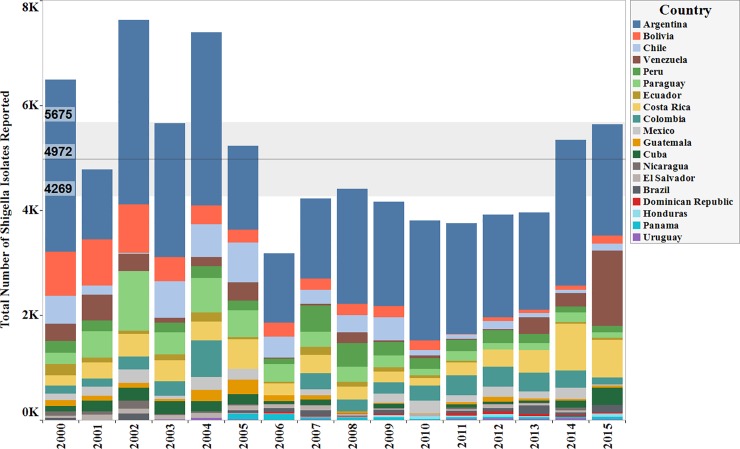
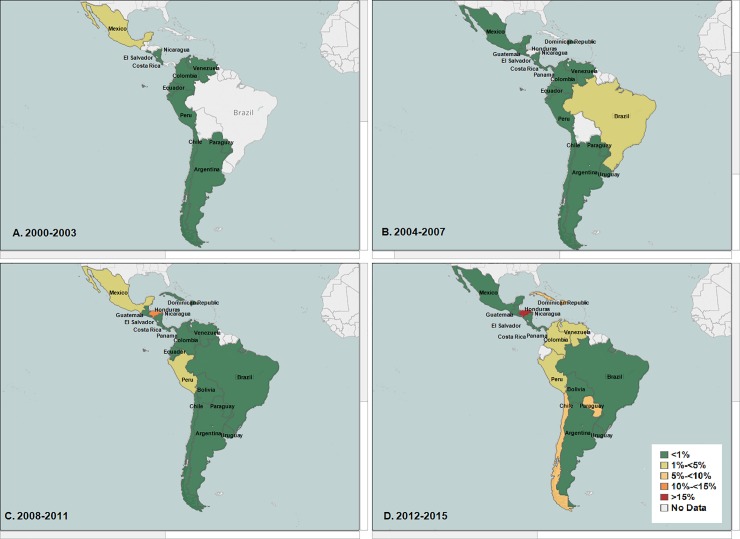
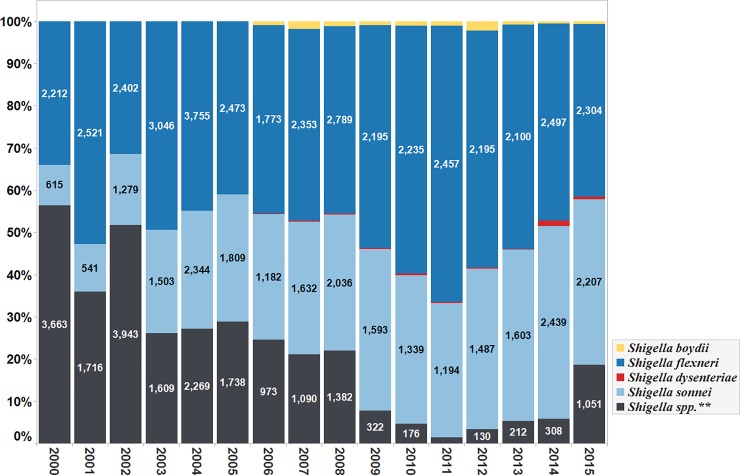
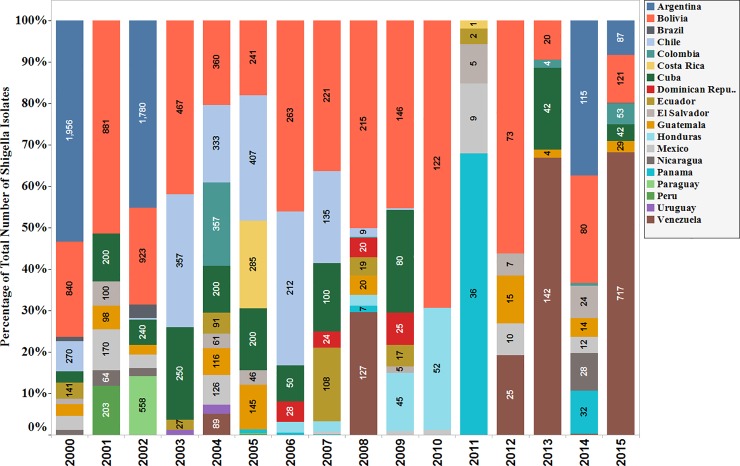
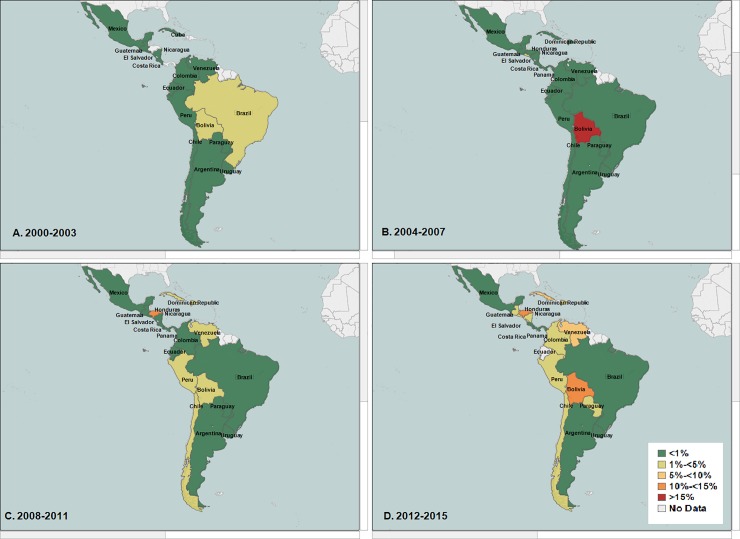
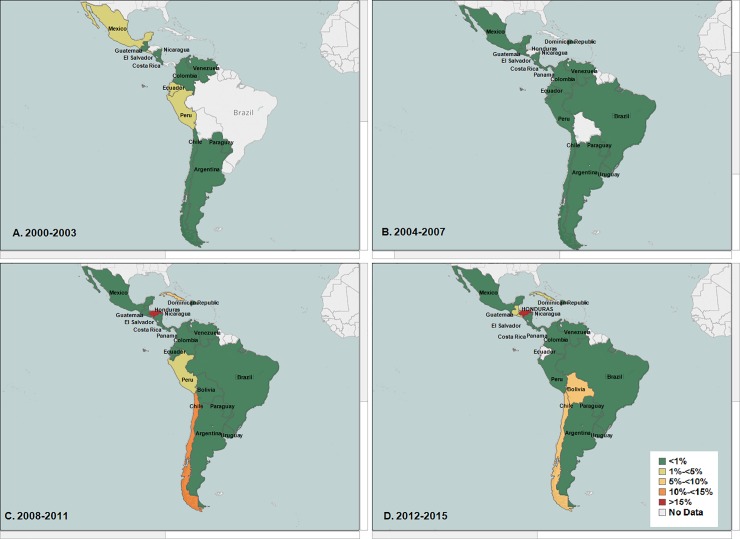
79,548 Shigella isolates were tested and reported between 2000-2015. The most common isolated species were S. flexneri (49%), and S. sonnei (28%). There was a steady increase in the proportion of S. sonnei isolates within the region(p<0.001). The average annual percentage increase (AAPI) in nonsusceptibility was 18.4% (p<0.001) for ciprofloxacin (baseline = 0.3); and 13.2%(p<0.001) for NA (baseline = 3). AAPI nonsusceptibility to ciprofloxacin was 13.3% for S. flexneri (p<0.04); and 39.9% for S. sonnei (p<0.001). Honduras, Dominican Republic, Venezuela, and Chile reported the highest increase in nonsusceptibility to ciprofloxacin among all Shigella isolates.
There is an increasing trend in Shigella nonsusceptibility to ciprofloxacin and NA, including among the most common shigella species, in Latin America. This rise of nonsusceptibility among Shigella species to commonly used treatments such as ciprofloxacin is alarming and threatens the control and management of this currently treatable infection. Improved data quality, collection and reporting is needed in Latin America to respond effectively to the rising trends observed. This includes the need for quality isolate level epidemiological data; molecular data, and data on antibiotic consumption and use.
志贺菌病是全球导致腹泻死亡的第二大原因。由于出现了对环丙沙星等一线抗生素治疗药物具有耐药性的志贺氏菌菌株,全球负担变得更加复杂。本研究旨在描述拉丁美洲最常见的志贺氏菌种的流行病学分布及其对环丙沙星和萘啶酸(NA)的抗菌敏感性模式。
通过拉丁美洲抗菌药物耐药性监测网络(ReLAVRA)从 2000 年至 2015 年获得了来自 19 个国家的实验室数据。采用临床和实验室标准协会(CLSI)对肠杆菌科的药敏折点来解释对环丙沙星和 NA 的志贺氏菌药敏纸片扩散试验。采用负二项回归分析了志贺氏菌分离株抗菌敏感性的纵向趋势。
2000 年至 2015 年间共检测并报告了 79548 株志贺氏菌分离株。最常见的分离菌株为福氏志贺菌(49%)和宋内志贺菌(28%)。该地区宋内志贺菌分离株的比例呈稳步上升趋势(p<0.001)。环丙沙星(基线=0.3)和 NA(基线=3)的不敏感的平均年百分比变化(AAPI)分别为 18.4%(p<0.001)和 13.2%(p<0.001)。福氏志贺菌对环丙沙星的 AAPI 不敏感率为 13.3%(p<0.04),而宋内志贺菌则为 39.9%(p<0.001)。洪都拉斯、多米尼加共和国、委内瑞拉和智利报告称,所有志贺菌分离株中对环丙沙星的不敏感率增长最高。
拉丁美洲志贺菌对环丙沙星和 NA 的不敏感率呈上升趋势,包括最常见的志贺菌种。志贺菌种对常用治疗药物(如环丙沙星)的不敏感率上升令人震惊,威胁到这种目前可治疗感染的控制和管理。拉丁美洲需要提高数据质量、收集和报告,以有效应对所观察到的上升趋势。这包括需要质量分离株水平的流行病学数据、分子数据以及抗生素消耗和使用数据。