Upper Yangtze river economic research center/School of Economics, Chongqing Technology and Business University, Chongqing 400067, China.
Department of Business, ESCP Europe Business School, 75011 Paris, France.
Int J Environ Res Public Health. 2019 Aug 1;16(15):2748. doi: 10.3390/ijerph16152748.
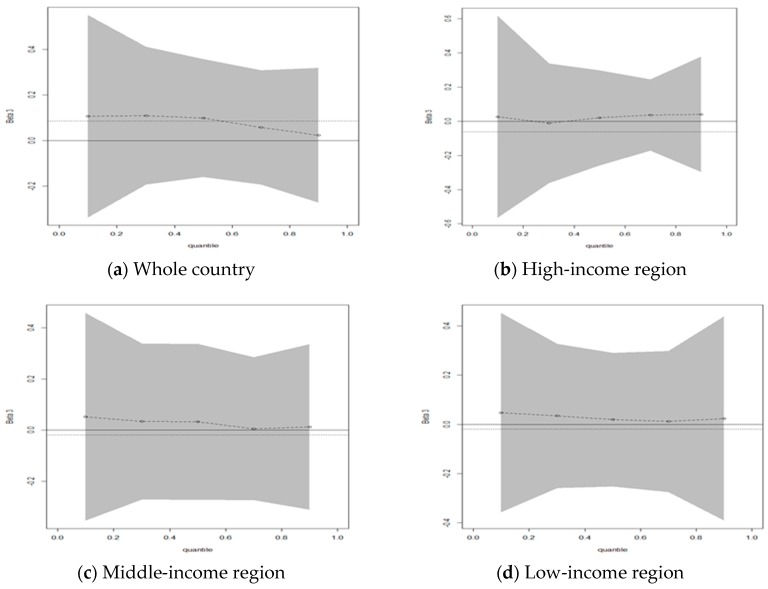
Industrial development has brought about not only rapid economic growth, but also serious environmental pollution in China, which has led to serious health problems and heavy economic burdens on healthcare. Therefore, the relationship between the industrial air pollution and health care expenditure (HCE) has attracted the attention of researchers, most of which used the traditional empirical methods, such as ordinary least squares (OLS), logistic and so on. By collecting the panel data of 30 provinces of China during 2005-2016, this paper attempts to use the Bayesian quantile regression (BQR) to reveal the impact of industrial air pollution represented by industrial waste gas emission (IWGE) on HCE in high-, middle-, low-income regions. It was found that double heterogeneity in the influence of IWGE on HCE was obvious, which revealed that people in high-, middle-, low-income regions have significantly different understandings of environmental pollution and health problems. In addition, the BQR method provided more information than the traditional empirical methods, which verified that the BQR method, as a new empirical method for previous studies, was applicable in this topic and expanded the discussion space of this research field.
工业发展不仅带来了中国经济的快速增长,也带来了严重的环境污染,导致严重的健康问题和医疗保健的沉重经济负担。因此,工业空气污染与医疗保健支出(HCE)之间的关系引起了研究人员的关注,其中大多数使用了传统的经验方法,如普通最小二乘法(OLS)、逻辑回归等。本文通过收集 2005-2016 年中国 30 个省份的面板数据,尝试使用贝叶斯分位数回归(BQR)来揭示以工业废气排放(IWGE)为代表的工业空气污染对高、中、低收入地区 HCE 的影响。结果表明,IWGE 对 HCE 的影响存在双重异质性,这表明高、中、低收入地区的人们对环境污染和健康问题的理解存在显著差异。此外,BQR 方法比传统的经验方法提供了更多的信息,验证了 BQR 方法作为之前研究的一种新的经验方法,在本主题中是适用的,并扩展了该研究领域的讨论空间。