Zeeshan Muhammad, Han Jiabin, Rehman Alam, Ullah Irfan, Afridi Fakhr E Alam
College of Business Administration, Liaoning Technical University, Xingcheng, Liaoning Province, 125105, People's Republic of China.
Faculty of Management Sciences, National University of Modern Languages, Islamabad, Pakistan.
Risk Manag Healthc Policy. 2021 Feb 11;14:527-539. doi: 10.2147/RMHP.S281729. eCollection 2021.
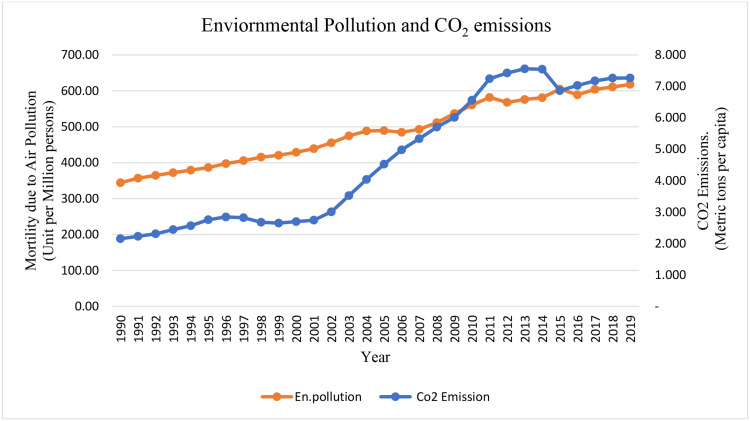
This study investigates the nexus between household health expenditure, CO emissions and environmental pollution in China. We analyzed the asymmetric dynamic relationship between CO emissions, environmental pollution and household health expenditure for the period 1990 to 2019 in China.
This study adopted nonlinear autoregressive distributed lag (NARDL) and Granger causality following the diagnostic test. Furthermore, we applied Dickey-Fuller (ADF), PP unit root tests, Zivot and Andrews test for structural breaks in our analysis. The NARDL is the most suitable econometric technique for estimations, especially if the asymmetric relationship exists among the variables. NARDL technique is capable to explore the dynamic relationship between CO emissions, environmental pollution and household health expenditure.
The empirical results verify the asymmetric nexus between CO emissions, environmental pollution and household health expenditure in the context of China. The outcomes revealed that in the short run and long run positive shocks of CO emissions and environmental pollution positively affecting health expenditure, while negative shocks reduce health spendings. The results also demonstrate bi-directional causality among household health spendings, CO emissions and environmental pollution.
Our results support many previous studies, documenting that CO emissions positively contribute to the amount of household health expenditure, confirming the asymmetric relationship between CO emissions and household health expenditure. The results also confirm the statistically significant and asymmetrically positive relationship between environmental pollution and household health expenditure. This implies that Chinese residents have to bear more household health expenditure, in the case of more CO emissions and a greater amount of environmental pollution.
本研究调查了中国家庭健康支出、一氧化碳排放与环境污染之间的关系。我们分析了1990年至2019年中国一氧化碳排放、环境污染与家庭健康支出之间的不对称动态关系。
本研究采用非线性自回归分布滞后(NARDL)模型,并在诊断检验后进行格兰杰因果检验。此外,我们在分析中应用了迪基-富勒(ADF)检验、菲利普斯-佩伦(PP)单位根检验以及齐沃特和安德鲁斯结构断点检验。NARDL是最适合进行估计的计量经济学技术,特别是当变量之间存在不对称关系时。NARDL技术能够探究一氧化碳排放、环境污染与家庭健康支出之间的动态关系。
实证结果验证了中国背景下一氧化碳排放、环境污染与家庭健康支出之间的不对称关系。结果显示,在短期和长期内,一氧化碳排放和环境污染的正向冲击对健康支出有正向影响,而负向冲击则会减少健康支出。结果还表明家庭健康支出、一氧化碳排放和环境污染之间存在双向因果关系。
我们的结果支持了许多先前的研究,这些研究表明一氧化碳排放对家庭健康支出有正向贡献,证实了一氧化碳排放与家庭健康支出之间的不对称关系。结果还证实了环境污染与家庭健康支出之间具有统计学意义的不对称正向关系。这意味着在一氧化碳排放增加和环境污染加剧的情况下,中国居民不得不承担更多的家庭健康支出。