van Vliet Liesbeth Mirjam, Francke Anneke L, Meijers Maartje C, Westendorp Janine, Hoffstädt Hinke, Evers Andrea W M, van der Wall Elsken, de Jong Paul, Peerdeman Kaya J, Stouthard Jacqueline, van Dulmen Sandra
Health, Medical and Neuropsychology Unit, Institute of Psychology, Leiden University, Leiden, Netherlands.
Department of Communication, NIVEL, Netherlands Institute of Health Services Research, Utrecht, Netherlands.
Front Psychiatry. 2019 Jul 17;10:464. doi: 10.3389/fpsyt.2019.00464. eCollection 2019.
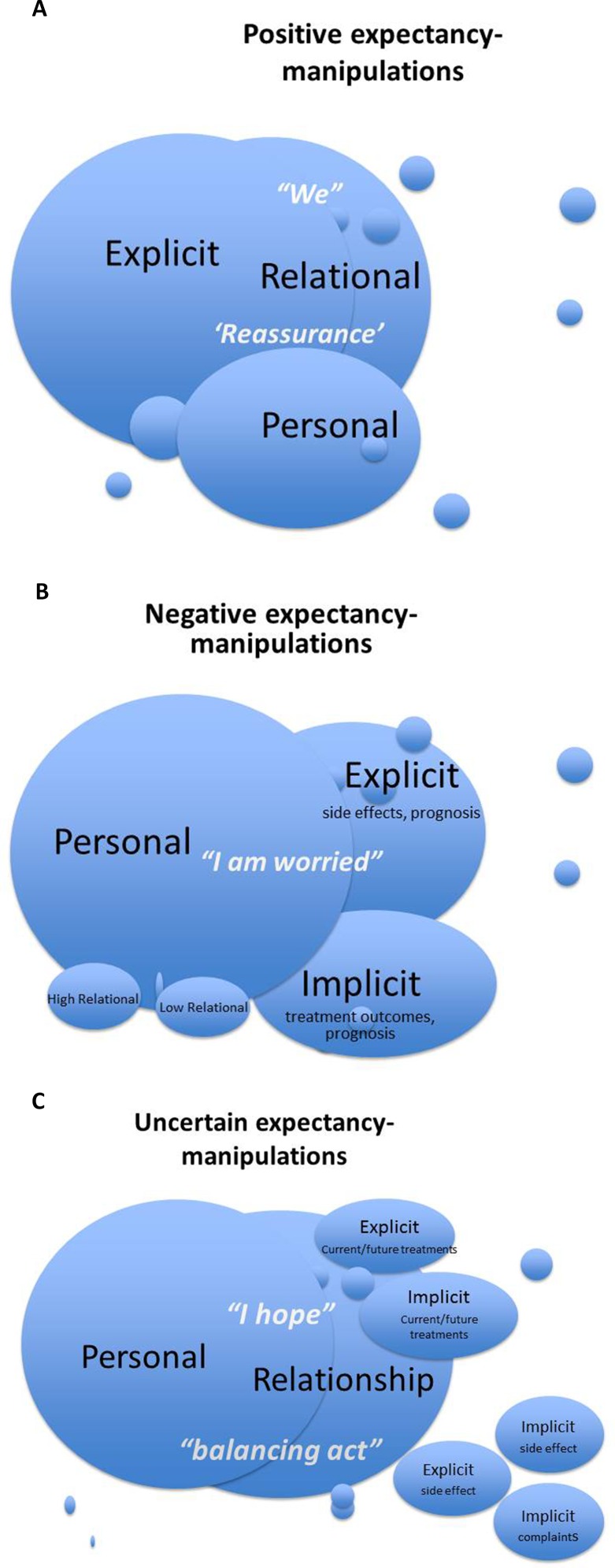
Information provision about prognosis, treatments, and side-effects is important in advanced cancer, yet also associated with impaired patient well-being. To counter potential detrimental effects, communication strategies based on placebo and nocebo effect mechanisms might be promising to apply in daily practice. This study aimed to provide more insight into and oncologists use expectancy and empathy expressions in consultations with patients with advanced breast cancer. Forty-five consultations between oncologists and patients were audiotaped. To determine how often expectancy and empathy expressions were used, a coding scheme was created. Most consultations ( = 33) were coded and discussed by two coders, and the remaining 13 were coded by one coder. To determine how expectancy and empathy expressions were used, principles of inductive content analysis were followed. Discussed evaluation (i.e., scan) results were good ( = 26,58%) or uncertain ( = 12,27%) and less often bad ( = 7,15%). Uncertain expectations about prognosis, treatment outcomes, and side effects occurred in 13, 38, and 27 consultations (29%, 85%, and 56%), followed by negative expectations in 8, 26, and 28 consultations (18%, 58%, and 62%) and positive expectations in 6, 34, and 17 consultations (13%, 76%, and 38%). When oncologists provided expectancy expressions, they tapped into three different dimensions: relational, personal, and explicit. Positive expectations emphasized the doctor-patient relationship, while negative expectations focused on the severity of the illness, and uncertainty was characterized by a balance between (potential) negative outcomes and hope. Observed generic or specific empathy expressions were regularly provided, most frequently understanding ( = 29,64% of consultations), respecting ( = 17,38%), supporting ( = 16,36%), and exploring ( = 16,36%). A lack of empathy occurred less often and contained, among others, not responding to patients' emotional concerns ( = 13,27% of consultations), interrupting ( = 7,16%), and an absence of understanding ( = 4,9%). In consultations with mainly positive or uncertain medical outcomes, oncologists predominantly made use of uncertain expectations () and used several empathic behaviors. Replication studies, e.g., in these and other medical situations, are needed. Follow-up studies should test the effect of specific communication strategies on patient outcomes, to counter potential negative effects of information provision. Studies should focus on uncertain situations. Ultimately, specific placebo and nocebo effect-inspired communication strategies can be harnessed in clinical care to improve patient outcomes.
在晚期癌症中,提供有关预后、治疗及副作用的信息很重要,但这也与患者幸福感受损有关。为应对潜在的有害影响,基于安慰剂和反安慰剂效应机制的沟通策略在日常实践中应用可能很有前景。本研究旨在更深入了解肿瘤学家在与晚期乳腺癌患者会诊时如何使用期望和共情表达。对肿瘤学家与患者之间的45次会诊进行了录音。为确定期望和共情表达的使用频率,创建了一个编码方案。大多数会诊(n = 33)由两名编码员进行编码和讨论,其余13次由一名编码员编码。为确定期望和共情表达的使用方式,遵循归纳性内容分析原则。讨论的评估(即扫描)结果为良好(n = 26,58%)或不确定(n = 12,27%),较差的情况较少(n = 7,15%)。对预后、治疗结果和副作用的不确定期望分别出现在13次、38次和27次会诊中(29%、85%和56%),其次是负面期望分别出现在8次、26次和28次会诊中(18%、58%和62%),正面期望分别出现在6次、34次和17次会诊中(13%、76%和38%)。当肿瘤学家提供期望表达时,他们涉及三个不同维度:关系维度、个人维度和明确维度。正面期望强调医患关系,而负面期望关注疾病的严重程度,不确定性则以(潜在)负面结果与希望之间的平衡为特征。观察到的一般或特定共情表达经常出现,最常见的是理解(占会诊的29.64%)、尊重(17.38%)、支持(16.36%)和探索(16.36%)。缺乏共情的情况较少出现,包括不回应患者的情感关切(占会诊的13.27%)、打断(7.16%)和缺乏理解(4.9%)。在主要具有积极或不确定医疗结果的会诊中,肿瘤学家主要使用不确定期望(n = )并采用了几种共情行为。需要进行重复研究,例如在这些及其他医疗情境中。后续研究应测试特定沟通策略对患者结果的影响,以应对信息提供的潜在负面影响。研究应关注不确定情况。最终,可在临床护理中利用受特定安慰剂和反安慰剂效应启发的沟通策略来改善患者结果。