Institute of Immunopharmacology and Immunotherapy, School of Pharmaceutical Sciences, Shandong University, Jinan, China.
Front Immunol. 2019 Jul 16;10:1582. doi: 10.3389/fimmu.2019.01582. eCollection 2019.
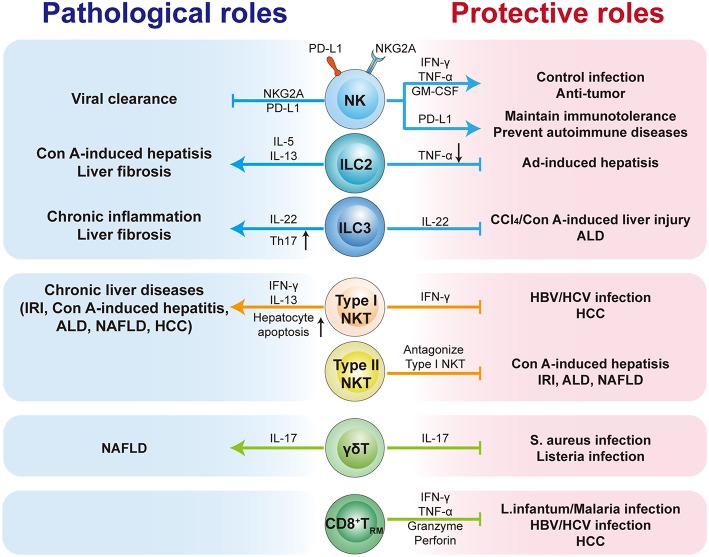
Tissue-resident lymphocytes usually reside in barrier sites and are involved in innate and adaptive immunity. In recent years, many studies have shown that multiple types of lymphocytes are resident in the liver, including memory CD8 T (T) cells; "unconventional" T cells, such as invariant natural killer T (iNKT) cells, mucosal associated invariant T (MAIT) cells, and γδT cells; innate lymphoid cells (ILCs) such as natural killer (NK) cells and other ILCs. Although diverse types of tissue-resident lymphocytes share similar phenotypes, functional properties, and transcriptional regulation, the unique microenvironment of the liver can reshape their phenotypic and functional characteristics. Liver-resident lymphocytes serve as sentinels and perform immunosurveillance in response to infection and non-infectious insults, and are involved in the maintenance of liver homeostasis. Under the pathological conditions, distinct liver-resident lymphocytes exert protective or pathological effects in the process of various liver diseases. In this review, we highlight the unique properties of liver-resident lymphocytes, and discuss their functional characteristics in different liver diseases.
组织驻留淋巴细胞通常驻留在屏障部位,并参与固有和适应性免疫。近年来,许多研究表明,多种类型的淋巴细胞存在于肝脏中,包括记忆 CD8 T(T)细胞;“非常规”T 细胞,如不变自然杀伤 T(iNKT)细胞、黏膜相关不变 T(MAIT)细胞和γδT 细胞;先天淋巴细胞(ILC),如自然杀伤(NK)细胞和其他 ILC。尽管不同类型的组织驻留淋巴细胞具有相似的表型、功能特性和转录调控,但肝脏的独特微环境可以重塑它们的表型和功能特征。肝驻留淋巴细胞作为哨兵,在感染和非传染性损伤时进行免疫监视,并参与维持肝脏内稳态。在病理条件下,不同的肝驻留淋巴细胞在各种肝脏疾病的发生发展过程中发挥保护或病理作用。在本文中,我们重点介绍了肝驻留淋巴细胞的独特特性,并讨论了它们在不同肝脏疾病中的功能特征。