VIM, UR892, Equipe Virus Influenza, INRA, University PARIS-SACLAY, Jouy-en-Josas, France.
Front Immunol. 2019 Jul 17;10:1605. doi: 10.3389/fimmu.2019.01605. eCollection 2019.
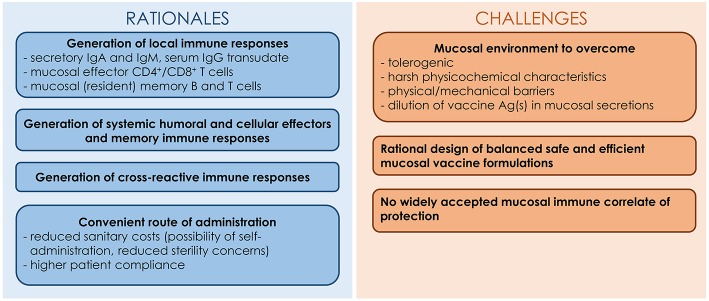
Despite efforts made to develop efficient preventive strategies, infections with influenza A viruses (IAV) continue to cause serious clinical and economic problems. Current licensed human vaccines are mainly inactivated whole virus particles or split-virion administered via the parenteral route. These vaccines provide incomplete protection against IAV in high-risk groups and are poorly/not effective against the constant antigenic drift/shift occurring in circulating strains. Advances in mucosal vaccinology and in the understanding of the protective anti-influenza immune mechanisms suggest that intranasal immunization is a promising strategy to fight against IAV. To date, human mucosal anti-influenza vaccines consist of live attenuated strains administered intranasally, which elicit higher local humoral and cellular immune responses than conventional parenteral vaccines. However, because of inconsistent protective efficacy and safety concerns regarding the use of live viral strains, new vaccine candidates are urgently needed. To prime and induce potent and long-lived protective immune responses, mucosal vaccine formulations need to ensure the immunoavailability and the immunostimulating capacity of the vaccine antigen(s) at the mucosal surfaces, while being minimally reactogenic/toxic. The purpose of this review is to compile innovative delivery/adjuvant systems tested for intranasal administration of inactivated influenza vaccines, including micro/nanosized particulate carriers such as lipid-based particles, virus-like particles and polymers associated or not with immunopotentiatory molecules including microorganism-derived toxins, Toll-like receptor ligands and cytokines. The capacity of these vaccines to trigger specific mucosal and systemic humoral and cellular responses against IAV and their (cross)-protective potential are considered.
尽管已经做出了努力来开发有效的预防策略,但甲型流感病毒 (IAV) 的感染仍然会导致严重的临床和经济问题。目前许可使用的人类疫苗主要是通过注射途径给予的全病毒颗粒或分裂病毒。这些疫苗对高危人群中的 IAV 提供不完全保护,并且对循环株中不断发生的抗原漂移/转变效果不佳/无效。黏膜疫苗学的进步以及对保护性抗流感免疫机制的理解表明,鼻内免疫是对抗 IAV 的一种有前途的策略。迄今为止,人类黏膜抗流感疫苗由鼻内给予的减毒活菌株组成,其在诱导局部体液和细胞免疫反应方面优于传统的注射疫苗。然而,由于活病毒株使用的保护效果不一致和安全性问题,迫切需要新的疫苗候选物。为了引发强大且持久的保护性免疫反应,黏膜疫苗制剂需要确保疫苗抗原在黏膜表面的免疫原性和免疫刺激能力,同时具有最小的致反应性/毒性。本综述的目的是汇编用于鼻内给予灭活流感疫苗的创新递送/佐剂系统,包括基于脂质的颗粒、病毒样颗粒和聚合物等微/纳米颗粒载体,以及与免疫增强分子(包括微生物衍生毒素、Toll 样受体配体和细胞因子)相关或不相关的免疫增强分子。考虑了这些疫苗引发针对 IAV 的特异性黏膜和系统体液和细胞反应的能力及其(交叉)保护潜力。