Xie Shangxian, Sun Su, Lin Furong, Li Muzi, Pu Yunqiao, Cheng Yanbing, Xu Bing, Liu Zhihua, da Costa Sousa Leonardo, Dale Bruce E, Ragauskas Arthur J, Dai Susie Y, Yuan Joshua S
Synthetic and Systems Biology Innovation Hub and Department of Plant Pathology and Microbiology Texas A&M University College Station TX 77843 USA.
Joint Institute for Biological Sciences and Biosciences Division Oak Ridge National Laboratory Oak Ridge TN 37831 USA.
Adv Sci (Weinh). 2019 May 1;6(13):1801980. doi: 10.1002/advs.201801980. eCollection 2019 Jul 3.
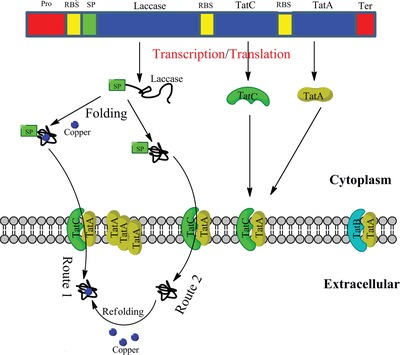
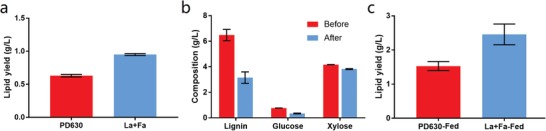
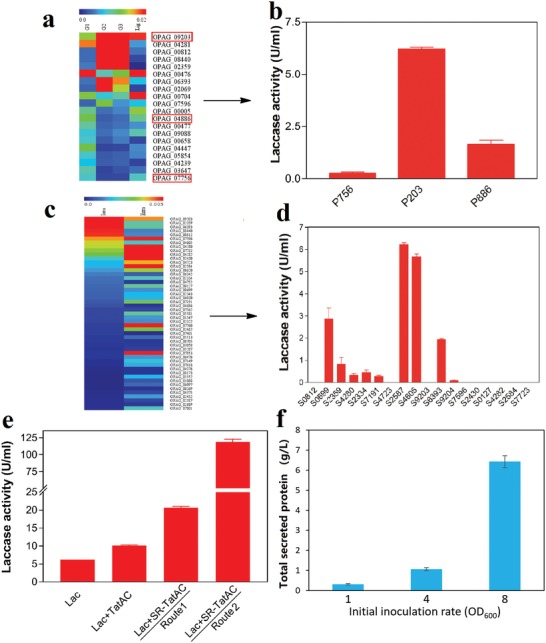
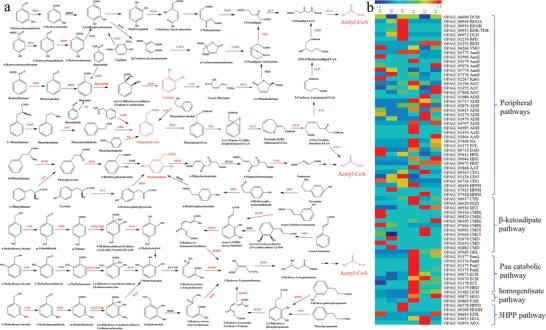
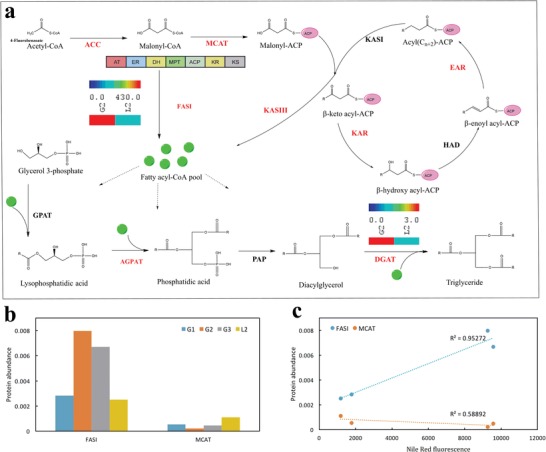
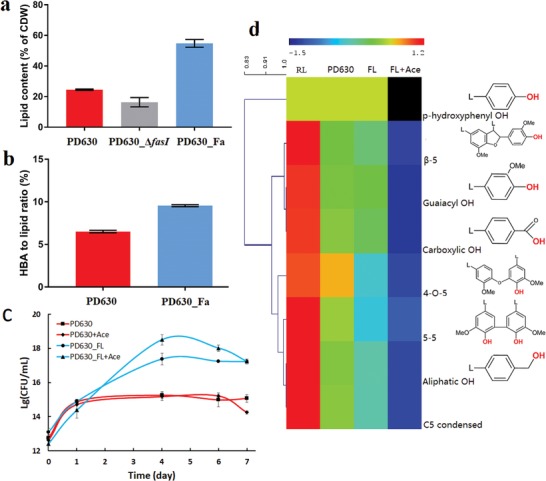
Bacterial protein secretion represents a significant challenge in biotechnology, which is essential for the cost-effective production of therapeutics, enzymes, and other functional proteins. Here, it is demonstrated that proteomics-guided engineering of transcription, translation, secretion, and folding of ligninolytic laccase balances the process, minimizes the toxicity, and enables efficient heterologous secretion with a total protein yield of 13.7 g L. The secretory laccase complements the biochemical limits on lignin depolymerization well in PD630. Further proteomics analysis reveals the mechanisms for the oleaginous phenotype of PD630, where a distinct multiunit fatty acid synthase I drives the carbon partition to storage lipid. The discovery guides the design of efficient lipid conversion from lignin and carbohydrate. The proteomics-guided integration of laccase-secretion and lipid production modules enables a high titer in converting lignin-enriched biorefinery waste to lipid. The fundamental mechanisms, engineering components, and design principle can empower transformative platforms for biomanufacturing and biorefining.
细菌蛋白质分泌是生物技术领域的一项重大挑战,而这对于经济高效地生产治疗药物、酶及其他功能蛋白至关重要。在此,研究表明,通过蛋白质组学指导对木质素分解漆酶的转录、翻译、分泌和折叠进行工程改造,可平衡该过程、将毒性降至最低,并实现高效异源分泌,总蛋白产量达13.7 g/L。分泌型漆酶在PD630中很好地补充了木质素解聚的生化限制。进一步的蛋白质组学分析揭示了PD630产油表型的机制,其中独特的多亚基脂肪酸合酶I驱动碳分配至储存脂质。这一发现为从木质素和碳水化合物高效转化脂质的设计提供了指导。蛋白质组学指导下的漆酶分泌和脂质生产模块整合,能够实现将富含木质素的生物精炼废料高效转化为脂质。这些基本机制、工程组件和设计原则可为生物制造和生物精炼的变革性平台提供支持。