Wu Zengyou, Peng Kun, Zhang Yin, Wang Mei, Yong Cheng, Chen Ling, Qu Ping, Huang Hongying, Sun Enhui, Pan Mingzhu
College of Materials Science and Engineering, Nanjing Forestry University, Nanjing, 210037, China.
Jiangsu Collaborative Innovation Center for Solid Organic Waste Resource Utilization/Key Laboratory of Saline-Alkali Soil Improvement and Utilization (Coastal Saline-Alkali Lands), Ministry of Agriculture and Rural Affairs/Institute of Agricultural Resources and Environment, Jiangsu Academy of Agricultural Sciences, Nanjing, 210014, China.
Mater Today Bio. 2022 Sep 28;16:100445. doi: 10.1016/j.mtbio.2022.100445. eCollection 2022 Dec.
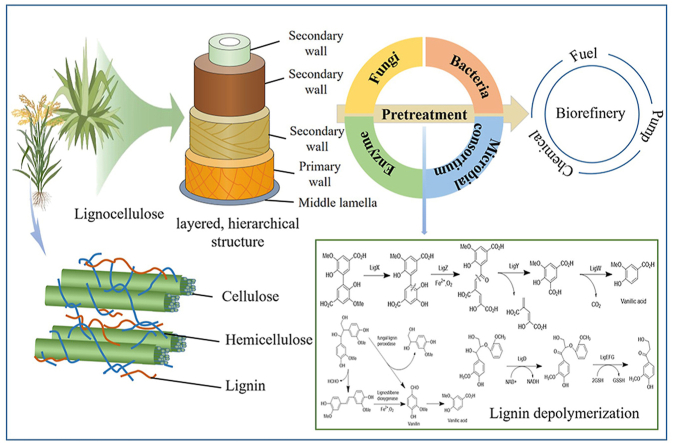
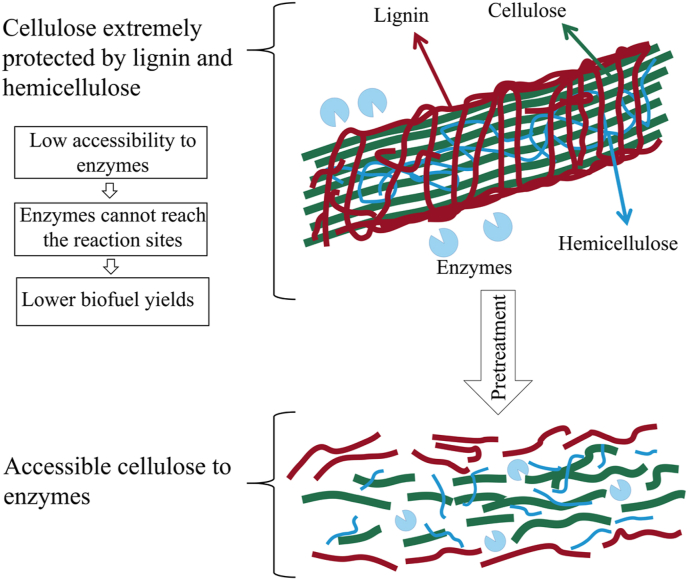
Lignocellulose utilization has been gaining great attention worldwide due to its abundance, accessibility, renewability and recyclability. Destruction and dissociation of the cross-linked, hierarchical structure within cellulose hemicellulose and lignin is the key procedure during chemical utilization of lignocellulose. Of the pretreatments, biological treatment, which can effectively target the complex structures, is attractive due to its mild reaction conditions and environmentally friendly characteristics. Herein, we report a comprehensive review of the current biological pretreatments for lignocellulose dissociation and their corresponding degradation mechanisms. Firstly, we analyze the layered, hierarchical structure of cell wall, and the cross-linked network between cellulose, hemicellulose and lignin, then highlight that the cracking of β-aryl ether is considered the key to lignin degradation because of its dominant position. Secondly, we explore the effect of biological pretreatments, such as fungi, bacteria, microbial consortium, and enzymes, on substrate structure and degradation efficiency. Additionally, combining biological pretreatment with other methods (chemical methods and catalytic materials) may reduce the time necessary for the whole process, which also help to strengthen the lignocellulose dissociation efficiency. Thirdly, we summarize the related applications of lignocellulose, such as fuel production, chemicals platform, and bio-pulping, which could effectively alleviate the energy pressure through bioconversion into high value-added products. Based on reviewing of current progress of lignocellulose pretreatment, the challenges and future prospects are emphasized. Genetic engineering and other technologies to modify strains or enzymes for improved biotransformation efficiency will be the focus of future research.
木质纤维素因其丰富性、易获取性、可再生性和可回收性而在全球范围内受到广泛关注。纤维素、半纤维素和木质素内部交联的分层结构的破坏和解离是木质纤维素化学利用过程中的关键步骤。在预处理方法中,生物处理能够有效针对复杂结构,因其反应条件温和且环境友好而备受关注。在此,我们对当前用于木质纤维素解离的生物预处理方法及其相应的降解机制进行了全面综述。首先,我们分析了细胞壁的分层结构以及纤维素、半纤维素和木质素之间的交联网络,然后强调由于β-芳基醚的主导地位,其裂解被认为是木质素降解的关键。其次,我们探讨了真菌、细菌、微生物群落和酶等生物预处理对底物结构和降解效率的影响。此外,将生物预处理与其他方法(化学方法和催化材料)相结合可能会减少整个过程所需的时间,这也有助于提高木质纤维素的解离效率。第三,我们总结了木质纤维素的相关应用,如燃料生产、化学品平台和生物制浆,这些应用可以通过生物转化为高附加值产品有效缓解能源压力。基于对木质纤维素预处理当前进展的综述,强调了面临的挑战和未来前景。利用基因工程等技术改造菌株或酶以提高生物转化效率将是未来研究的重点。