Doctorado en Ciencias Biomédicas, Con Orientaciones en Inmunología y Neurociencias, Universidad de Guadalajara, Guadalajara, Mexico.
Centro de Investgación en Inmunología y Dermatología (CIINDE), Zapopan, Mexico.
Front Cell Infect Microbiol. 2019 Jul 18;9:256. doi: 10.3389/fcimb.2019.00256. eCollection 2019.
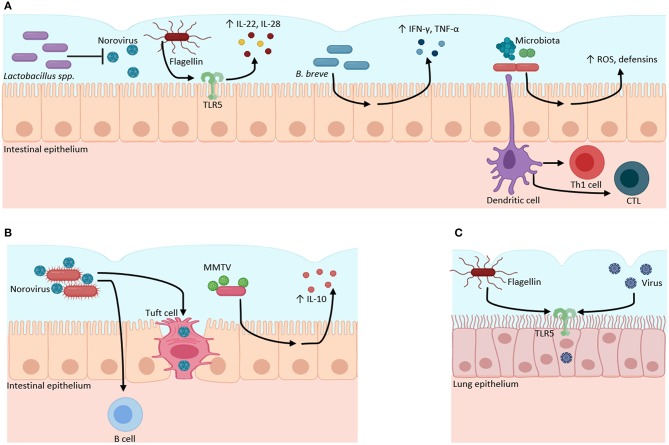
Viruses are obligate intracellular pathogens that require the protein synthesis machinery of the host cells to replicate. These microorganisms have evolved mechanisms to avoid detection from the host immune innate and adaptive response, which are known as viral evasion mechanisms. Viruses enter the host through skin and mucosal surfaces that happen to be colonized by communities of thousands of microorganisms collectively known as the commensal microbiota, where bacteria have a role in the modulation of the immune system and maintaining homeostasis. These bacteria are necessary for the development of the immune system and to prevent the adhesion and colonization of bacterial pathogens and parasites. However, the interactions between the commensal microbiota and viruses are not clear. The microbiota could confer protection against viral infection by priming the immune response to avoid infection, with some bacterial species being required to increase the antiviral response. On the other hand, it could also help to promote viral evasion of certain viruses by direct and indirect mechanisms, with the presence of the microbiota increasing infection and viruses using LPS and surface polysaccharides from bacteria to trigger immunosuppressive pathways. In this work, we reviewed the interaction between the microbiota and viruses to prevent their entry into host cells or to help them to evade the host antiviral immunity. This review is focused on the influence of the commensal microbiota in the viruses' success or failure of the host cells infection.
病毒是专性细胞内病原体,需要宿主细胞的蛋白质合成机制来复制。这些微生物已经进化出了避免被宿主固有和适应性免疫识别的机制,这些机制被称为病毒逃避机制。病毒通过皮肤和黏膜表面进入宿主,这些表面恰好被数以千计的微生物群落定植,这些微生物共同被称为共生菌群,其中细菌在调节免疫系统和维持体内平衡方面发挥作用。这些细菌对于免疫系统的发育以及防止细菌病原体和寄生虫的黏附和定植是必需的。然而,共生菌群和病毒之间的相互作用尚不清楚。共生菌群可以通过启动免疫反应来避免感染,从而为预防病毒感染提供保护,某些细菌物种的存在需要增加抗病毒反应。另一方面,共生菌群也可以通过直接和间接机制帮助促进某些病毒的逃避,共生菌群的存在增加了感染,而病毒则利用 LPS 和细菌表面多糖来触发免疫抑制途径。在这项工作中,我们综述了共生菌群与病毒之间的相互作用,以防止它们进入宿主细胞或帮助它们逃避宿主抗病毒免疫。本综述重点关注共生菌群对病毒成功或失败感染宿主细胞的影响。