Attwood Graeme T, Wakelin Steve A, Leahy Sinead C, Rowe Suzanne, Clarke Shannon, Chapman David F, Muirhead Richard, Jacobs Jeanne M E
Animal Science, AgResearch, Palmerston North, New Zealand.
Forage Science, AgResearch, Lincoln, New Zealand.
Front Nutr. 2019 Jul 16;6:107. doi: 10.3389/fnut.2019.00107. eCollection 2019.
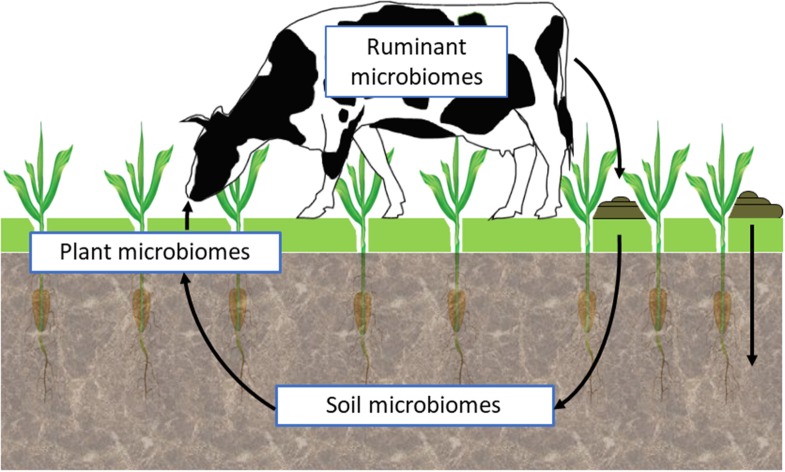
The production of dairy, meat, and fiber by ruminant animals relies on the biological processes occurring in soils, forage plants, and the animals' rumens. Each of these components has an associated microbiome, and these have traditionally been viewed as distinct ecosystems. However, these microbiomes operate under similar ecological principles and are connected via water, energy flows, and the carbon and nitrogen nutrient cycles. Here, we summarize the microbiome research that has been done in each of these three environments (soils, forage plants, animals' rumen) and investigate what additional benefits may be possible through understanding the interactions between the various microbiomes. The challenge for future research is to enhance microbiome function by appropriate matching of plant and animal genotypes with the environment to improve the output and environmental sustainability of pastoral agriculture.
反刍动物生产乳制品、肉类和纤维依赖于土壤、饲草植物以及动物瘤胃中发生的生物过程。这些组成部分各自都有相关的微生物群落,传统上它们被视为不同的生态系统。然而,这些微生物群落遵循相似的生态原则运行,并通过水、能量流以及碳和氮养分循环相互联系。在此,我们总结了在这三种环境(土壤、饲草植物、动物瘤胃)中各自开展的微生物群落研究,并探究通过了解不同微生物群落之间的相互作用可能带来的其他益处。未来研究面临的挑战是通过使植物和动物基因型与环境适当匹配来增强微生物群落功能,以提高畜牧农业的产量和环境可持续性。