IHDPC Department, Rwanda Biomedical Center, Po Box 7162, Kigali, Rwanda.
Health Department, Clinton Health Access Initiative (CHAI), Kigali, Rwanda.
BMC Infect Dis. 2019 Aug 5;19(1):688. doi: 10.1186/s12879-019-4322-7.
The epidemiology and risk factors for hepatitis C virus (HCV) infection in Rwanda are not well known; however, this information is crucial to shaping the country's public health approach to hepatitis C control.
A HCV screening campaign was conducted in the general population in 24 districts previously identified to have a high HCV disease burden. At the time of sample collection, sociodemographic information and self-reported risk factors were collected. Bivariate and multivariate logistic regressions were conducted to assess risk factors independently associated with hepatitis C antibodies (HCVAb) seroprevalence.
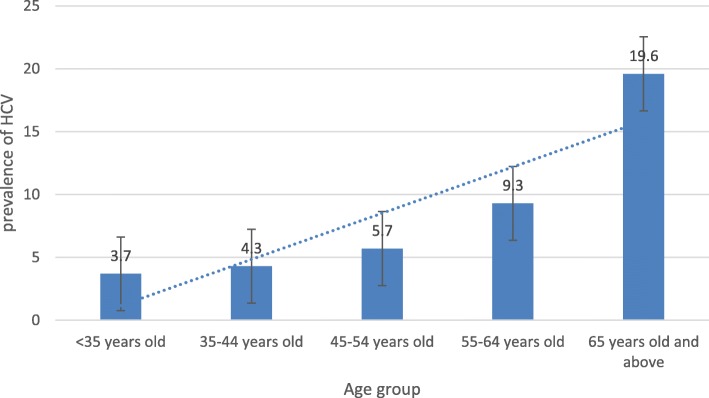
Out of a total of 326,263 individuals screened for HCVAb, 22,183 (6.8%) were positive. In multivariate analysis, risk factors identified as statistically associated with HCVAb Seroprevalence include history of traditional operation or scarification (OR = 1.09, 95% CI: 1.05-1.14), presence of viral hepatitis in the family (OR = 1.27, 95% CI: 1.15-1.40), widowed or separated/divorced (OR = 1.36, 95% CI: 1.26-1.47), Southern province (OR = 1.98, 95% CI: 1.88-2.08) and aged 65 years and older (OR = 4.86, 95% CI: 4.62-5.11). Ubudehe category 3 (OR = 0.97, 95% CI: 0.93-1.01) and participants using RAMA (Health insurances for employees of public and private sectors) insurance (OR = 0.76, 95% CI: 0.70-0.85) had lower odds of HCV seroprevalence.
Our findings provide important information for Rwanda's strategy on prevention and case-finding. Future prevention interventions should aim to reduce transmission through targeted messaging around traditional healing practices and case-finding targeting individuals with a history of exposure or advanced age.
卢旺达丙型肝炎病毒(HCV)感染的流行病学和危险因素尚不清楚;然而,这些信息对于制定该国丙型肝炎控制的公共卫生方法至关重要。
在先前确定 HCV 疾病负担较高的 24 个地区,对普通人群进行了 HCV 筛查活动。在采集样本时,收集了社会人口统计学信息和自我报告的危险因素。进行了二变量和多变量逻辑回归分析,以评估与丙型肝炎抗体(HCVAb)血清阳性率独立相关的危险因素。
在总共筛查了 326263 人检测 HCVAb 中,22183 人(6.8%)呈阳性。在多变量分析中,被确定为与 HCVAb 血清阳性率具有统计学关联的危险因素包括传统手术或纹身史(OR=1.09,95%CI:1.05-1.14)、家族中存在病毒性肝炎(OR=1.27,95%CI:1.15-1.40)、丧偶或离异/离婚(OR=1.36,95%CI:1.26-1.47)、南部省份(OR=1.98,95%CI:1.88-2.08)和 65 岁及以上年龄(OR=4.86,95%CI:4.62-5.11)。Ubudehe 类别 3(OR=0.97,95%CI:0.93-1.01)和使用 RAMA(公共和私营部门员工的健康保险)保险的参与者(OR=0.76,95%CI:0.70-0.85)HCV 血清阳性率的可能性较低。
我们的研究结果为卢旺达的预防和病例发现策略提供了重要信息。未来的预防干预措施应旨在通过针对传统治疗方法的有针对性的信息传递以及针对有暴露史或高龄的个体的病例发现来减少传播。