Division of Population Medicine, Cardiff University, Heath Park, Cardiff, CF14 4YS, UK.
Centre for Trials Research, Cardiff University, Neuadd Meirionnydd, Heath Park, Cardiff, CF14 4YS, UK.
Trials. 2019 Aug 5;20(1):474. doi: 10.1186/s13063-019-3603-1.
Around two million adults in the UK have significantly impaired decision-making capacity. However, there are concerns that this population is under-represented in research, due in part to the challenges around obtaining consent. Under-representation of populations denies those who would have wanted to participate the opportunity to make a contribution to society, but also fails to generate results that are applicable to them. Consequently, the evidence base for their care is poorer than for other populations. We recently published in this journal an analysis of Participant Information Sheets provided to consultees and legal representatives of adults who lack capacity and noted the small number of trials designed to include adults who lack capacity. In order to understand how many adults who lack capacity to consent are actually enrolled in clinical trials, we further explored how many of the participants lacked capacity, and who acted as a consultee or legal representative on their behalf.
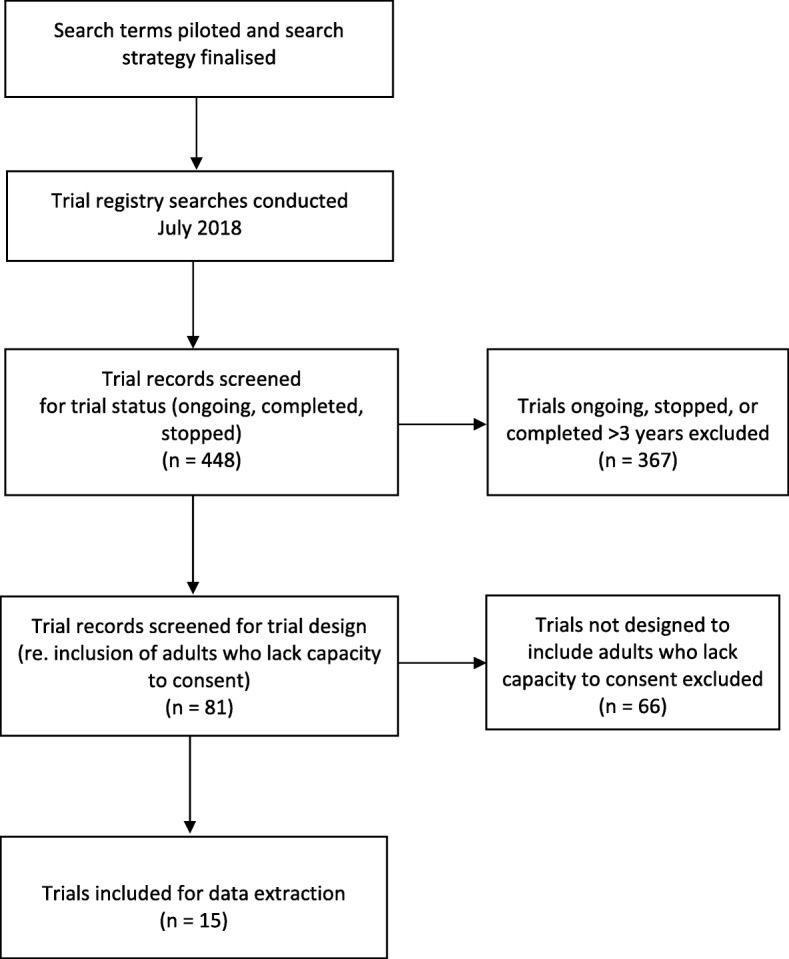
The ISRCTN registry was searched for UK clinical trials in conditions commonly associated with cognitive impairment that were designed to include (or not exclude) adults who lack capacity to consent. Details about participants and capacity status were obtained from published data or directly from the trial teams. Of the 80 retrieved clinical trials that had completed in the previous 3 years, we identified 15 which included adults who lack capacity to consent. Data regarding participants' capacity status were not available for five trials. Where capacity was reported, 5-100% participants lacked capacity to consent. Trials predominantly utilised personal consultees/legal representatives; however, 39% (634/1631) of participants required a professional to act as consultee/legal representative.
Only a small number of trials including adults who lacked capacity were identified. The majority of participants were represented by a personal consultee/legal representative; however, between 21 and 100% of participants across five trials required the involvement of a professional, suggesting it is not uncommon. Data relating to capacity status were rarely reported, potentially masking the under-representation of adults who lack capacity. The findings may help researchers and funders target resources towards studies involving under-represented populations to increase the much-needed evidence base for their care and treatment.
英国约有 200 万成年人的决策能力严重受损。然而,由于在获得同意方面存在挑战,人们担心这部分人群在研究中代表性不足。代表性不足使得那些本想参与的人失去了为社会做出贡献的机会,但也未能产生适用于他们的结果。因此,他们的护理证据基础比其他人群差。我们最近在本期刊上发表了一项对缺乏能力的成年人的咨询者和法定代表提供的参与者信息表的分析,并指出了旨在纳入缺乏能力的成年人的试验数量较少。为了了解实际上有多少缺乏同意能力的成年人被纳入临床试验,我们进一步探讨了有多少参与者缺乏能力,以及谁代表他们充当咨询者或法定代表。
在 ISRCTN 注册处搜索了与认知障碍相关的常见疾病的英国临床试验,这些试验旨在纳入(或不排除)缺乏同意能力的成年人。从已发表的数据或直接从试验团队获得参与者和能力状况的详细信息。在检索到的 80 项在过去 3 年内完成的临床试验中,我们确定了 15 项纳入了缺乏同意能力的成年人的临床试验。五项试验未提供有关参与者能力状况的数据。在报告能力的情况下,5-100%的参与者缺乏同意能力。试验主要使用个人咨询者/法定代表;然而,39%(634/1631)的参与者需要专业人士充当咨询者/法定代表。
只确定了少数纳入缺乏能力的成年人的试验。大多数参与者由个人咨询者/法定代表代表;然而,在五个试验中,有 21-100%的参与者需要专业人员的参与,这表明这种情况并不罕见。很少有关于能力状况的数据报告,这可能掩盖了缺乏能力的成年人代表性不足的问题。这些发现可能有助于研究人员和资助者将资源集中在涉及代表性不足的人群的研究上,以增加他们护理和治疗急需的证据基础。