Stener-Victorin Elisabet, Manti Maria, Fornes Romina, Risal Sanjiv, Lu Haojiang, Benrick Anna
Department of Physiology and Pharmacology, Karolinska Institutet, 171 77 Stockholm, Sweden.
Centre for Translational Microbiome Research (CTMR), Department of Microbiology, Tumor and Cell biology, Karolinska Institutet, 171 77 Stockholm Sweden.
Med Sci (Basel). 2019 Aug 5;7(8):86. doi: 10.3390/medsci7080086.
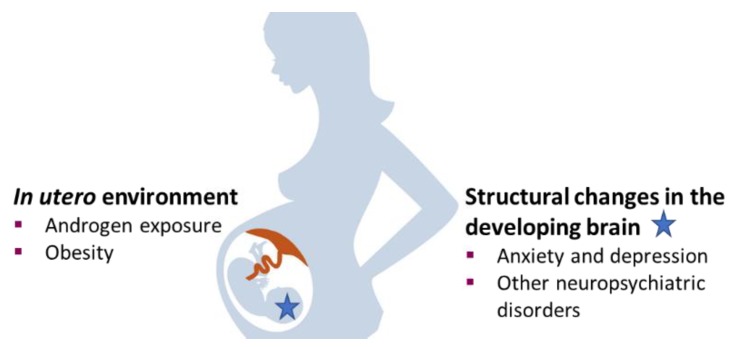
Women with polycystic ovary syndrome (PCOS) exhibit compromised psychiatric health. Independent of obesity, women with PCOS are more susceptible to have anxiety and depression diagnoses and other neuropsychiatric disorders. During pregnancy women with PCOS display high circulating androgen levels that may cause prenatal androgen exposure affecting the growing fetus and increasing the risk of mood disorders in offspring. Increasing evidence supports a non-genetic, maternal contribution to the development of PCOS and anxiety disorders in the next generation. Prenatal androgenized rodent models reflecting the anxiety-like phenotype of PCOS in the offspring, found evidence for the altered placenta and androgen receptor function in the amygdala, together with changes in the expression of genes associated with emotional regulation and steroid receptors in the amygdala and hippocampus. These findings defined a previously unknown mechanism that may be critical in understanding how maternal androgen excess can increase the risk of developing anxiety disorders in daughters and partly in sons of PCOS mothers. Maternal obesity is another common feature of PCOS causing an unfavorable intrauterine environment which may contribute to psychiatric problems in the offspring. Whether environmental factors such as prenatal androgen exposure and obesity increase the offspring's susceptibility to develop psychiatric ill-health will be discussed.
患有多囊卵巢综合征(PCOS)的女性存在精神健康受损的情况。与肥胖无关,患有PCOS的女性更容易被诊断出患有焦虑症、抑郁症及其他神经精神疾病。在孕期,患有PCOS的女性体内雄激素水平较高,这可能导致胎儿在产前暴露于雄激素环境中,影响胎儿的生长发育,并增加其后代患情绪障碍的风险。越来越多的证据支持,母亲对下一代PCOS和焦虑症的发生有非遗传方面的影响。反映后代PCOS焦虑样表型的产前雄激素化啮齿动物模型发现,杏仁核中的胎盘和雄激素受体功能发生改变,同时杏仁核和海马体中与情绪调节及类固醇受体相关的基因表达也发生了变化。这些发现确定了一种此前未知的机制,这对于理解母亲雄激素过多如何增加PCOS母亲的女儿甚至部分儿子患焦虑症的风险可能至关重要。母亲肥胖是PCOS的另一个常见特征,会导致不良的子宫内环境,并可能导致后代出现精神问题。本文将讨论诸如产前雄激素暴露和肥胖等环境因素是否会增加后代患精神疾病的易感性。