Maguire Finlay, Rehman Muhammad Attiq, Carrillo Catherine, Diarra Moussa S, Beiko Robert G
Faculty of Computer Science, Dalhousie University, Halifax, Nova Scotia, Canada.
Guelph Research and Development Center, Agriculture and Agri-Food Canada (AAFC), Guelph, Ontario, Canada.
mSystems. 2019 Aug 6;4(4):e00211-19. doi: 10.1128/mSystems.00211-19.
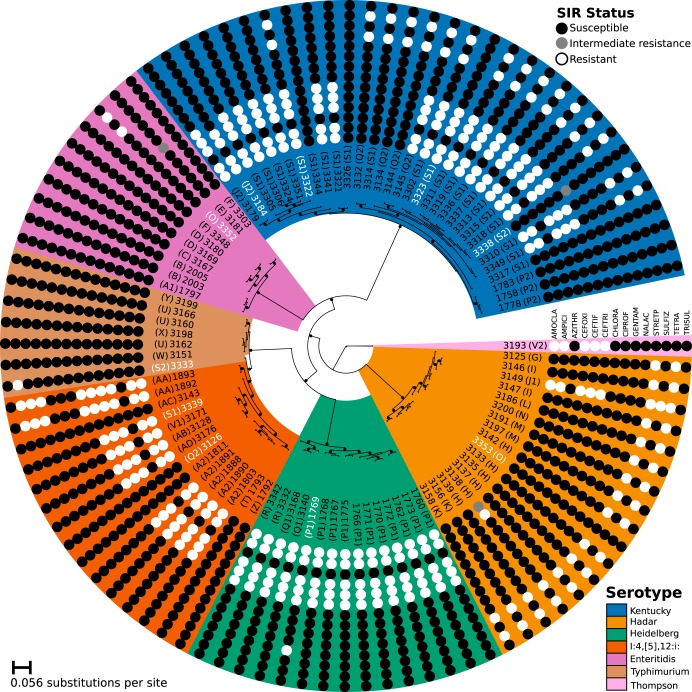
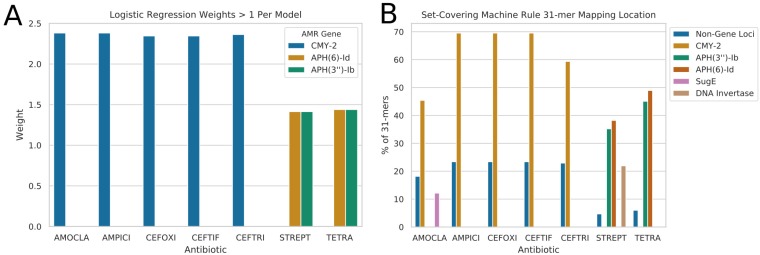
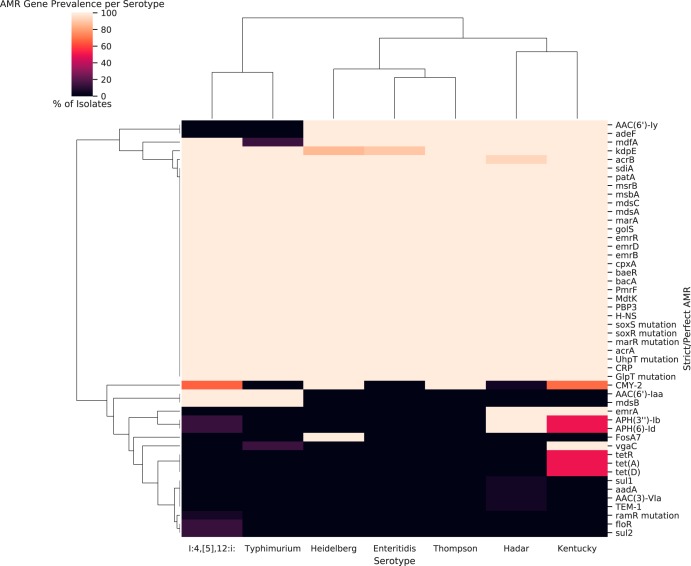
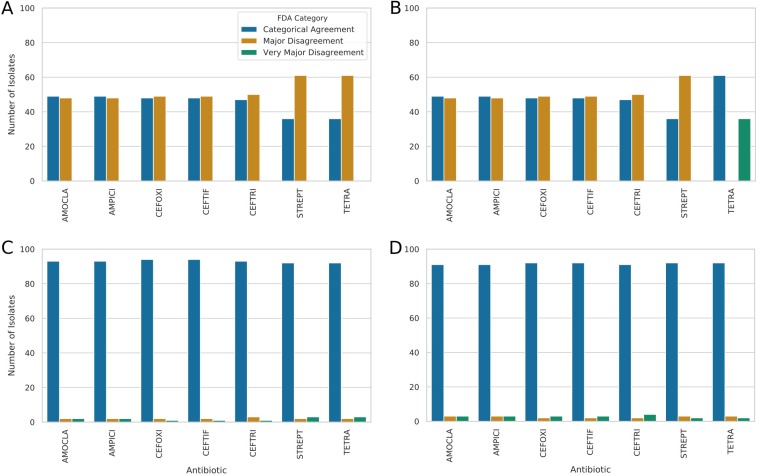
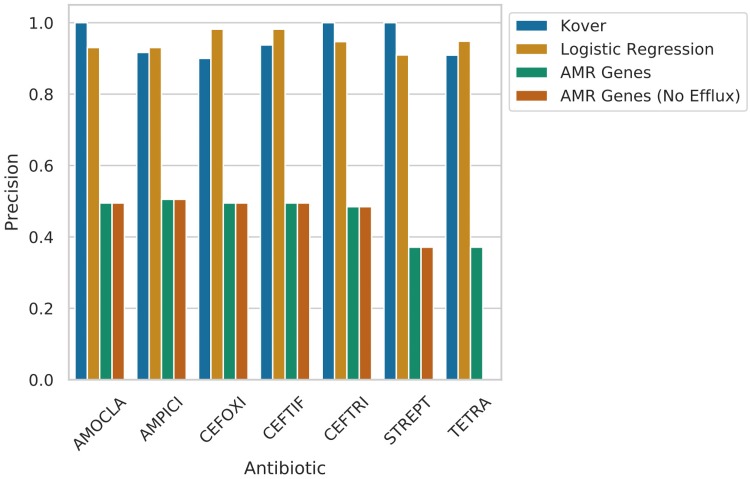
Nontyphoidal (NTS) is a leading global cause of bacterial foodborne morbidity and mortality. Our ability to treat severe NTS infections has been impaired by increasing antimicrobial resistance (AMR). To understand and mitigate the global health crisis AMR represents, we need to link the observed resistance phenotypes with their underlying genomic mechanisms. Broiler chickens represent a key reservoir and vector for NTS infections, but isolates from this setting have been characterized in only very low numbers relative to clinical isolates. In this study, we sequenced and assembled 97 genomes encompassing 7 serotypes isolated from broiler chicken in farms in British Columbia between 2005 and 2008. Through application of machine learning (ML) models to predict the observed AMR phenotype from this genomic data, we were able to generate highly (0.92 to 0.99) precise logistic regression models using known AMR gene annotations as features for 7 antibiotics (amoxicillin-clavulanic acid, ampicillin, cefoxitin, ceftiofur, ceftriaxone, streptomycin, and tetracycline). Similarly, we also trained "reference-free" k-mer-based set-covering machine phenotypic prediction models (0.91 to 1.0 precision) for these antibiotics. By combining the inferred k-mers and logistic regression weights, we identified the primary drivers of AMR for the 7 studied antibiotics in these isolates. With our research representing one of the largest studies of a diverse set of NTS isolates from broiler chicken, we can thus confirm that the -like β-lactamase is a primary driver of β-lactam resistance and that the phosphotransferases and are the principal drivers of streptomycin resistance in this important ecosystem. Antimicrobial resistance (AMR) represents an existential threat to the function of modern medicine. Genomics and machine learning methods are being increasingly used to analyze and predict AMR. This type of surveillance is very important to try to reduce the impact of AMR. Machine learning models are typically trained using genomic data, but the aspects of the genomes that they use to make predictions are rarely analyzed. In this work, we showed how, by using different types of machine learning models and performing this analysis, it is possible to identify the key genes underlying AMR in nontyphoidal (NTS). NTS is among the leading cause of foodborne illness globally; however, AMR in NTS has not been heavily studied within the food chain itself. Therefore, in this work we performed a broad-scale analysis of the AMR in NTS isolates from commercial chicken farms and identified some priority AMR genes for surveillance.
非伤寒沙门氏菌(NTS)是全球细菌性食源性发病和死亡的主要原因。日益增加的抗菌药物耐药性(AMR)削弱了我们治疗严重NTS感染的能力。为了理解并缓解AMR所代表的全球健康危机,我们需要将观察到的耐药表型与其潜在的基因组机制联系起来。肉鸡是NTS感染的关键宿主和传播媒介,但相对于临床分离株,来自这种环境的分离株的特征描述数量极少。在本研究中,我们对2005年至2008年期间从不列颠哥伦比亚省农场的肉鸡中分离出的97个基因组进行了测序和组装,这些基因组涵盖7种血清型。通过应用机器学习(ML)模型从该基因组数据预测观察到的AMR表型,我们能够使用已知的AMR基因注释作为7种抗生素(阿莫西林-克拉维酸、氨苄青霉素、头孢西丁、头孢噻呋、头孢曲松、链霉素和四环素)的特征,生成高度精确(0.92至0.99)的逻辑回归模型。同样,我们还针对这些抗生素训练了基于“无参考”k-mer的集覆盖机器表型预测模型(精度为0.91至1.0)。通过结合推断出的k-mer和逻辑回归权重,我们确定了这些分离株中7种研究抗生素的AMR主要驱动因素。我们的研究是对来自肉鸡的多种NTS分离株进行的最大规模研究之一,因此我们可以确认,类似的β-内酰胺酶是β-内酰胺耐药性的主要驱动因素,而磷酸转移酶和是这个重要生态系统中链霉素耐药性的主要驱动因素。抗菌药物耐药性(AMR)对现代医学的功能构成了生存威胁。基因组学和机器学习方法正越来越多地用于分析和预测AMR。这种监测对于试图减少AMR的影响非常重要。机器学习模型通常使用基因组数据进行训练,但很少分析它们用于进行预测的基因组方面。在这项工作中,我们展示了如何通过使用不同类型的机器学习模型并进行这种分析,来识别非伤寒沙门氏菌(NTS)中AMR的关键基因。NTS是全球食源性疾病的主要原因之一;然而,NTS中的AMR在食物链本身中尚未得到深入研究。因此,在这项工作中,我们对来自商业养鸡场的NTS分离株中的AMR进行了广泛分析,并确定了一些用于监测的优先AMR基因。