Research School of Population Health, Australian National University, Australia.
The Hospital for Tropical Diseases, Wellcome Trust Major Overseas Programme, Oxford University Clinical Research Unit, Ho Chi Minh City, Viet Nam.
Infect Genet Evol. 2020 Nov;85:104534. doi: 10.1016/j.meegid.2020.104534. Epub 2020 Sep 11.
Nontyphoidal Salmonella (NTS) are associated with both diarrhea and bacteremia. Antimicrobial resistance (AMR) is common in NTS in low-middle income countries, but the major source(s) of AMR NTS in humans are not known. Here, we aimed to assess the role of animals as a source of AMR in human NTS infections in Vietnam. We retrospectively combined and analyzed 672 NTS human and animal isolates from four studies in southern Vietnam and compared serovars, sequence types (ST), and AMR profiles. We generated a population structure of circulating organisms and aimed to attribute sources of AMR in NTS causing invasive and noninvasive disease in humans using Bayesian multinomial mixture models.
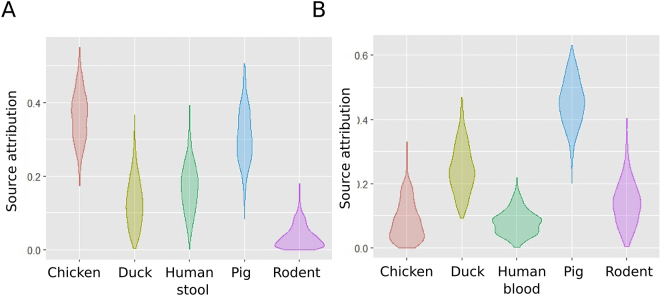
Among 672 NTS isolates, 148 (22%) originated from human blood, 211 (31%) from human stool, and 313 (47%) from animal stool. The distribution of serovars, STs, and AMR profiles differed among sources; serovars Enteritidis, Typhimurium, and Weltevreden were the most common in human blood, human stool, and animals, respectively. We identified an association between the source of NTS and AMR profile; the majority of AMR isolates were isolated from human blood (p < 0.001). Modelling by ST-AMR profile found chickens and pigs were likely the major sources of AMR NTS in human blood and stool, respectively; but unsampled sources were found to be a major contributor.
Antimicrobial use in food animals is hypothesized to play role in the emergence of AMR in human pathogens. Our cross-sectional population-based approach suggests a significant overlap between AMR in NTS in animals and humans, but animal NTS does explain the full extent of AMR in human NTS infections in Vietnam.
非伤寒沙门氏菌(NTS)与腹泻和菌血症有关。在中低收入国家,NTS 普遍存在抗生素耐药性(AMR),但人类中 AMR NTS 的主要来源尚不清楚。在这里,我们旨在评估动物作为越南人类 NTS 感染中 AMR 来源的作用。我们回顾性地结合并分析了来自越南南部四个研究的 672 个人类和动物 NTS 分离株,并比较了血清型、序列型(ST)和 AMR 谱。我们生成了循环生物体的种群结构,并旨在使用贝叶斯多项混合模型来归因于导致人类侵袭性和非侵袭性疾病的 NTS 中 AMR 的来源。
在 672 个 NTS 分离株中,有 148 株(22%)来自人类血液,211 株(31%)来自人类粪便,313 株(47%)来自动物粪便。血清型、ST 和 AMR 谱的分布因来源而异;肠炎沙门氏菌、鼠伤寒沙门氏菌和韦尔泰登沙门氏菌分别是人类血液、人类粪便和动物中最常见的血清型。我们发现 NTS 的来源与 AMR 谱之间存在关联;大多数 AMR 分离株来自人类血液(p<0.001)。通过 ST-AMR 谱进行建模发现,鸡和猪可能分别是人类血液和粪便中 AMR NTS 的主要来源,但未采样的来源被认为是主要来源。
食物动物中抗生素的使用被假设在人类病原体中 AMR 的出现中发挥作用。我们基于人群的横断面方法表明,动物和人类 NTS 中的 AMR 之间存在显著重叠,但动物 NTS 并不能解释越南人类 NTS 感染中 AMR 的全部程度。