Lane Department of Computer Science & Electrical Engineering, West Virginia University, Morgantown, USA.
Sci Rep. 2019 Aug 6;9(1):11425. doi: 10.1038/s41598-019-46850-0.
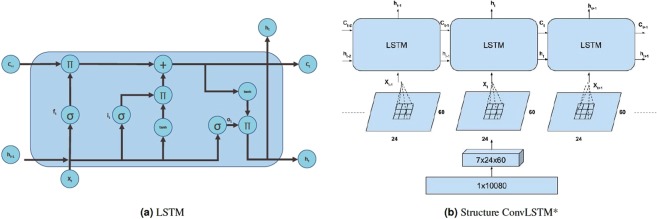
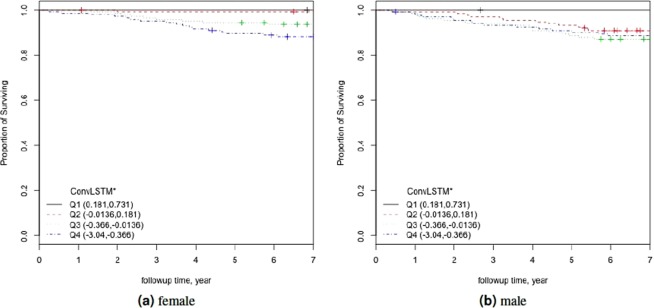
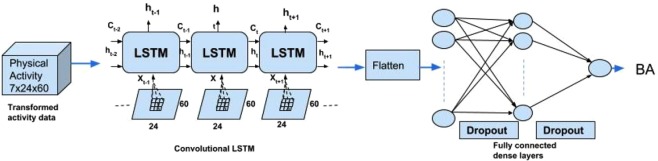
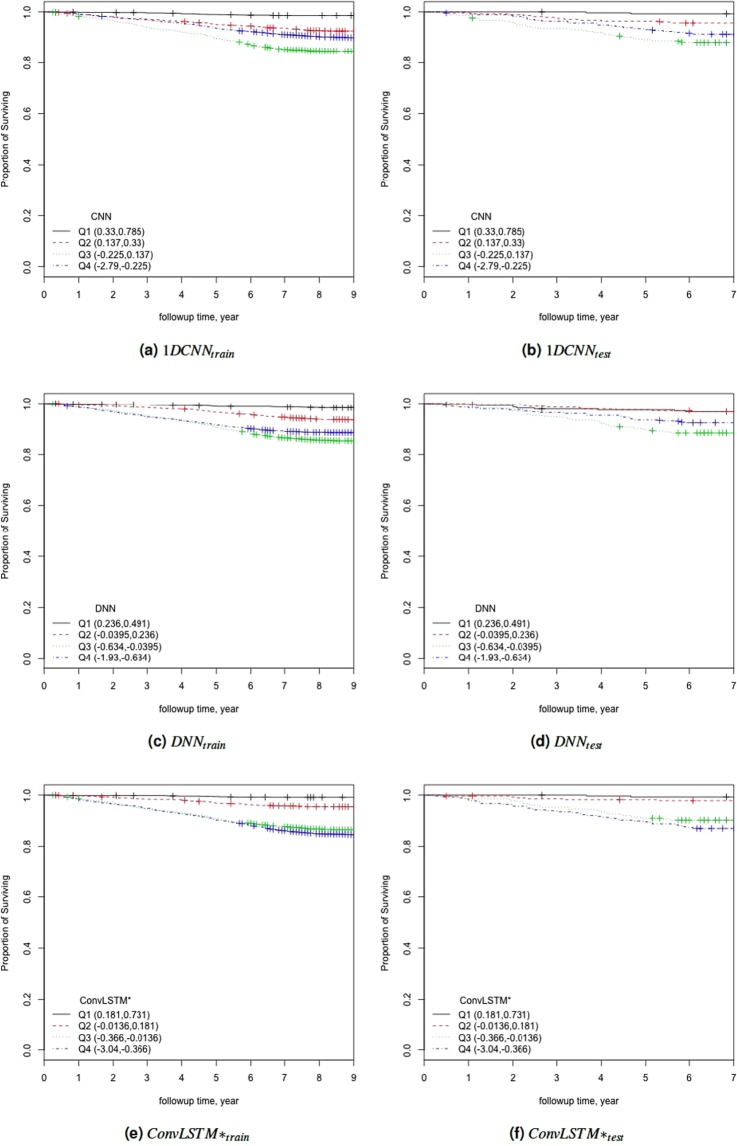
Human age estimation is an important and difficult challenge. Different biomarkers and numerous approaches have been studied for biological age estimation, each with its advantages and limitations. In this work, we investigate whether physical activity can be exploited for biological age estimation for adult humans. We introduce an approach based on deep convolutional long short term memory (ConvLSTM) to predict biological age, using human physical activity as recorded by a wearable device. We also demonstrate five deep biological age estimation models including the proposed approach and compare their performance on the NHANES physical activity dataset. Results on mortality hazard analysis using both the Cox proportional hazard model and Kaplan-Meier curves each show that the proposed method for estimating biological age outperforms other state-of-the-art approaches. This work has significant implications in combining wearable sensors and deep learning techniques for improved health monitoring, for instance, in a mobile health environment. Mobile health (mHealth) applications provide patients, caregivers, and administrators continuous information about a patient, even outside the hospital.
人类年龄估计是一个重要且具有挑战性的问题。不同的生物标志物和众多方法已被研究用于生物年龄估计,每种方法都有其优点和局限性。在这项工作中,我们研究了体力活动是否可用于估计成年人的生物年龄。我们引入了一种基于深度卷积长短期记忆(ConvLSTM)的方法,使用可穿戴设备记录的人体体力活动来预测生物年龄。我们还展示了包括所提出方法在内的五个深度生物年龄估计模型,并比较了它们在 NHANES 体力活动数据集上的性能。使用 Cox 比例风险模型和 Kaplan-Meier 曲线进行的死亡率风险分析结果均表明,所提出的生物年龄估计方法优于其他最先进的方法。这项工作对于将可穿戴传感器和深度学习技术结合起来进行健康监测具有重要意义,例如在移动健康环境中。移动健康(mHealth)应用程序为患者、护理人员和管理员提供了关于患者的持续信息,即使在医院外也是如此。