
与红腐病同时出现的海水及其周围环境中细菌群落的组成变化
Compositional Shifts of Bacterial Communities Associated With and Surrounding Seawater Co-occurring With Red Rot Disease.
作者信息
Yan Yong-Wei, Yang Hui-Chao, Tang Lei, Li Jie, Mao Yun-Xiang, Mo Zhao-Lan
机构信息
Laboratory for Marine Fisheries and Aquaculture, Qingdao National Laboratory for Marine Science and Technology, Key Laboratory of Maricultural Organism Disease Control, Ministry of Agriculture and Rural Affairs, Yellow Sea Fisheries Research Institute, Chinese Academy of Fishery Sciences, Qingdao, China.
College of Fisheries and Life Science, Shanghai Ocean University, Shanghai, China.
出版信息
Front Microbiol. 2019 Jul 23;10:1666. doi: 10.3389/fmicb.2019.01666. eCollection 2019.
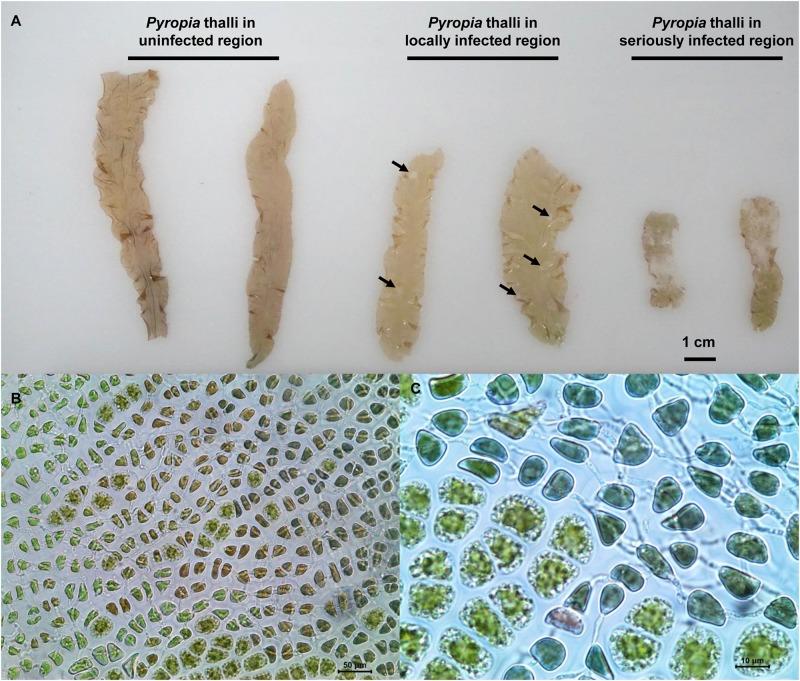
is commercially the most important edible red alga in China, and red rot disease is viewed as one of the major constraints for its cultivation. Microbes within the oomycetic genus have been reported as the causative agents for this disease; however, little is known about the interactions between the disease and the epiphytic and planktonic bacterial communities. In the present study, bacterial communities associated with uninfected, locally infected, and seriously infected thalli collected from cultivation farms, and within seawater adjacent to the thalli, were investigated using in-depth 16S ribosomal RNA (rRNA) gene sequencing in conjunction with assessing multiple environmental factors. For both thalli and seawater, uninfected and infected communities were significantly different though alpha diversity was similar. Phylogenetic differences between epiphytic bacterial communities associated with were mainly reflected by the relative changes in the dominant operational taxonomic units (OTUs) assigned as genus , genus , and family Rhodobacteraceae. The prevalent OTUs in seawater also differed in relative abundance across the communities and were affiliated with diverse taxa, including the phyla Actinobacteria, Verrucomicrobia, and Bacteroidetes, and the classes Alpha- and Gamma-proteobacteria. The differentiation of bacterial communities associated with and seawater was primarily shaped by reactive silicate (RS) content and salinity, respectively. In particular, 14 potential indicators (two OTUs on and twelve OTUs in seawater) were identified that significantly differentiated health statuses and correlated with environmental changes. Overall, the present study provides insights into the alterations of bacterial communities associated with and surrounding seawater co-occurring with red rot disease. Observed changes were closely associated with health status of algal host, and highlight the potential of using community differentiation to forecast disease occurrence.
在中国,它是商业上最重要的可食用红藻,而红腐病被视为其养殖的主要限制因素之一。卵菌纲中的微生物已被报道为这种疾病的病原体;然而,对于该疾病与附生和浮游细菌群落之间的相互作用知之甚少。在本研究中,使用深度16S核糖体RNA(rRNA)基因测序并结合评估多种环境因素,对从养殖场采集的未感染、局部感染和严重感染的藻体以及藻体附近海水中的细菌群落进行了调查。对于藻体和海水,未感染和感染的群落虽然α多样性相似,但存在显著差异。与藻体相关的附生细菌群落之间的系统发育差异主要由被指定为属、属和红杆菌科的优势操作分类单元(OTU)的相对变化反映出来。海水中普遍存在的OTU在不同群落中的相对丰度也有所不同,并且隶属于不同的分类群,包括放线菌门、疣微菌门和拟杆菌门,以及α-和γ-变形菌纲。与藻体和海水相关的细菌群落的分化分别主要由活性硅酸盐(RS)含量和盐度决定。特别是,确定了14个潜在指标(藻体上的2个OTU和海水中的12个OTU),它们显著区分了藻体的健康状况并与环境变化相关。总体而言,本研究为与红腐病同时出现的藻体和周围海水相关细菌群落的变化提供了见解。观察到的变化与藻类宿主的健康状况密切相关,并突出了利用群落分化来预测疾病发生的潜力。



 Zotero 插件