Wuhan University of Technology, Wuhan, Hubei, People's Republic of China.
BGI Education Center, University of Chinese Academy of Sciences, Shenzhen, China.
Genes Genomics. 2019 Nov;41(11):1253-1264. doi: 10.1007/s13258-019-00855-1. Epub 2019 Aug 9.
Akkermansia muciniphila is an important bacterium that resides on the mucus layer of the intestinal tract. Akkermansia muciniphila has a high abundance in human feces and plays an important role in human health.
In this article, 23 whole genome sequences of the Akkermansia genus were comparatively studied.
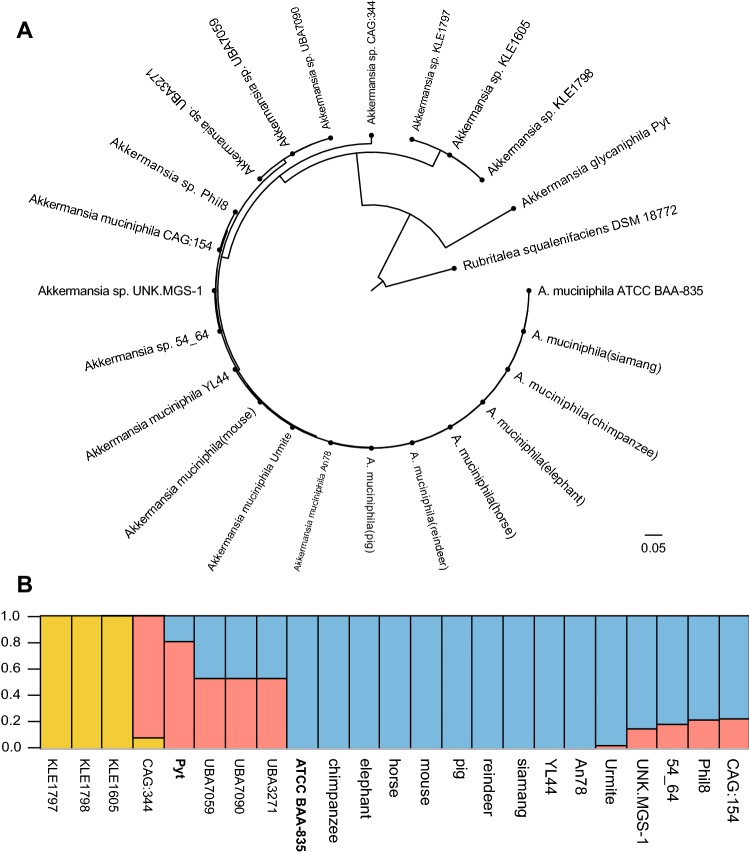
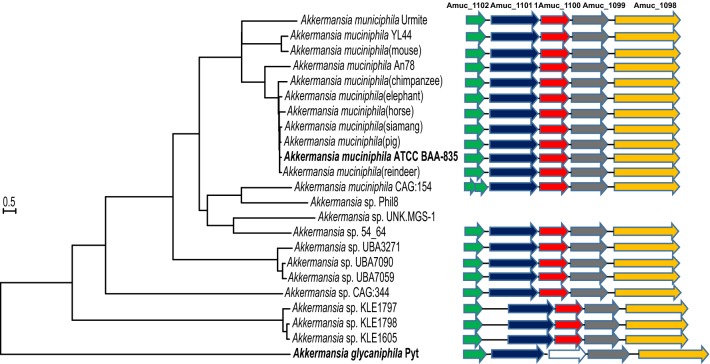
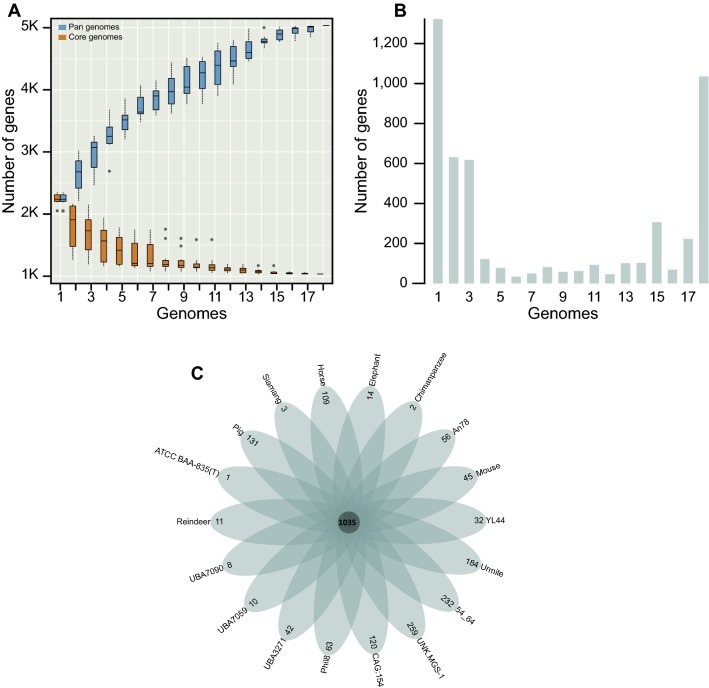
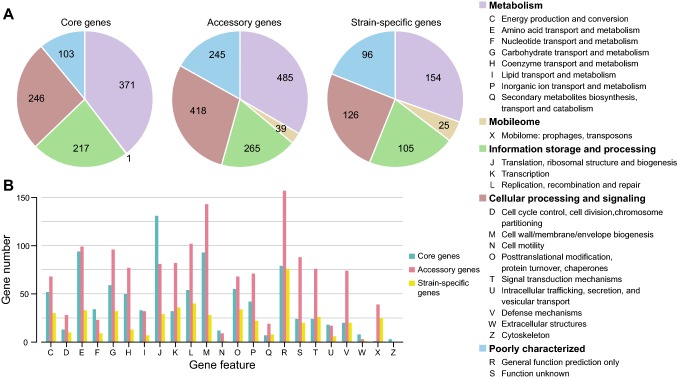
Phylogenetic trees were constructed with three methods: All amino acid sequences of each strain were used to construct the first phylogenetic tree using the web server of Composition Vector Tree Version 3. The matrix of Genome-to-Genome Distances which were obtained from GGDC 2.0 was used to construct the second phylogenetic tree using FastME. The concatenated single-copy core gene-based phylogenetic tree was generated through MEGA. The single-copy genes were obtained using OrthoMCL. Population structure was assessed by STRUCTURE 2.3.4 using the SNPs in core genes. PROKKA and Roary were used to do pan-genome analyses. The biosynthetic gene clusters were predicted using antiSMASH 4.0. IalandViewer 4 was used to detect the genomic islands.
The results of comparative genomic analysis revealed that: (1) The 23 Akkermansia strains formed 4 clades in phylogenetic trees. The A. muciniphila strains isolated from different geographic regions and ecological niches, formed a closely related clade. (2) The 23 Akkermansia strains were divided into 4 species based on digital DNA-DNA hybridization (dDDH) values. (3) Pan-genome of A. muciniphila is in an open state and increases with addition of new sequenced genomes. (4) SNPs were not evenly distributed throughout the A. muciniphila genomes. The genes in regions with high SNP density are related to metabolism and cell wall/membrane envelope biogenesis. (5) The thermostable outer-membrane protein, Amuc_1100, was conserved in the Akkermansia genus, except for Akkermansia glycaniphila Pyt.
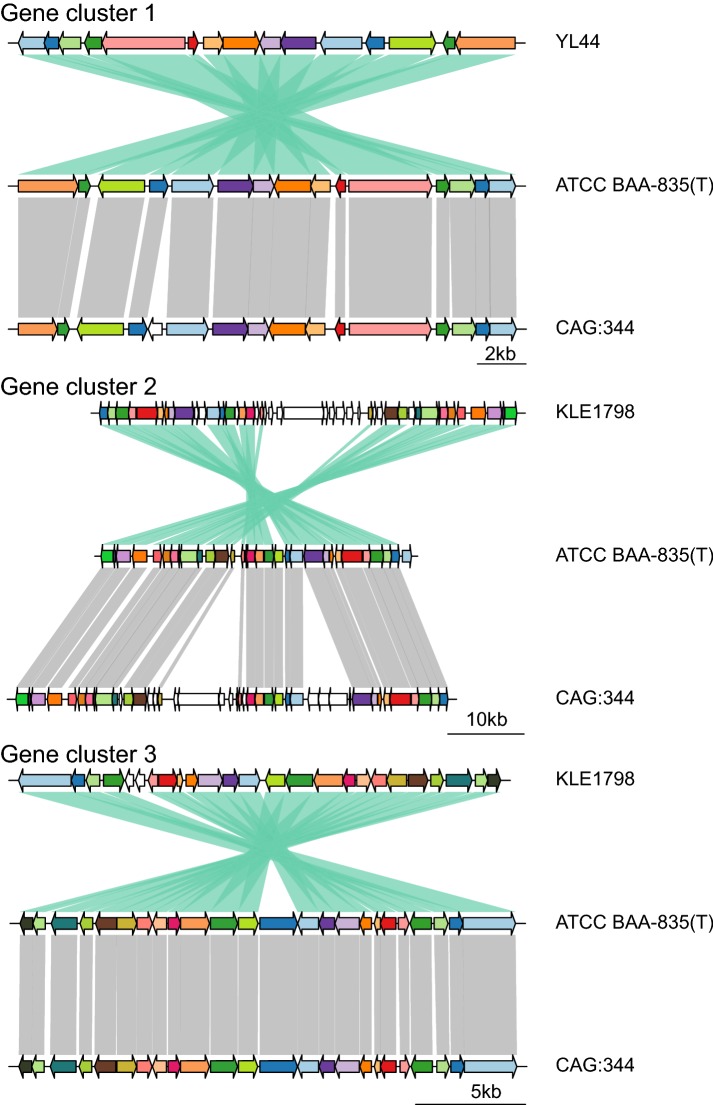
Overall, applying comparative genomic and pan-genomic analyses, we classified and illuminated the phylogenetic relationship of the 23 Akkermansia strains. Insights of the evolutionary, population structure, gene clusters and genome islands of Akkermansia provided more information about the possible physiological and probiotic mechanisms of the Akkermansia strains, and gave some instructions for the in-depth researches about the use of Akkermansia as a gut probiotic in the future.
阿克曼氏菌(Akkermansia muciniphila)是一种重要的肠道黏液层定居菌,在人类粪便中丰度较高,在人体健康中发挥着重要作用。
本研究对 23 株阿克曼氏菌属的全基因组序列进行了比较分析。
采用 3 种方法构建系统发育树:使用 Composition Vector Tree Version 3 网络服务器,基于每个菌株的所有氨基酸序列构建第一棵系统发育树;使用 GGDC 2.0 中的基因组到基因组距离矩阵,通过 FastME 构建第二棵系统发育树;使用 MEGA 构建基于串联单拷贝核心基因的系统发育树。使用 OrthoMCL 获得单拷贝基因。通过 STRUCTURE 2.3.4 基于核心基因中的 SNPs 评估种群结构。使用 PROKKA 和 Roary 进行全基因组分析。使用 antiSMASH 4.0 预测生物合成基因簇。使用 IalandViewer 4 检测基因组岛。
比较基因组分析结果表明:(1)23 株阿克曼氏菌在系统发育树中形成 4 个分支。从不同地理区域和生态位分离的 A. muciniphila 菌株形成了密切相关的分支。(2)根据数字 DNA-DNA 杂交(dDDH)值,将 23 株阿克曼氏菌分为 4 个种。(3)A. muciniphila 的泛基因组处于开放状态,随着新测序基因组的增加而增加。(4)SNP 并非均匀分布于 A. muciniphila 基因组中。高 SNP 密度区域的基因与代谢和细胞壁/膜包膜生物发生有关。(5)耐热外膜蛋白 Amuc_1100 在阿克曼氏菌属中保守,除阿克曼氏糖阿克曼氏菌 Pyt 外。
总之,通过比较基因组和泛基因组分析,我们对 23 株阿克曼氏菌的分类和系统发育关系进行了分类和阐明。阿克曼氏菌的进化、种群结构、基因簇和基因组岛的研究结果为阿克曼氏菌菌株的生理和益生菌机制提供了更多信息,并为未来将阿克曼氏菌作为肠道益生菌的深入研究提供了一些指导。