Tibbs Taylor N, Lopez Lacey R, Arthur Janelle C
Department of Microbiology and Immunology, University of North Carolina at Chapel Hill, Chapel Hill, North Carolina, United States of America.
Center for Gastrointestinal Biology and Disease, University of North Carolina at Chapel Hill, Chapel Hill, North Carolina, United States of America.
Microb Cell. 2019 May 13;6(8):324-334. doi: 10.15698/mic2019.08.685.
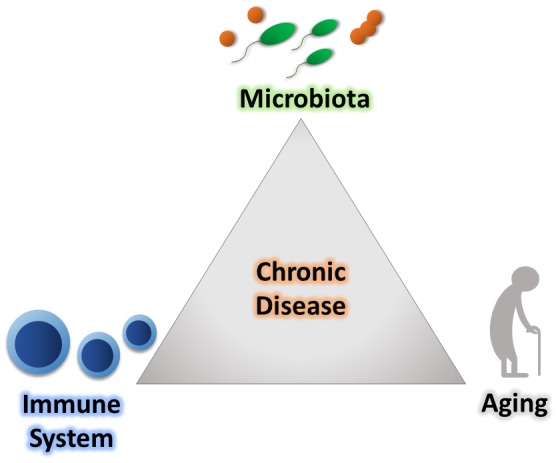
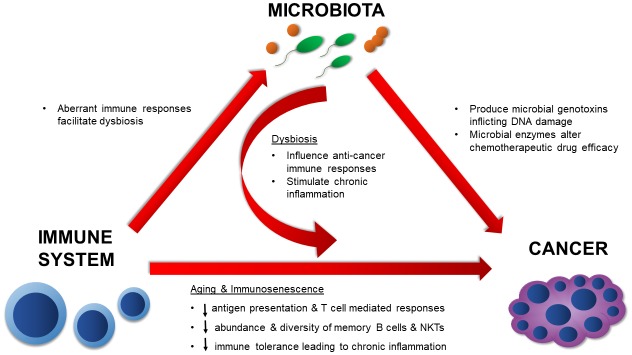
From birth, the microbiota plays an essential role in human development by educating host immune responses. Proper maturation of the immune system perturbs chronic inflammation and the pathogenesis of disease by preventing inappropriate immune responses. While many have detailed the roles of specific microbial groups in immune development and human disease, it remains to be elucidated how the microbiota influences the immune system during aging. Furthermore, it is not yet understood how age-related changes to the microbiota and immune system influence the development of age-related diseases. In this review, we outline the role of the microbiota in immune system development as well as functional changes that occur to immune cell populations during immunosenescence. In addition, we highlight how commensal microbes influence the pathogenesis of cancer, a prominent disease of aging. The information provided herein suggests that age-related changes to the microbiota and immune system should be considered in disease treatment and prevention strategies.
从出生起,微生物群就通过塑造宿主免疫反应在人类发育过程中发挥着至关重要的作用。免疫系统的正常成熟通过防止不适当的免疫反应来扰乱慢性炎症和疾病的发病机制。虽然许多人已经详细阐述了特定微生物群在免疫发育和人类疾病中的作用,但微生物群在衰老过程中如何影响免疫系统仍有待阐明。此外,目前还不清楚微生物群和免疫系统与年龄相关的变化如何影响与年龄相关疾病的发展。在这篇综述中,我们概述了微生物群在免疫系统发育中的作用,以及免疫衰老过程中免疫细胞群体发生的功能变化。此外,我们强调共生微生物如何影响癌症(一种突出的衰老相关疾病)的发病机制。本文提供的信息表明,在疾病治疗和预防策略中应考虑微生物群和免疫系统与年龄相关的变化。