Department of Statistics, college of Statistics, Iowa State University, Ames, Iowa, United States of America.
Department of Veterinary Diagnostic and Production Animal Medicine, College of Veterinary Medicine, Iowa State University, Ames, Iowa, United States of America.
PLoS One. 2019 Aug 12;14(8):e0220879. doi: 10.1371/journal.pone.0220879. eCollection 2019.
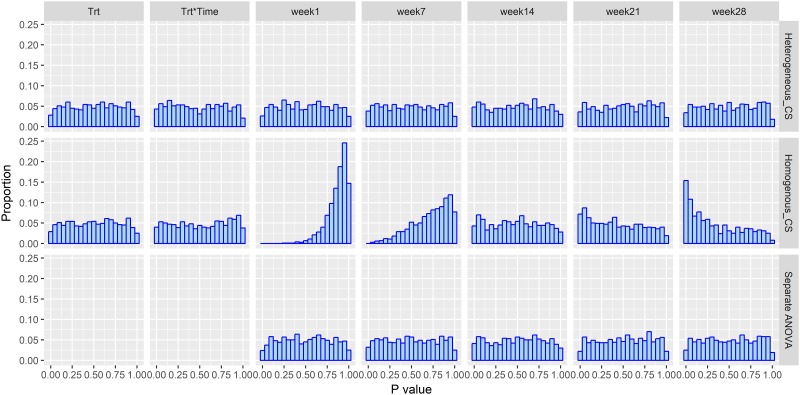
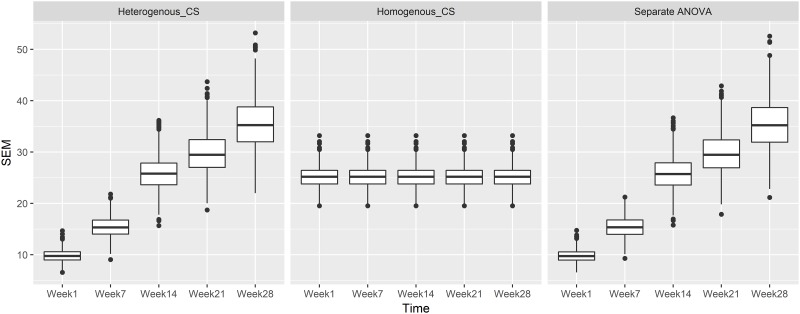
A common feature of preclinical animal experiments is repeated measurement of the outcome, e.g., body weight measured in mice pups weekly for 20 weeks. Separate time point analysis or repeated measures analysis approaches can be used to analyze such data. Each approach requires assumptions about the underlying data and violations of these assumptions have implications for estimation of precision, and type I and type II error rates. Given the ethical responsibilities to maximize valid results obtained from animals used in research, our objective was to evaluate approaches to reporting repeated measures design used by investigators and to assess how assumptions about variation in the outcome over time impact type I and II error rates and precision of estimates. We assessed the reporting of repeated measures designs of 58 studies in preclinical animal experiments. We used simulation modelling to evaluate three approaches to statistical analysis of repeated measurement data. In particular, we assessed the impact of (a) repeated measure analysis assuming that the outcome had non-constant variation at all time points (heterogeneous variance) (b) repeated measure analysis assuming constant variation in the outcome (homogeneous variance), (c) separate ANOVA at individual time point in repeated measures designs. The evaluation of the three model fitting was based on comparing the p-values distributions, the type I and type II error rates and by implication, the shrinkage or inflation of standard error estimates from 1000 simulated dataset. Of 58 studies with repeated measures design, three provided a rationale for repeated measurement and 23 studies reported using a repeated-measures analysis approach. Of the 35 studies that did not use repeated-measures analysis, fourteen studies used only two time points to calculate weight change which potentially means collected data was not fully utilized. Other studies reported only select time points (n = 12) raising the issue of selective reporting. Simulation studies showed that an incorrect assumption about the variance structure resulted in modified error rates and precision estimates. The reporting of the validity of assumptions for repeated measurement data is very poor. The homogeneous variation assumption, which is often invalid for body weight measurements, should be confirmed prior to conducting the repeated-measures analysis using homogeneous covariance structure and adjusting the analysis using corrections or model specifications if this is not met.
临床前动物实验的一个共同特征是对结果进行重复测量,例如,每周对 20 周龄的小鼠幼崽进行体重测量。可以使用单独的时间点分析或重复测量分析方法来分析此类数据。每种方法都需要对基础数据做出假设,违反这些假设会影响精度以及 I 型和 II 型错误率的估计。鉴于从用于研究的动物中获得最大有效结果的伦理责任,我们的目标是评估研究人员使用的重复测量设计报告方法,并评估随时间变化的结果的变异对 I 型和 II 型错误率以及估计精度的影响。我们评估了 58 项临床前动物实验中重复测量设计的报告情况。我们使用模拟模型来评估三种重复测量数据统计分析方法。特别是,我们评估了以下三种方法的影响:(a)在所有时间点假设结果具有非恒定变化(异方差)的重复测量分析;(b)假设结果具有恒定变化(同方差)的重复测量分析;(c)重复测量设计中在各个时间点进行单独的 ANOVA。三种模型拟合的评估是基于比较 p 值分布、I 型和 II 型错误率,并且意味着从 1000 个模拟数据集推断出标准误差估计值的收缩或膨胀。在有重复测量设计的 58 项研究中,有三项提供了重复测量的基本原理,有 23 项研究报告使用了重复测量分析方法。在未使用重复测量分析的 35 项研究中,有 14 项研究仅使用了两个时间点来计算体重变化,这意味着收集的数据没有得到充分利用。其他研究仅报告了部分时间点(n = 12),这引发了选择性报告的问题。模拟研究表明,对方差结构的错误假设会导致修改后的误差率和精度估计。重复测量数据有效性假设的报告非常差。对于体重测量,同方差假设通常是无效的,在使用同方差协方差结构进行重复测量分析之前,应该确认该假设,并且如果不满足要求,则应该通过校正或模型指定来调整分析。