Departments of Oral Health Sciences and Biochemistry & Molecular Biology, Hollings Cancer Center, Medical University of South Carolina (MUSC), Charleston, South Carolina.
Departments of Oral Health Sciences and Biochemistry & Molecular Biology, Hollings Cancer Center, Medical University of South Carolina (MUSC), Charleston, South Carolina.
Transl Res. 2019 Dec;214:92-104. doi: 10.1016/j.trsl.2019.07.010. Epub 2019 Jul 29.
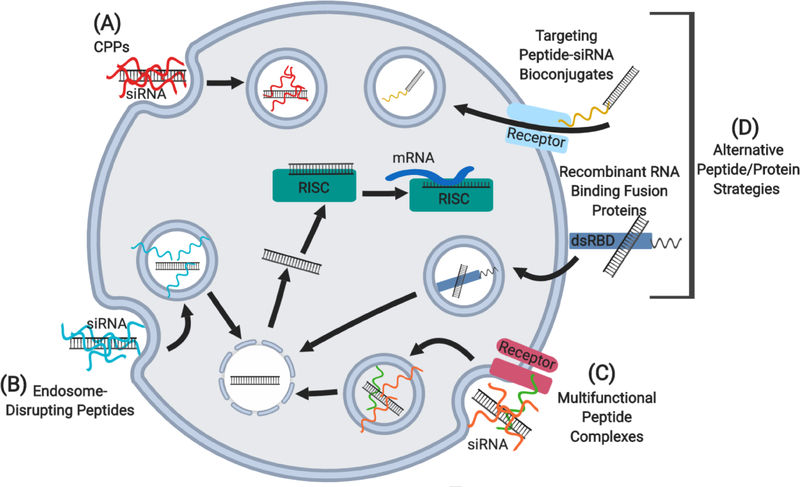
Cancer is a significant health concern worldwide and its clinical treatment presents many challenges. Consequently, much research effort has focused on the development of new anticancer drugs to combat this disease. One area of exploration, in particular, has been in the therapeutic application of RNA interference (RNAi). Although RNAi appears to be an attractive therapeutic tool for the treatment of cancer, one of the primary obstacles towards its pervasive use in the clinic has been cell/tissue type-specific cytosolic delivery of therapeutic small interfering RNA (siRNA) molecules. Consequently, varied drug delivery platforms have been developed and widely explored for siRNA delivery. Among these candidate drug delivery systems, peptides have shown great promise as siRNA carriers due to their varied physiochemical properties and functions, simple formulations, and flexibility in design. In this review, we will focus on distinguishing between the different classes of peptide carriers based on their functions, as well as summarize and discuss the various design strategies and advancements that have been made in circumventing the barriers to siRNA delivery for cancer treatment. Resolution of these challenges by peptide carriers will accelerate the translation of RNAi-based therapies to the clinic.
癌症是全球范围内一个重大的健康问题,其临床治疗存在诸多挑战。因此,大量的研究工作集中在开发新的抗癌药物来对抗这种疾病。特别是在 RNA 干扰(RNAi)的治疗应用方面进行了探索。尽管 RNAi 似乎是治疗癌症的一种有吸引力的治疗工具,但在临床上广泛应用的主要障碍之一是治疗性小干扰 RNA(siRNA)分子在细胞/组织类型特异性细胞溶质中的递送。因此,已经开发并广泛探索了各种药物递送平台来递送 siRNA。在这些候选药物递送系统中,由于其多样的物理化学性质和功能、简单的配方以及设计的灵活性,肽已显示出作为 siRNA 载体的巨大潜力。在这篇综述中,我们将重点介绍根据功能区分不同类别的肽载体,并总结和讨论为克服 siRNA 递送至癌症治疗中的障碍而做出的各种设计策略和进展。肽载体解决这些挑战将加速基于 RNAi 的疗法向临床的转化。