Research Unit, Consorci Sanitari del Maresme, 08304 Mataró (Barcelona), Spain.
Centro de Investigación Biomédica en Red de Enfermedades Hepáticas y Digestivas (CIBERehd), Instituto de Salud Carlos III, 08036 Barcelona, Spain.
Nutrients. 2019 Aug 9;11(8):1857. doi: 10.3390/nu11081857.
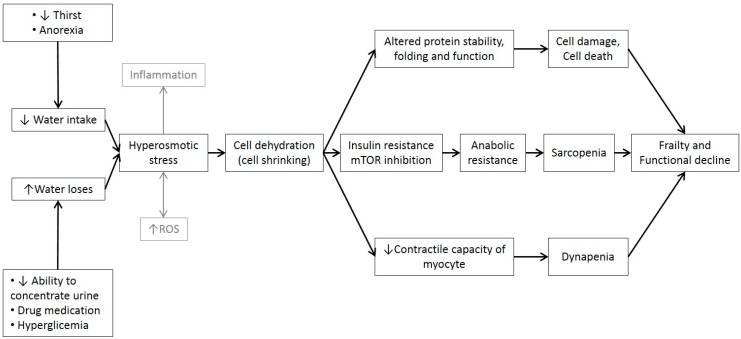
Water, the main component of the body, is distributed in the extracellular and intracellular compartments. Water exchange between these compartments is mainly governed by osmotic pressure. Extracellular water osmolarity must remain within very narrow limits to be compatible with life. Older adults lose the thirst sensation and the ability to concentrate urine, and this favours increased extracellular osmolarity (hyperosmotic stress). This situation, in turn, leads to cell dehydration, which has severe consequences for the intracellular protein structure and function and, ultimately, results in cell damage. Moreover, the fact that water determines cell volume may act as a metabolic signal, with cell swelling acting as an anabolic signal and cell shrinkage acting as a catabolic signal. Ageing also leads to a progressive loss in muscle mass and strength. Muscle strength is the main determinant of functional capacity, and, in elderly people, depends more on muscle quality than on muscle quantity (or muscle mass). Intracellular water content in lean mass has been related to muscle strength, functional capacity, and frailty risk, and has been proposed as an indicator of muscle quality and cell hydration. This review aims to assess the role of hyperosmotic stress and cell dehydration on muscle function and frailty.
水是人体的主要组成部分,分布在细胞外液和细胞内液中。这些隔室之间的水交换主要受渗透压控制。细胞外液渗透压必须保持在非常狭窄的范围内才能与生命兼容。老年人失去口渴感和浓缩尿液的能力,这会导致细胞外液渗透压增加(高渗应激)。这种情况反过来又导致细胞脱水,对细胞内蛋白质的结构和功能产生严重影响,最终导致细胞损伤。此外,水决定细胞体积这一事实可能作为一种代谢信号,细胞肿胀作为合成代谢信号,细胞收缩作为分解代谢信号。衰老还会导致肌肉质量和力量的逐渐丧失。肌肉力量是功能能力的主要决定因素,在老年人中,肌肉质量比肌肉数量(或肌肉质量)更能决定功能能力。瘦体重中的细胞内水含量与肌肉力量、功能能力和虚弱风险有关,并被提议作为肌肉质量和细胞水合作用的指标。本综述旨在评估高渗应激和细胞脱水对肌肉功能和虚弱的影响。