Ohio State University, Columbus, Ohio, 43210, USA.
Duke University Medical Center, Durham, North Carolina, 27708, USA.
Sci Rep. 2019 Aug 12;9(1):11619. doi: 10.1038/s41598-019-48031-5.
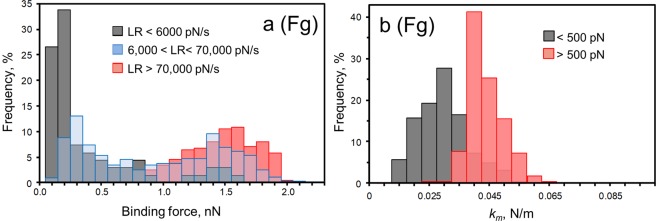
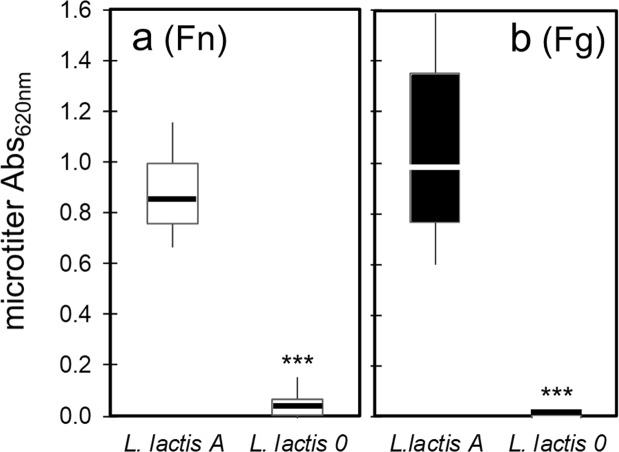
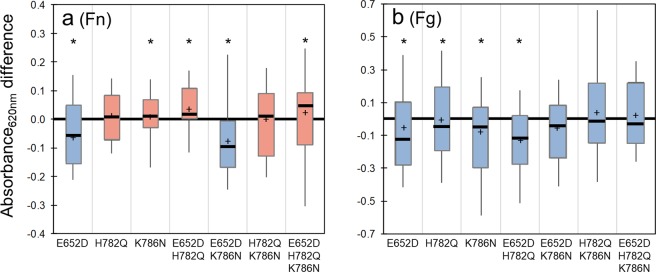
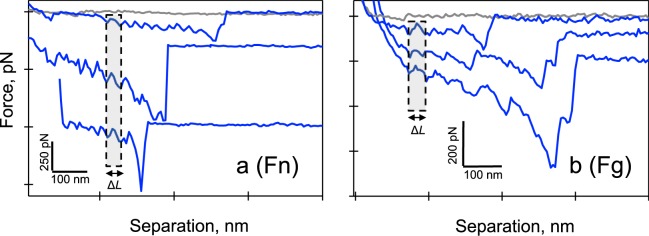
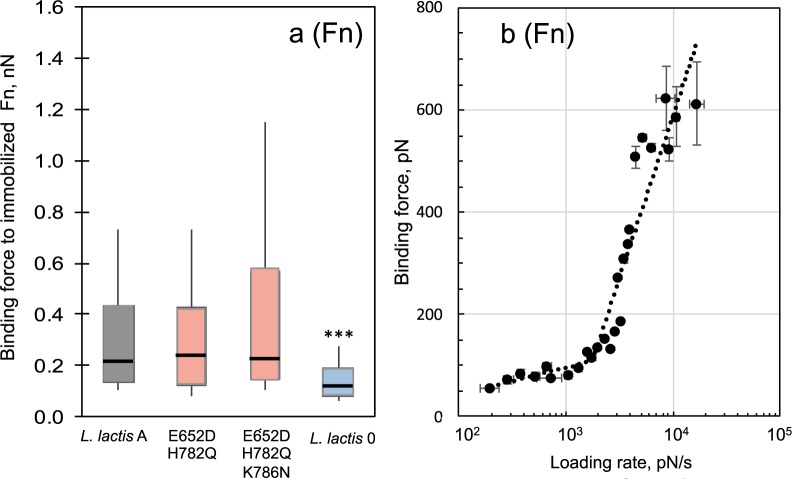
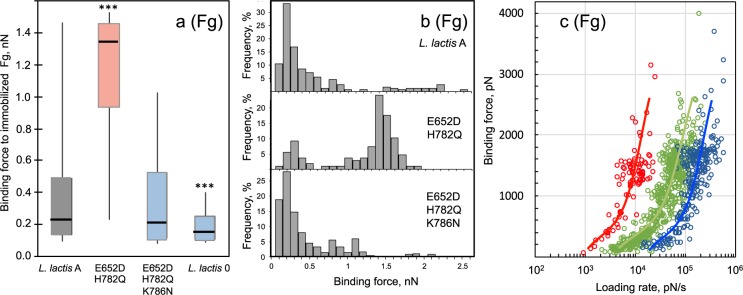
Fibronectin-binding protein A (FnBPA), a protein displayed on the outer surface of Staphylococcus aureus, has a structured A-domain that binds fibrinogen (Fg) and a disordered repeat-region that binds fibronectin (Fn). Amino acid substitutions in Fn-binding repeats (FnBRs) have previously been linked to cardiovascular infection in humans. Here we used microtiter and atomic force microscopy (AFM) to investigate adhesion by variants of full-length FnBPA covalently anchored in the outer cell wall of Lactococcus lactis, a Gram-positive surrogate that otherwise lacks adhesins to mammalian ligands. Fn adhesion increased in five of seven FnBPA variants under static conditions. The bond targeting Fn increased its strength with load under mechanical dissociation. Substitutions extended bond lifetime (1/k) up to 2.1 times for FnBPA-Fn. Weaker adhesion was observed for Fg in all FnBPA variants tested with microtiter. However, mechanical dissociation with AFM showed significantly increased tensile strength for Fg interacting with the E652D/H782Q variant. This is consistent with a force-induced mechanism and suggests that the dock, lock, and latch (DLL) mechanism is favored for Fg-binding under mechanical stress. Collectively, these experiments reveal that FnBPA exhibits bimodal, ligand-dependent adhesive behavior. Amino acid substitutions in the repeat-region of FnBPA impact binding to both ligands. This was unexpected for Fg since all variants have the same A-domain sequence, and the Fg-binding site is distant from the repeat region. This indicates that FnBRs may fold back on the A-domain in a way that impacts the DLL binding mechanism for Fg.
纤连蛋白结合蛋白 A(FnBPA)是一种位于金黄色葡萄球菌外表面的蛋白质,具有一个结构域 A,该结构域可结合纤维蛋白原(Fg),以及一个无序重复区,该重复区可结合纤连蛋白(Fn)。以前的研究表明,Fn 结合重复区(FnBR)中的氨基酸取代与人类心血管感染有关。在这里,我们使用微量滴定和原子力显微镜(AFM)来研究通过共价固定在乳球菌细胞壁外层的全长 FnBPA 变体的粘附,乳球菌是一种革兰氏阳性的替代物,否则缺乏与哺乳动物配体结合的粘附素。在静态条件下,7 种 FnBPA 变体中的 5 种 Fn 粘附增加。在机械解离下,靶向 Fn 的键增加了其负载下的强度。与 FnBPA-Fn 相比,取代将键的寿命(1/k)延长了 2.1 倍。在用微量滴定法测试的所有 FnBPA 变体中,均观察到 Fg 的粘附减弱。然而,AFM 的机械解离显示,与 E652D/H782Q 变体相互作用的 Fg 的拉伸强度显著增加。这与力诱导机制一致,表明在机械应力下,DLL 机制有利于 Fg 结合。总的来说,这些实验表明 FnBPA 表现出双模态、配体依赖性的粘附行为。FnBPA 重复区中的氨基酸取代会影响与两种配体的结合。这对于 Fg 来说是出乎意料的,因为所有变体都具有相同的 A 结构域序列,并且 Fg 结合位点远离重复区。这表明 FnBR 可能以影响 DLL 结合机制的方式折叠回到 A 结构域,以适应 Fg。