Spanish-Portuguese Institute for Agricultural Research (CIALE), Department of Botany and Plant Physiology, University of Salamanca, Salamanca, Spain.
Spanish-Portuguese Institute for Agricultural Research (CIALE), Department of Microbiology and Genetics, University of Salamanca, Salamanca, Spain.
Sci Rep. 2019 Aug 12;9(1):11650. doi: 10.1038/s41598-019-48269-z.
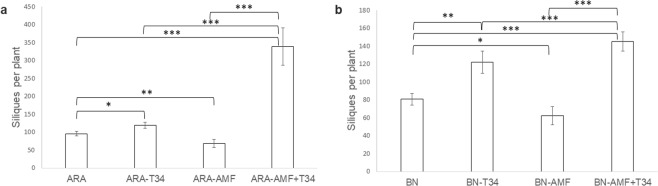
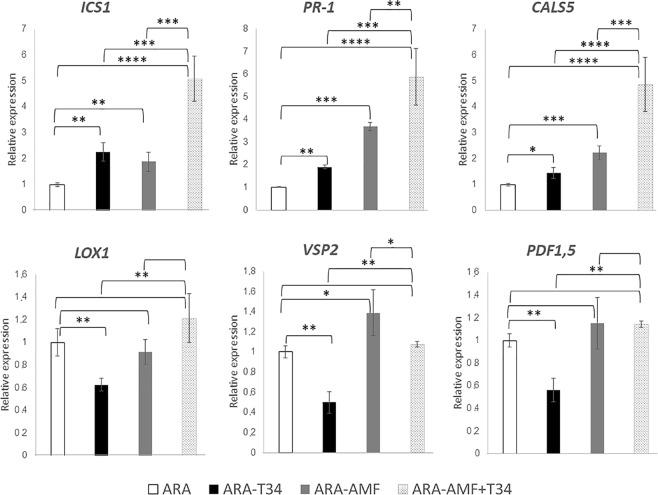
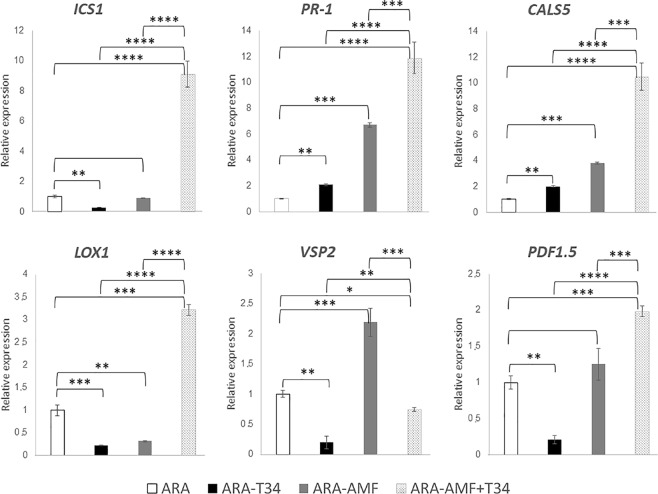
The family Brassicaceae includes plants that are non-host for arbuscular mycorrhizal fungi (AMF) such as the model plant Arabidopsis thaliana (arabidopsis) and the economically important crop plant Brassica napus (rapeseed). It is well known that Trichoderma species have the ability to colonize the rhizosphere of Brassicaceae plants, promoting growth and development as well as stimulating systemic defenses. The aim of the present work is to ascertain that Brassicaceae plants increase productivity when AMF and Trichoderma are combinedly applied, and how such an effect can be ruled. This simultaneous application of a Trichoderma harzianum biocontrol strain and an AMF formulation produces a significant increase in the colonization by Trichoderma and the presence of AMF in arabidopsis and rapeseed roots, such colonization accompanied by improved productivity in both Brassicaceae species. Expression profiling of defense-related marker genes suggests that the phytohormone salicylic acid plays a key role in the modulation of the root colonization process when both fungi are jointly applied.
十字花科植物包括非丛枝菌根真菌(AMF)宿主的植物,如模式植物拟南芥(arabidopsis)和经济上重要的作物油菜(rapeseed)。众所周知,木霉属物种具有定殖十字花科植物根际的能力,促进生长和发育,并刺激系统防御。本工作的目的是确定当 AMF 和木霉属物种联合应用时,十字花科植物的生产力会提高,以及如何控制这种效果。哈茨木霉生防菌株和 AMF 制剂的同时应用可显著增加木霉属和 AMF 在拟南芥和油菜根中的定殖,这种定殖伴随着两种十字花科植物生产力的提高。防御相关标记基因的表达谱表明,当两种真菌共同应用时,植物激素水杨酸在调节根定殖过程中起着关键作用。