Department of Epidemiology, School of Public Health, Fudan University, Shanghai, China.
School of Public Health, Fudan University, Key Laboratory of Public Health Safety, Ministry of Education, Shanghai, China.
Sci Rep. 2019 Aug 12;9(1):11641. doi: 10.1038/s41598-019-48255-5.
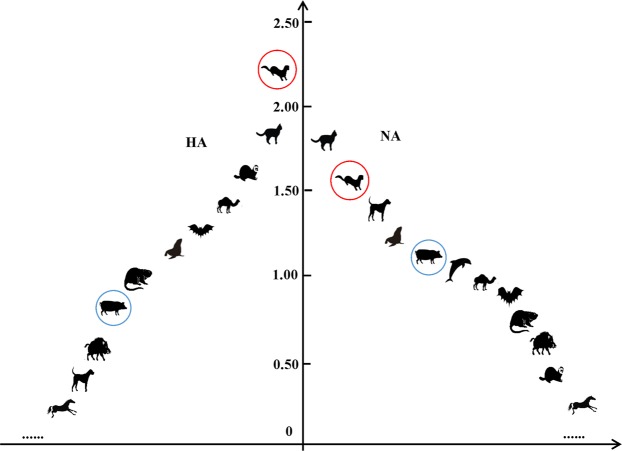
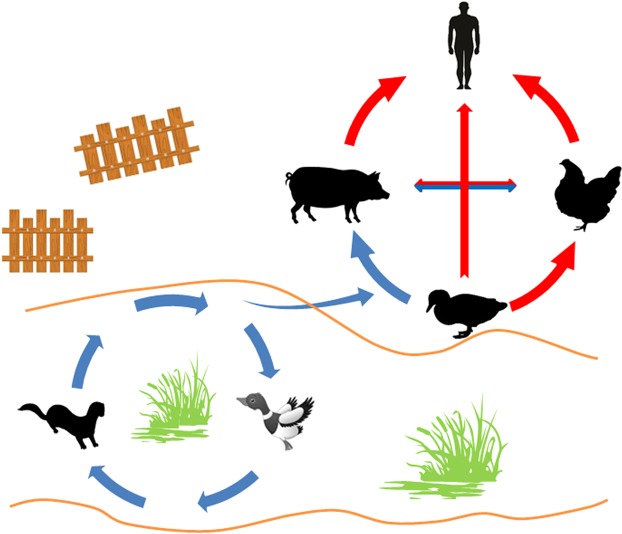
Avian influenza A viruses (AIVs) can occasionally transmit to mammals and lead to the development of human pandemic. A species of mammal is considered as a mixing vessel in the process of host adaptation. So far, pigs are considered as a plausible intermediate host for the generation of human pandemic strains, and are labelled 'mixing vessels'. In this study, through the analysis of two professional databases, the Influenza Virus Resource of NCBI and the Global Initiative on Sharing Avian Influenza Data (GISAID), we found that the species of mink (Neovison vison) can be infected by more subtypes of influenza A viruses with considerably higher α-diversity related indices. It suggested that the semiaquatic mammals (riverside mammals), rather than pigs, might be the intermediate host to spread AIVs and serve as a potential mixing vessel for the interspecies transmission among birds, mammals and human. In epidemic areas, minks, possibly some other semiaquatic mammals as well, could be an important sentinel species for influenza surveillance and early warning.
禽流感病毒(AIVs)偶尔会传播给哺乳动物,并导致人类大流行的发生。哺乳动物被认为是宿主适应过程中的混合容器。到目前为止,猪被认为是产生人类大流行株的合理中间宿主,并被标记为“混合容器”。在这项研究中,通过对两个专业数据库——NCBI 的流感病毒资源和全球分享禽流感数据倡议(GISAID)的分析,我们发现水貂(Neovison vison)可以感染更多亚型的甲型流感病毒,其α多样性相关指数也相当高。这表明半水生哺乳动物(河边哺乳动物),而不是猪,可能是传播 AIVs 的中间宿主,并可能成为鸟类、哺乳动物和人类之间种间传播的潜在混合容器。在疫区,水貂,可能还有其他一些半水生哺乳动物,可能是流感监测和预警的重要哨兵物种。