Afrizal Sandra Hakiem, Hidayanto Achmad Nizar, Handayani Putu Wuri, Budiharsana Meiwita, Eryando Tris
Faculty of Public Health, Universitas Indonesia, Jawa Barat, Indonesia.
Faculty of Computer Science, Universitas Indonesia, Jawa Barat, Indonesia.
Healthc Inform Res. 2019 Jul;25(3):141-152. doi: 10.4258/hir.2019.25.3.141. Epub 2019 Jul 31.
The aim of this study is to explore the enabling factors associated with readiness in Electronic Health Record (EHR) implementation and to identify the barriers related to readiness regarding the situation of primary health cares in developed and developing countries.
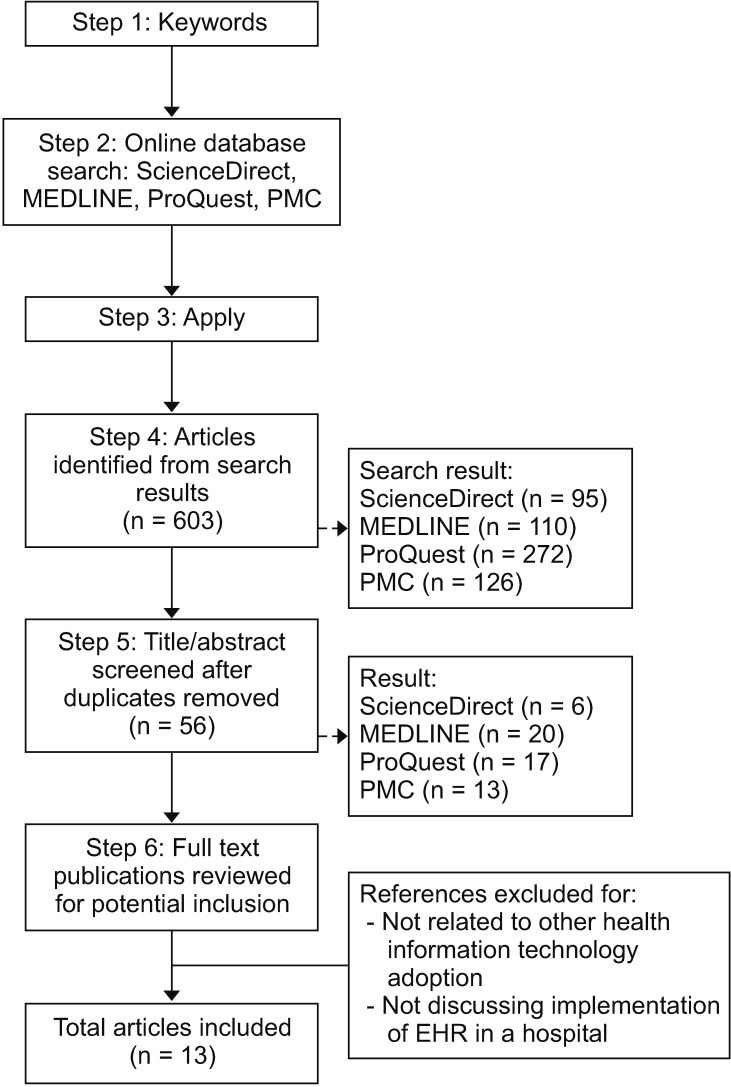
A narrative review of open-source literature was conducted using the ProQuest, ScienceDirect, MEDLINE, and PMC databases to identify the enabling factors and barriers to EHR readiness. The keywords applied were 'electronic health record', 'readiness', 'primary health care', and 'primary care'.
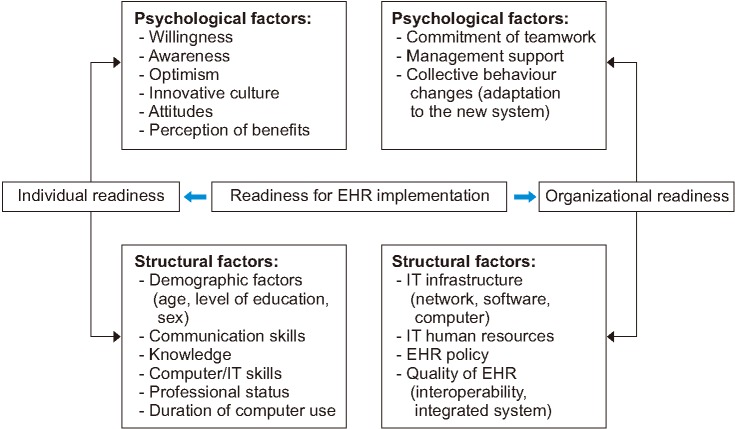
Some barriers were found that may affect readiness, specifically individual barriers and organizational barriers. In developing countries, organizational barriers such as a lack of skilled manpower, insufficient senior management, and a lack of interaction among team members were the common barriers, while in developed countries individual barriers such as unfamiliarity with new systems and a lack of time to use computers were frequently found as barriers to readiness.
This study summarized the enabling factors and barriers with regard to EHR readiness in developed and developing countries.
本研究旨在探讨与电子健康记录(EHR)实施准备情况相关的促进因素,并确定发达国家和发展中国家初级卫生保健状况下与准备情况相关的障碍。
使用ProQuest、ScienceDirect、MEDLINE和PMC数据库对开源文献进行叙述性综述,以确定EHR准备情况的促进因素和障碍。应用的关键词为“电子健康记录”、“准备情况”、“初级卫生保健”和“初级保健”。
发现了一些可能影响准备情况的障碍,特别是个人障碍和组织障碍。在发展中国家,常见障碍包括缺乏技术熟练的人力、高级管理层不足以及团队成员之间缺乏互动等组织障碍,而在发达国家,个人障碍如对新系统不熟悉和缺乏使用计算机的时间等经常被发现是准备情况的障碍。
本研究总结了发达国家和发展中国家在EHR准备情况方面的促进因素和障碍。