Kholifah Siti Nur, Yumni Hilmi, Susanto Tantut
Polytechnic of Health Sciences of Ministry of Health of Surabaya, Surabaya, Indonesia.
Department of Family and Community Health Nursing, School of Nursing, University of Jember, Jember, Indonesia.
Int J Nurs Sci. 2017 Oct 12;4(4):367-373. doi: 10.1016/j.ijnss.2017.10.001. eCollection 2017 Oct 10.
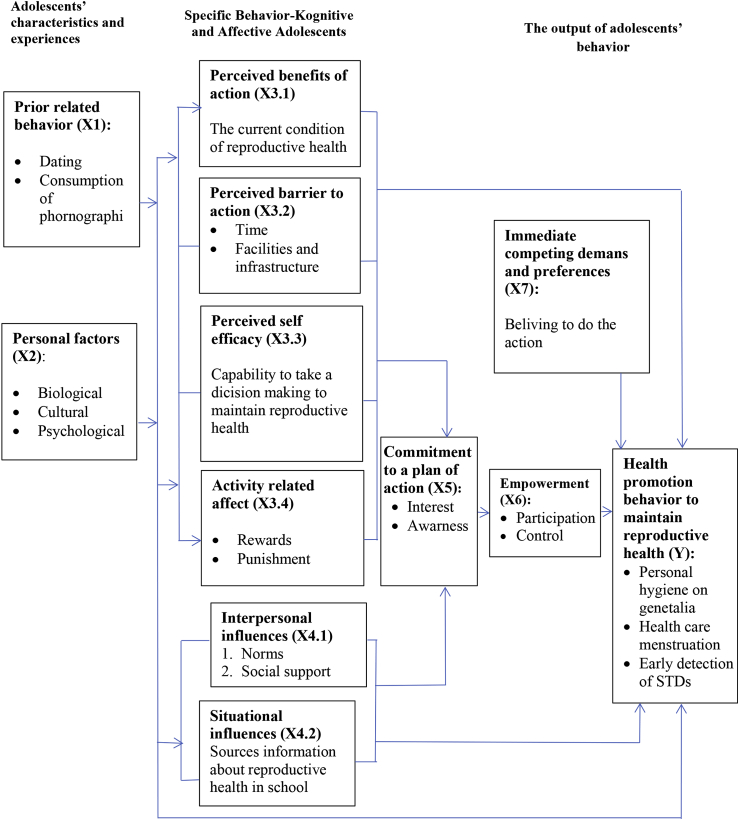
We aim to explore the factors related to the health promotion behavior of reproductive health (RH) among Indonesian adolescents via structural equation modeling.
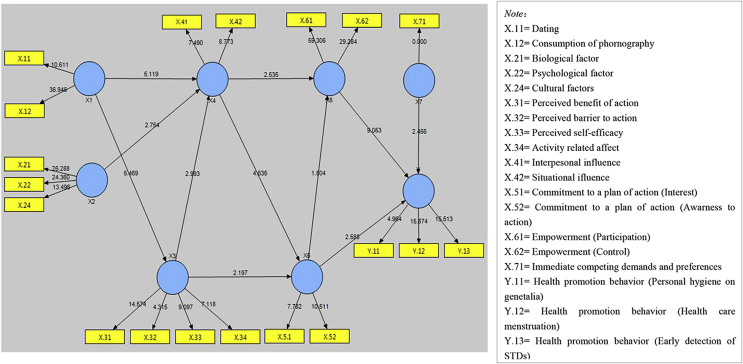
A cross-sectional quantitative study was used to measure 108 adolescents aged 12-16 years. We employed a self-administered questionnaire developed from the health promotion model (HPM) and the empowerment model (EM) on the basis of self-efficacy to determine the factors related to health promotion in maintaining RH behavior. Structural equation modeling (SEM) was used to examine relationships among the variables. The Analysis of Moment Structures (AMOS) approach was used to evaluate if the proposed model is suitable for the data based on goodness-of-fit indices.
The model is appropriate for the data. Three interrelationships emerge among independent variables ( > 0.05), namely, personal and cognitive behaviors ( = -0.01), cognitive and health promotion behaviors ( = 0.09), and affective and health promotion behaviors ( = -0.17). The strongest relationship is between empowerment and health promotion behavior ( = 0.72). Affection (interpersonal and situational influences), immediate competing demands and preferences, and empowerment (participation and control) are directly related to RH behavior maintenance. Meanwhile, willingness of adolescents, prior related behavior, personal factor, and commitment to a plan of action are indirectly related to RH behavior maintenance. The model explains 43.9% of the variance in maintaining RH behavior.
The HPM and EM models help determine the factors related to RH behavior maintenance among adolescents. Intervention to promote RH among Indonesian adolescents should begin from the level of child-parent-health care professional encounter for empowering the RH of adolescents.
我们旨在通过结构方程模型探讨印度尼西亚青少年生殖健康(RH)促进行为的相关因素。
采用横断面定量研究方法,对108名12至16岁的青少年进行测量。我们使用了基于自我效能感从健康促进模型(HPM)和赋权模型(EM)开发的自填式问卷,以确定维持生殖健康行为中与健康促进相关的因素。采用结构方程模型(SEM)检验变量之间的关系。运用矩结构分析(AMOS)方法,根据拟合优度指标评估所提出的模型是否适用于数据。
该模型适用于这些数据。自变量之间出现了三种相互关系(>0.05),即个人与认知行为(=-0.01)、认知与健康促进行为(=0.09)以及情感与健康促进行为(=-0.17)。最强的关系是赋权与健康促进行为之间的关系(=0.72)。情感(人际和情境影响)、直接的竞争需求和偏好以及赋权(参与和控制)与生殖健康行为维持直接相关。同时,青少年的意愿、先前的相关行为、个人因素以及对行动计划的承诺与生殖健康行为维持间接相关。该模型解释了维持生殖健康行为中43.9%的方差。
HPM和EM模型有助于确定青少年生殖健康行为维持的相关因素。促进印度尼西亚青少年生殖健康的干预应从儿童-父母-医疗保健专业人员接触层面开始,以增强青少年的生殖健康。