Nursalam Nursalam, Fibriansari Rizeki Dwi, Yuwono Slamet Riyadi, Hadi Muhammad, Efendi Ferry, Bushy Angeline
Faculty of Nursing, Universitas Airlangga, Surabaya, Indonesia.
Polytechnic of Health of Surabaya, Ministry of Health, Indonesia.
Int J Nurs Sci. 2018 May 26;5(4):390-395. doi: 10.1016/j.ijnss.2018.05.001. eCollection 2018 Oct 10.
This study aimed to develop an empowerment model for burnout syndrome and quality of nursing work life (QNWL).
This study adopted a mixed-method cross-sectional approach. The variables included structural empowerment, psychological empowerment, burnout syndrome and QNWL. The population consisted of nurses who have civil servant status in one of the regional hospitals in Indonesia. The participants were recruited using multi-stage sampling measures with 134 respondents. Data were collected using questionnaires, which were then analysed using partial least squares. A focus group discussion was conducted with nurses, chief nurses and the hospital management to identify strategic issues and compile recommendations.
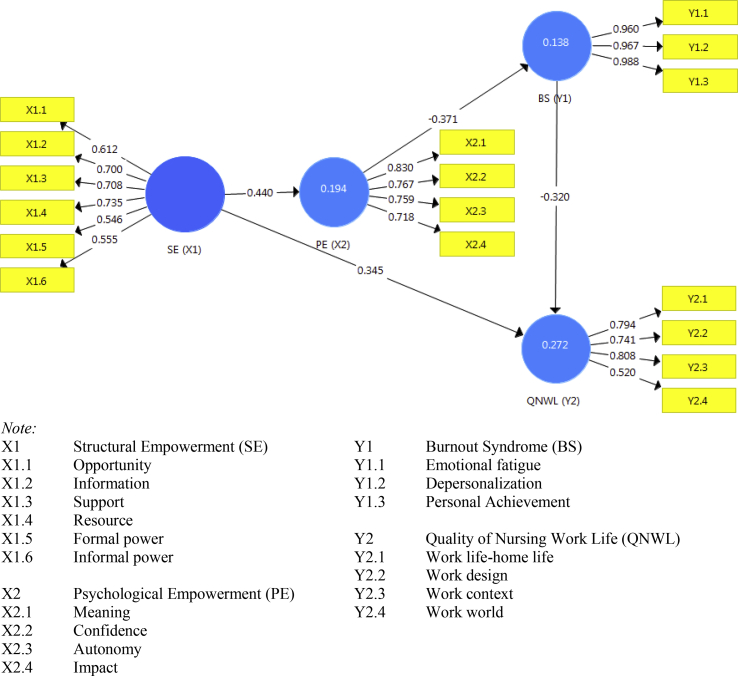
Structural empowerment influenced psychological empowerment (path coefficient = 0.440; = 6.222) and QNWL (path coefficient = 0.345; = 4.789). Psychological empowerment influenced burnout syndrome (path coefficient = -0.371; = 4.303), and burnout syndrome influenced QNWL (path coefficient = -0.320; = 5.102). Structural empowerment increased QNWL by 39.7%.
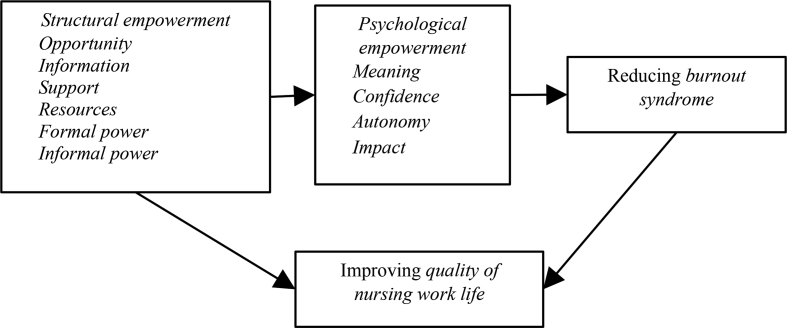
The development of a structural empowerment model by using the indicators of resources, support and information directly influenced the psychological empowerment of the sample of nurses. As an indicator of meaning, psychological empowerment decreased burnout syndrome. In turn, burnout syndrome, as the indicator of personal achievement, could affect the QNWL. Structural empowerment directly influenced the QNWL, particularly within the workplace context. Further studies must be conducted to analyse the effects of empowerment, leadership styles and customer satisfaction.
本研究旨在开发一种针对职业倦怠综合征和护理工作生活质量(QNWL)的赋权模型。
本研究采用混合方法横断面研究方法。变量包括结构赋权、心理赋权、职业倦怠综合征和护理工作生活质量。研究对象为印度尼西亚某地区医院具有公务员身份的护士。采用多阶段抽样方法招募了134名受访者。通过问卷调查收集数据,然后使用偏最小二乘法进行分析。与护士、护士长和医院管理层进行了焦点小组讨论,以确定战略问题并汇编建议。
结构赋权影响心理赋权(路径系数=0.440;t=6.222)和护理工作生活质量(路径系数=0.345;t=4.789)。心理赋权影响职业倦怠综合征(路径系数=-0.371;t=4.303),职业倦怠综合征影响护理工作生活质量(路径系数=-0.320;t=5.102)。结构赋权使护理工作生活质量提高了39.7%。
利用资源、支持和信息指标开发的结构赋权模型直接影响了护士样本的心理赋权。作为意义指标,心理赋权降低了职业倦怠综合征。反过来,作为个人成就指标的职业倦怠综合征会影响护理工作生活质量。结构赋权直接影响护理工作生活质量,特别是在工作场所背景下。必须进行进一步研究以分析赋权、领导风格和客户满意度的影响。