Department of Physiotherapy, College of Medicine, University of Ibadan, Ibadan, Nigeria.
Department of Physiotherapy, Federal Medical Centre, Abeokuta, Nigeria.
Sci Rep. 2023 May 15;13(1):7830. doi: 10.1038/s41598-022-25057-w.
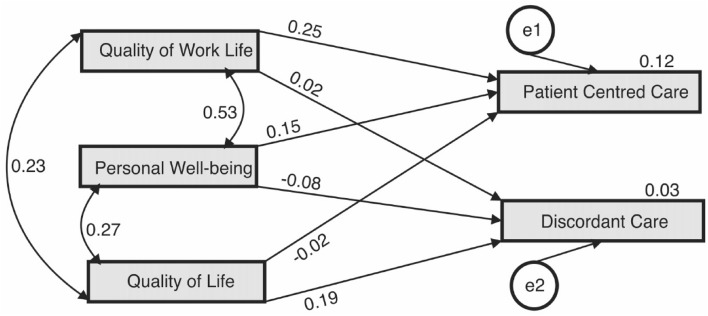
The Nigerian healthcare industry is bedevilled with infrastructural dilapidations and a dysfunctional healthcare system. This study investigated the influence of healthcare professionals' well-being and quality of work-life (QoWL) on the quality of care (QoC) of patients in Nigeria. A multicentre cross-sectional study was conducted at four tertiary healthcare institutions in southwest, Nigeria. Participants' demographic information, well-being, quality of life (QoL), QoWL, and QoC were obtained using four standardised questionnaires. Data were summarised using descriptive statistics. Inferential statistics included Chi-square, Pearson's correlation, independent samples t-test, confirmatory factor analyses and structural equation model. Medical practitioners (n = 609) and nurses (n = 570) constituted 74.6% of all the healthcare professionals with physiotherapists, pharmacists, and medical laboratory scientists constituting 25.4%. The mean (SD) participants' well-being = 71.65% (14.65), QoL = 61.8% (21.31), QoWL = 65.73% (10.52) and QoC = 70.14% (12.77). Participants' QoL had a significant negative correlation with QoC while well-being and quality of work-life had a significant positive correlation with QoC. We concluded that healthcare professionals' well-being and QoWL are important factors that influence the QoC rendered to patients. Healthcare policymakers in Nigeria should ensure improved work-related factors and the well-being of healthcare professionals to ensure good QoC for patients.
尼日利亚的医疗保健行业存在基础设施破旧和医疗体系功能失调等问题。本研究调查了医疗保健专业人员的幸福感和工作生活质量(QoWL)对尼日利亚患者护理质量(QoC)的影响。在尼日利亚西南部的四家三级医疗机构进行了一项多中心横断面研究。使用四个标准化问卷获取参与者的人口统计学信息、幸福感、生活质量(QoL)、QoWL 和 QoC。使用描述性统计对数据进行总结。推断性统计包括卡方检验、皮尔逊相关、独立样本 t 检验、验证性因子分析和结构方程模型。医生(n=609)和护士(n=570)构成了所有医疗保健专业人员的 74.6%,物理治疗师、药剂师和医学实验室科学家构成了 25.4%。参与者的幸福感平均(SD)为 71.65%(14.65),生活质量为 61.8%(21.31),工作生活质量为 65.73%(10.52),护理质量为 70.14%(12.77)。参与者的生活质量与护理质量呈显著负相关,而幸福感和工作生活质量与护理质量呈显著正相关。我们得出结论,医疗保健专业人员的幸福感和工作生活质量是影响向患者提供护理质量的重要因素。尼日利亚的医疗保健政策制定者应确保改善与工作相关的因素和医疗保健专业人员的幸福感,以确保为患者提供良好的护理质量。