Yun Jae Won, Lee Sejoon, Kim Hye Mi, Chun Sejong, Engleman Edgar G, Kim Hee Cheol, Kang Eun-Suk
Department of Laboratory Medicine & Genetics, Samsung Medical Center, Sungkyunkwan University School of Medicine, Seoul 06351, Korea.
Samsung Advanced Institute of Health Science and Technology, Sungkyunkwan University, Seoul 06351, Korea.
Cancers (Basel). 2019 Aug 12;11(8):1157. doi: 10.3390/cancers11081157.
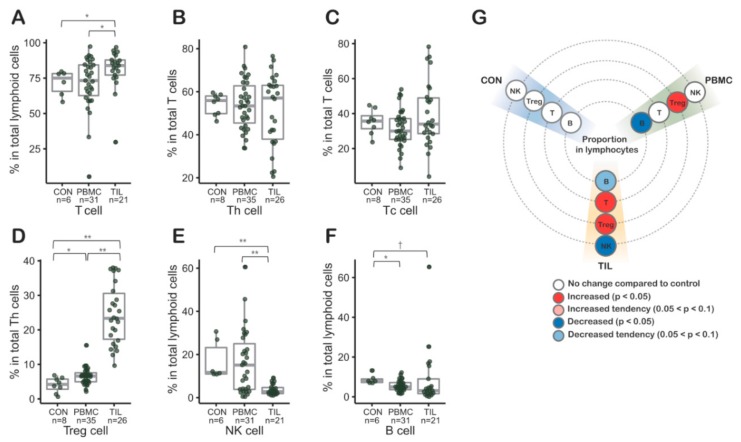
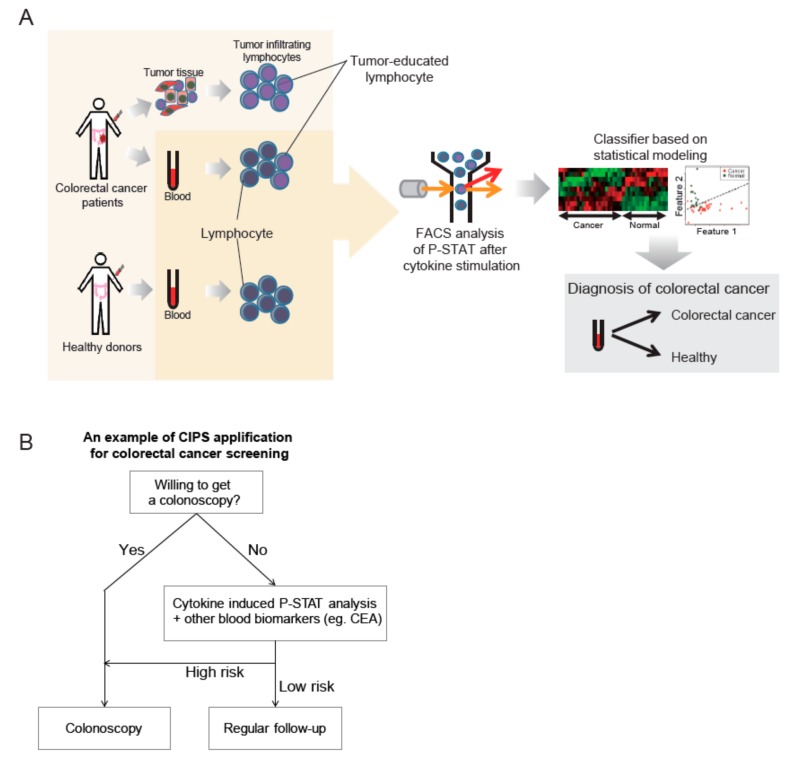
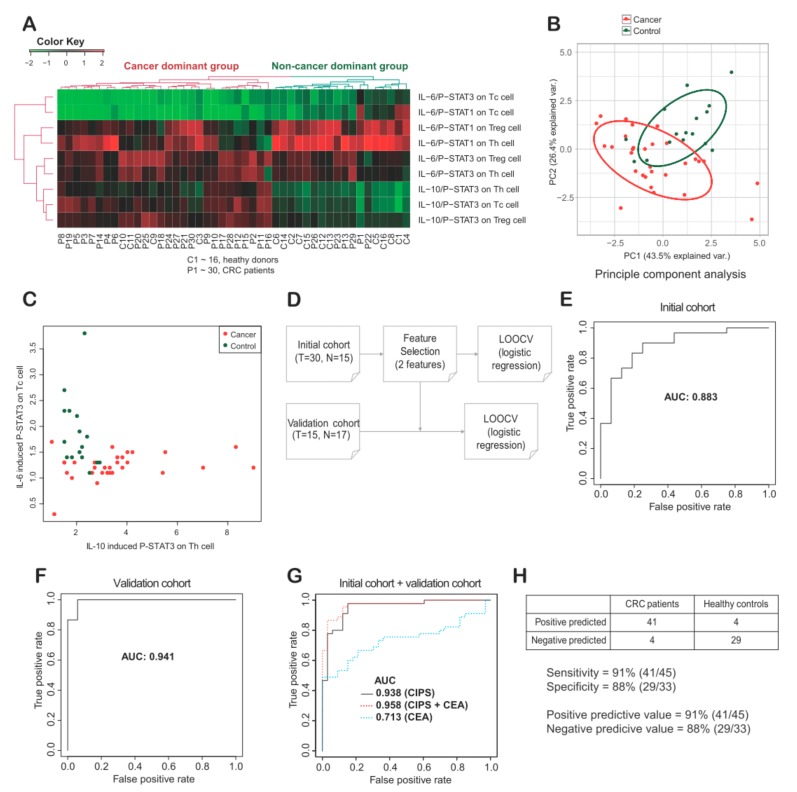
: Colorectal cancer (CRC) is one of the leading causes of cancer-related deaths worldwide. Although early diagnosis and treatment is the most successful strategy for improving patient survival, feasible and sensitive blood biomarkers for CRC screening remain elusive. : Sixty-five CRC patients and thirty-three healthy individuals were enrolled. Peripheral blood (PB) and tumor tissues from CRC patients, and PB from healthy individuals were subjected to immunophenotyping and phospho-flow analysis of cytokine-induced phosphorylated STAT (CIPS). Logistic regression was used as a classifier that separates CRC patients from healthy individuals. : The proportion of regulatory T cells was increased in PB from CRC patients compared to PB from healthy individuals ( < 0.05). Interestingly, peripheral T cells share several cytokine-induced phosphorylated STAT (CIPS) signatures with T cells from CRC tumor-sites. Additionally, a classifier was made using two signatures distinct between T cells from CRC patients and T cells from healthy individuals. The AUCs (area under curves) of the classifier were 0.88 in initial cohort and 0.94 in the additional validation cohort. Overall AUC was 0.94 with sensitivity of 91% and specificity of 88%. : This study highlights that immune cell signatures in peripheral blood could offer a new type of biomarker for CRC screening.
结直肠癌(CRC)是全球癌症相关死亡的主要原因之一。尽管早期诊断和治疗是提高患者生存率最成功的策略,但用于CRC筛查的可行且敏感的血液生物标志物仍然难以捉摸。
招募了65例CRC患者和33名健康个体。对CRC患者的外周血(PB)和肿瘤组织以及健康个体的PB进行细胞因子诱导的磷酸化STAT(CIPS)的免疫表型分析和磷酸化流式分析。使用逻辑回归作为区分CRC患者和健康个体的分类器。
与健康个体的PB相比,CRC患者PB中调节性T细胞的比例增加(<0.05)。有趣的是,外周T细胞与CRC肿瘤部位的T细胞具有几种细胞因子诱导的磷酸化STAT(CIPS)特征。此外,使用CRC患者的T细胞与健康个体的T细胞之间不同的两个特征制作了一个分类器。该分类器在初始队列中的曲线下面积(AUC)为0.88,在额外验证队列中为0.94。总体AUC为0.94,敏感性为91%,特异性为88%。
这项研究强调外周血中的免疫细胞特征可为CRC筛查提供一种新型生物标志物。