School of GeoSciences, University of Edinburgh, Edinburgh, EH9 3FF, UK.
National Centre for Earth Observation at the University of Edinburgh, Edinburgh, EH9 3FF, UK.
Nat Commun. 2019 Aug 13;10(1):3344. doi: 10.1038/s41467-019-11097-w.
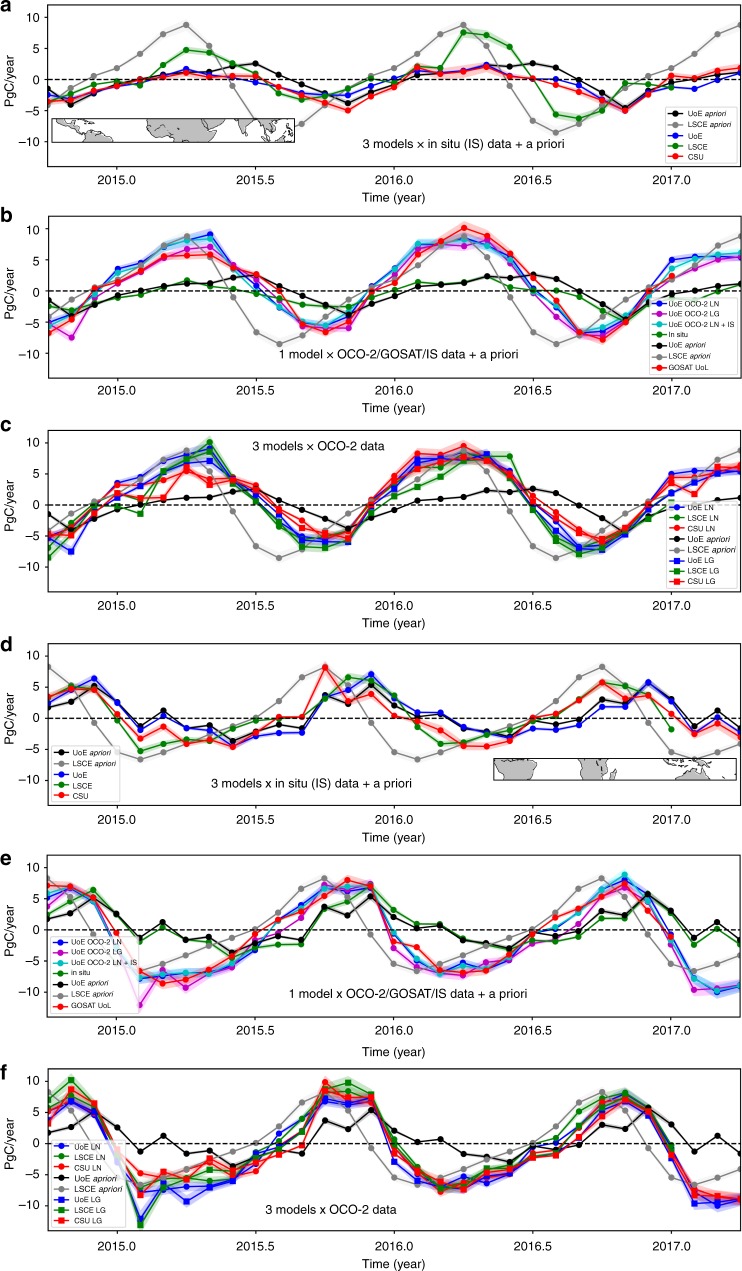
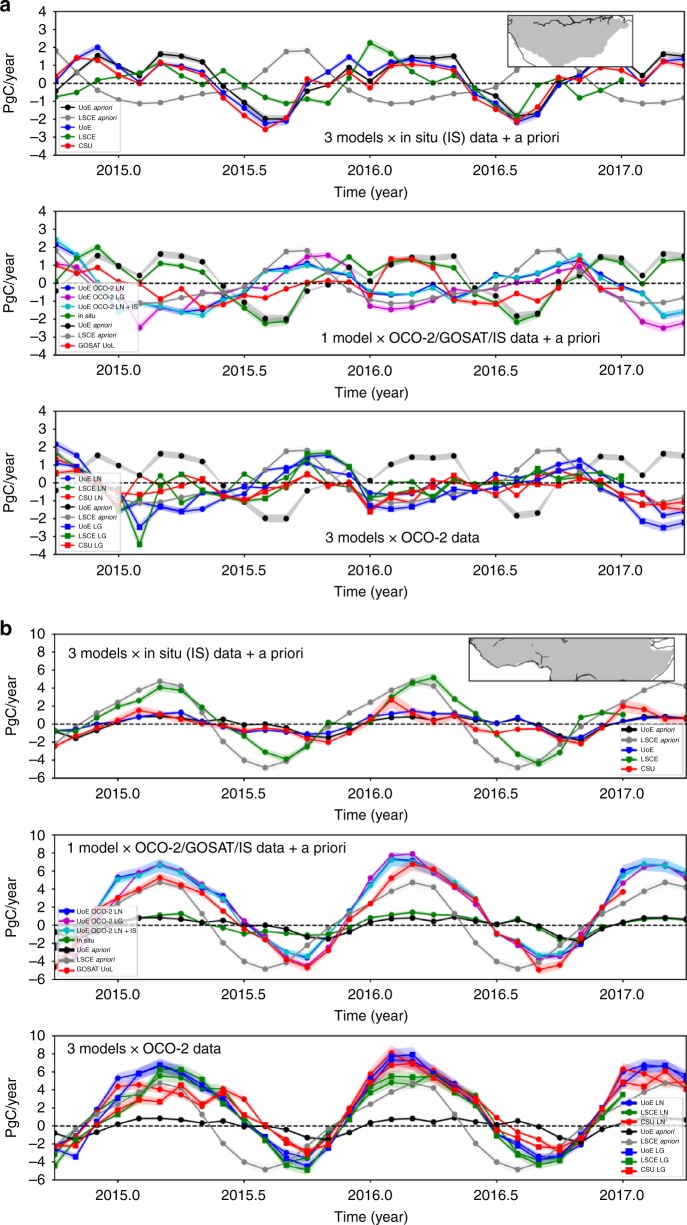
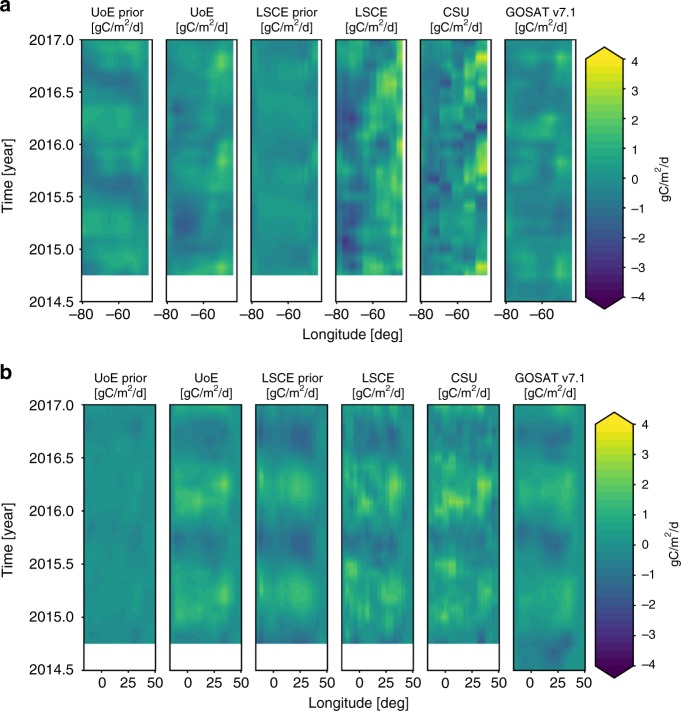
Tropical ecosystems are large carbon stores that are vulnerable to climate change. The sparseness of ground-based measurements has precluded verification of these ecosystems being a net annual source (+ve) or sink (-ve) of atmospheric carbon. We show that two independent satellite data sets of atmospheric carbon dioxide (CO), interpreted using independent models, are consistent with the land tropics being a net annual carbon emission of [Formula: see text] [Formula: see text] and [Formula: see text] petagrams (PgC) in 2015 and 2016, respectively. These pan-tropical estimates reflect unexpectedly large net emissions from tropical Africa of [Formula: see text] PgC in 2015 and [Formula: see text] PgC in 2016. The largest carbon uptake is over the Congo basin, and the two loci of carbon emissions are over western Ethiopia and western tropical Africa, where there are large soil organic carbon stores and where there has been substantial land use change. These signals are present in the space-borne CO record from 2009 onwards.
热带生态系统是大型碳储存库,容易受到气候变化的影响。由于地面测量数据稀疏,这些生态系统是大气碳的净年源(+ve)还是汇(-ve)一直无法得到验证。我们表明,使用独立模型解释的两份独立的二氧化碳(CO)卫星数据集与以下事实一致:陆地热带地区在 2015 年和 2016 年分别以每年[Formula: see text] [Formula: see text]和[Formula: see text] 百万吨碳(PgC)的净排放量为大气碳的净排放源。这些泛热带估计反映了热带非洲在 2015 年和 2016 年分别出现了令人意外的大量净碳排放,分别为[Formula: see text] PgC 和[Formula: see text] PgC。最大的碳吸收量发生在刚果盆地,两个碳排放地点位于埃塞俄比亚西部和热带西部非洲,那里有大量的土壤有机碳储存,而且土地利用发生了重大变化。这些信号存在于 2009 年以来的卫星 CO 记录中。