Küçük Çağlar, Koirala Sujan, Carvalhais Nuno, Miralles Diego G, Reichstein Markus, Jung Martin
Department of Biogeochemical Integration Max Planck Institute for Biogeochemistry Jena Germany.
Hydro-Climate Extremes Lab (H-CEL) Faculty of Bioscience Engineering Ghent University Ghent Belgium.
J Adv Model Earth Syst. 2022 Mar;14(3):e2021MS002730. doi: 10.1029/2021MS002730. Epub 2022 Feb 28.
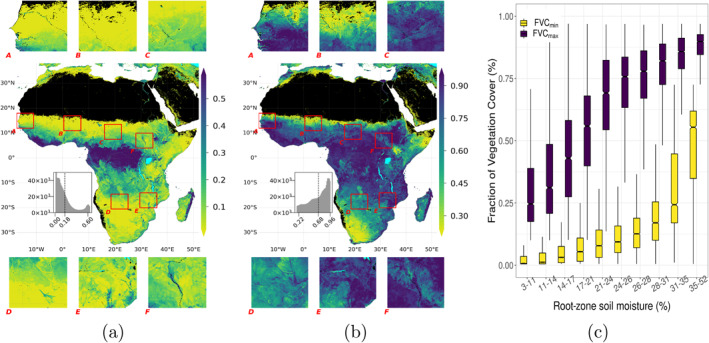
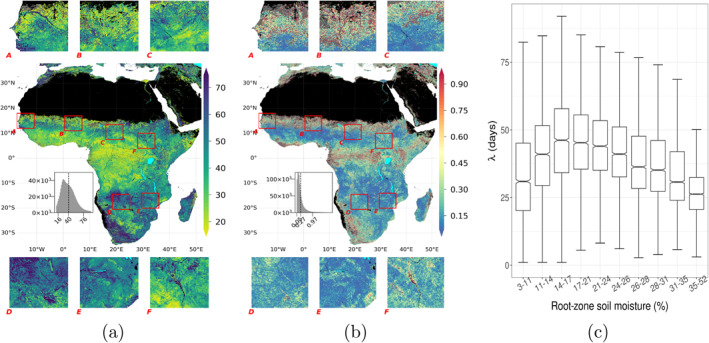
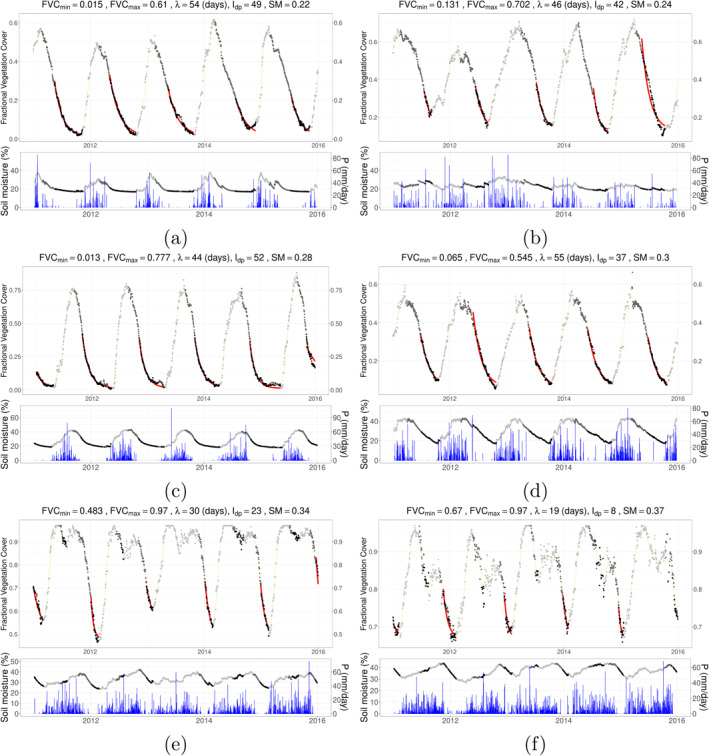
Hydrological interactions between vegetation, soil, and topography are complex, and heterogeneous in semi-arid landscapes. This along with data scarcity poses challenges for large-scale modeling of vegetation-water interactions. Here, we exploit metrics derived from daily Meteosat data over Africa at ca. 5 km spatial resolution for ecohydrological analysis. Their spatial patterns are based on Fractional Vegetation Cover (FVC) time series and emphasize limiting conditions of the seasonal wet to dry transition: the minimum and maximum FVC of temporal record, the FVC decay rate and the FVC integral over the decay period. We investigate the relevance of these metrics for large scale ecohydrological studies by assessing their co-variation with soil moisture, and with topographic, soil, and vegetation factors. Consistent with our initial hypothesis, FVC minimum and maximum increase with soil moisture, while the FVC integral and decay rate peak at intermediate soil moisture. We find evidence for the relevance of topographic moisture variations in arid regions, which, counter-intuitively, is detectable in the maximum but not in the minimum FVC. We find no clear evidence for wide-spread occurrence of the "inverse texture effect" on FVC. The FVC integral over the decay period correlates with independent data sets of plant water storage capacity or rooting depth while correlations increase with aridity. In arid regions, the FVC decay rate decreases with canopy height and tree cover fraction as expected for ecosystems with a more conservative water-use strategy. Thus, our observation-based products have large potential for better understanding complex vegetation-water interactions from regional to continental scales.
植被、土壤和地形之间的水文相互作用复杂,且在半干旱地区呈非均一性。这一情况以及数据稀缺给植被 - 水相互作用的大规模建模带来了挑战。在此,我们利用从非洲约5公里空间分辨率的每日气象卫星数据中得出的指标进行生态水文分析。它们的空间格局基于植被覆盖分数(FVC)时间序列,并强调了从季节性湿润到干燥过渡的限制条件:时间记录中的FVC最小值和最大值、FVC衰减率以及衰减期内的FVC积分。我们通过评估这些指标与土壤湿度以及地形、土壤和植被因子的协变关系,来研究它们在大规模生态水文研究中的相关性。与我们最初的假设一致,FVC最小值和最大值随土壤湿度增加,而FVC积分和衰减率在中等土壤湿度时达到峰值。我们发现干旱地区地形湿度变化具有相关性的证据,这与直觉相反,在FVC最大值中可检测到,而在最小值中未检测到。我们没有找到关于FVC广泛存在“反质地效应”的明确证据。衰减期内的FVC积分与植物储水能力或生根深度的独立数据集相关,且相关性随干旱程度增加。在干旱地区,正如具有更保守用水策略的生态系统所预期的那样,FVC衰减率随冠层高度和树木覆盖分数降低。因此,我们基于观测的产品在更好地理解从区域到大陆尺度的复杂植被 - 水相互作用方面具有巨大潜力。