Pedrosa Leire, Esposito Francis, Thomson Timothy M, Maurel Joan
Department of Medical Oncology, Hospital Clinic of Barcelona, 08036 Barcelona, Spain.
Translational Genomics and Targeted Therapeutics in Solid Tumors Group, Institut d'Investigació Biomèdica August Pi i Sunyer (IDIBAPS), 08036 Barcelona, Spain.
Cancers (Basel). 2019 Aug 14;11(8):1172. doi: 10.3390/cancers11081172.
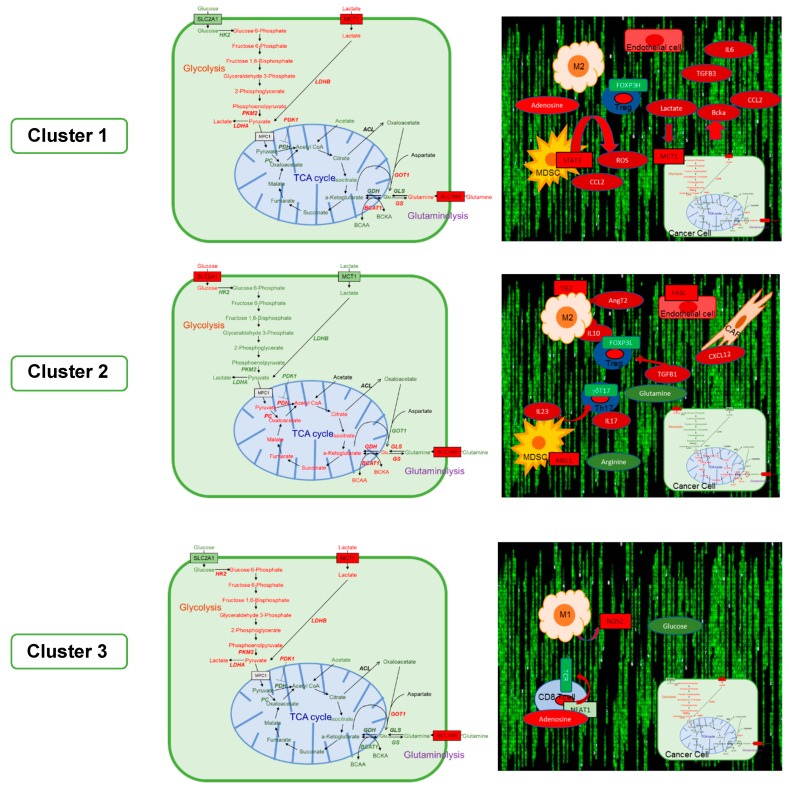
The current standard-of-care for metastatic colorectal cancer (mCRC) includes chemotherapy and anti-angiogenic or anti-epidermal growth factor receptor (EGFR) monoclonal antibodies, even though the addition of anti-angiogenic agents to backbone chemotherapy provides little benefit for overall survival. Since the approval of anti-angiogenic monoclonal antibodies bevacizumab and aflibercept, for the management of mCRC over a decade ago, extensive efforts have been devoted to discovering predictive factors of the anti-angiogenic response, unsuccessfully. Recent evidence has suggested a potential correlation between angiogenesis and immune phenotypes associated with colorectal cancer. Here, we review evidence of interactions between tumor angiogenesis, the immune microenvironment, and metabolic reprogramming. More specifically, we will highlight such interactions as inferred from our novel immune-metabolic (IM) signature, which groups mCRC into three distinct clusters, namely inflamed-stromal-dependent (IM Cluster 1), inflamed-non stromal-dependent (IM Cluster 2), and non-inflamed or cold (IM Cluster 3), and discuss the merits of the IM classification as a guide to new immune-metabolic combinatorial therapeutic strategies in mCRC.
转移性结直肠癌(mCRC)目前的标准治疗方案包括化疗以及抗血管生成或抗表皮生长因子受体(EGFR)单克隆抗体,尽管在基础化疗中添加抗血管生成药物对总生存期几乎没有益处。自十多年前抗血管生成单克隆抗体贝伐单抗和阿柏西普获批用于治疗mCRC以来,人们一直在广泛努力寻找抗血管生成反应的预测因素,但未获成功。最近的证据表明,血管生成与结直肠癌相关的免疫表型之间可能存在关联。在此,我们综述肿瘤血管生成、免疫微环境和代谢重编程之间相互作用的证据。更具体地说,我们将重点介绍从我们新的免疫代谢(IM)特征推断出的此类相互作用,该特征将mCRC分为三个不同的簇,即炎症基质依赖型(IM簇1)、炎症非基质依赖型(IM簇2)和非炎症或冷型(IM簇3),并讨论IM分类作为mCRC新免疫代谢联合治疗策略指南的优点。