Czechowski Tomasz, Rinaldi Mauro A, Famodimu Mufuliat Toyin, Van Veelen Maria, Larson Tony R, Winzer Thilo, Rathbone Deborah A, Harvey David, Horrocks Paul, Graham Ian A
Centre for Novel Agricultural Products, Department of Biology, University of York, York, United Kingdom.
Institute for Science and Technology in Medicine, Keele University, Keele, United Kingdom.
Front Plant Sci. 2019 Jul 30;10:984. doi: 10.3389/fpls.2019.00984. eCollection 2019.
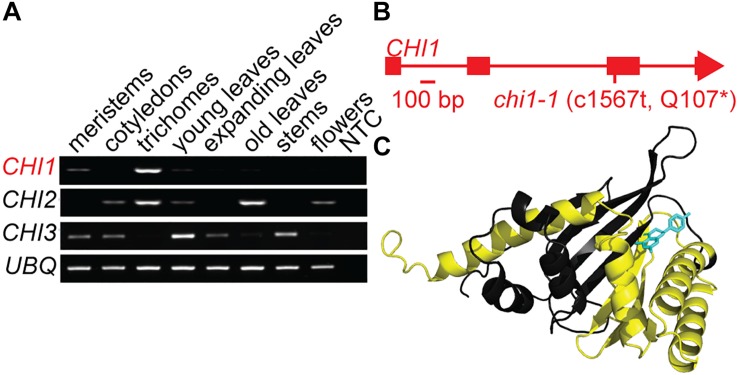
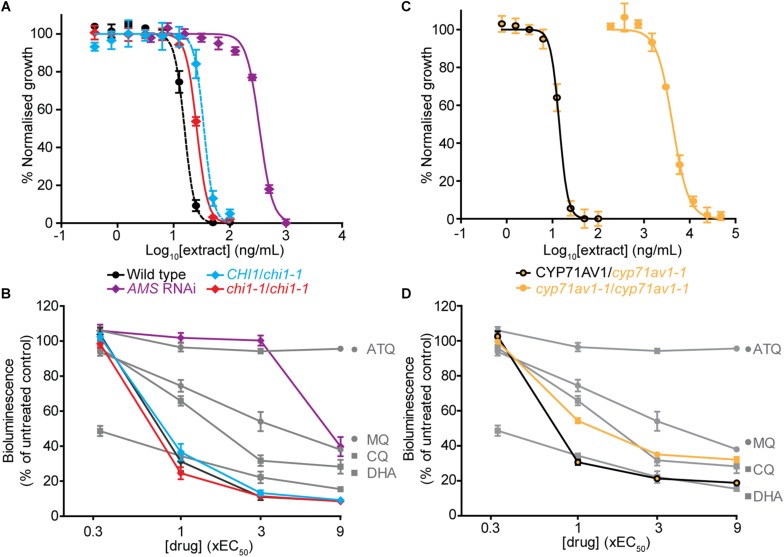
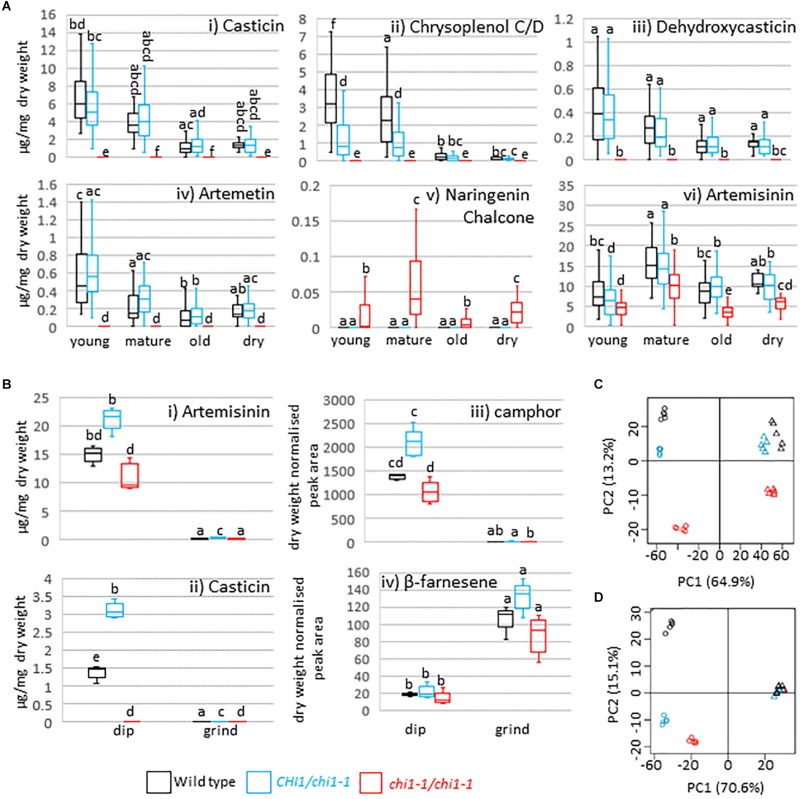
Artemisinin, a sesquiterpene lactone produced by glandular secretory trichomes, is the active ingredient in the most effective treatment for uncomplicated malaria caused by parasites. Other metabolites in or related species, particularly flavonoids, have been proposed to either act as antimalarials on their own or act synergistically with artemisinin to enhance antimalarial activity. We identified a mutation that disrupts the CHALCONE ISOMERASE 1 (CHI1) enzyme that is responsible for the second committed step of flavonoid biosynthesis. Detailed metabolite profiling revealed that lacks all major flavonoids but produces wild-type artemisinin levels, making this mutant a useful tool to test the antiplasmodial effects of flavonoids. We used whole-leaf extracts from and mutant lines impaired in artemisinin production in bioactivity assays against intraerythrocytic Dd2. We found that extracts did not differ from wild-type extracts in antiplasmodial efficacy nor initial rate of cytocidal action. Furthermore, extracts from the mutant and RNAi lines impaired in amorpha-4,11-diene synthase gene expression, which are both severely compromised in artemisinin biosynthesis but unaffected in flavonoid metabolism, showed very low or no antiplasmodial activity. These results demonstrate that bioactivity against of flavonoids is negligible when compared to that of artemisinin.
青蒿素是一种由腺毛分泌产生的倍半萜内酯,是治疗由寄生虫引起的非复杂性疟疾最有效的药物中的活性成分。青蒿或相关物种中的其他代谢产物,特别是黄酮类化合物,被认为要么自身具有抗疟作用,要么与青蒿素协同作用以增强抗疟活性。我们鉴定出一种突变,该突变破坏了查尔酮异构酶1(CHI1),该酶负责黄酮类生物合成的第二步关键反应。详细的代谢物谱分析表明,该突变体缺乏所有主要黄酮类化合物,但青蒿素水平与野生型相同,这使得该突变体成为测试黄酮类化合物抗疟效果的有用工具。我们使用青蒿和青蒿素产量受损的突变体系的全叶提取物,对红细胞内的恶性疟原虫Dd2进行生物活性测定。我们发现,青蒿提取物在抗疟效果和杀细胞作用的初始速率方面与野生型提取物没有差异。此外,在紫穗槐-4,11-二烯合酶基因表达受损的突变体和RNA干扰系的提取物,在青蒿素生物合成中严重受损但黄酮类代谢未受影响,显示出极低的抗疟活性或无抗疟活性。这些结果表明,与青蒿素相比,黄酮类化合物对恶性疟原虫的生物活性可忽略不计。