Esposito Valentine R, Dial Brian L, Fitch Robert D, Lark Robert K
Duke University School of Medicine, Durham, NC, USA.
Department of Orthopedic Surgery, Duke University Medical Center, Durham, NC, USA.
Asian Spine J. 2019 Dec;13(6):1010-1016. doi: 10.31616/asj.2019.0001. Epub 2019 Aug 20.
Retrospective study.
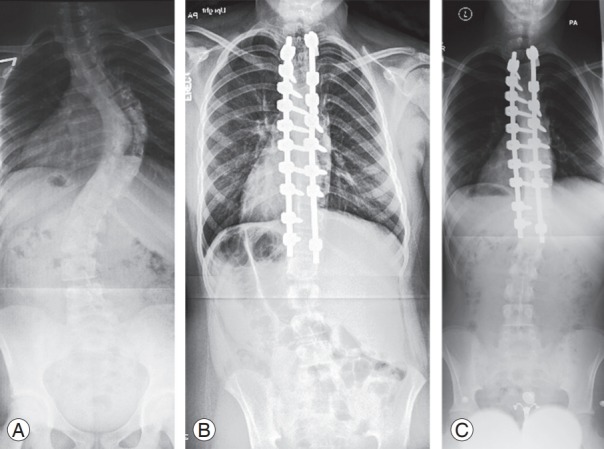
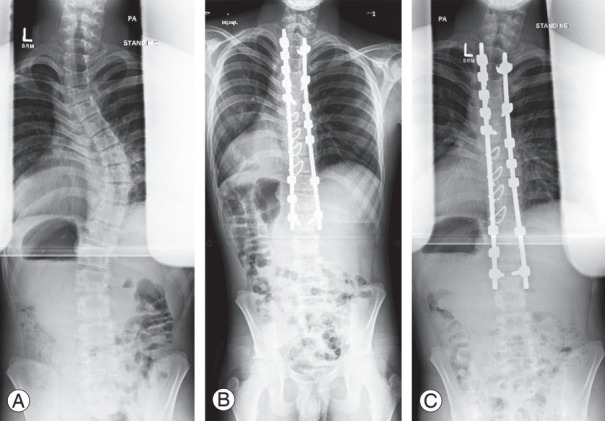
The objective of this study was to compare percent correction between apical and periapical pedicle screw (PS) and sublaminar wire constructs for Cobb correction and coronal balance correction.
The current gold standard for deformity correction in adolescent idiopathic scoliosis (AIS) are PS constructs. Sublaminar wires provide an alternative means of fixation when PS fixation cannot be safely performed. Two previous studies have compared percent curve correction between sublaminar wires and PSs, with conflicting conclusions.
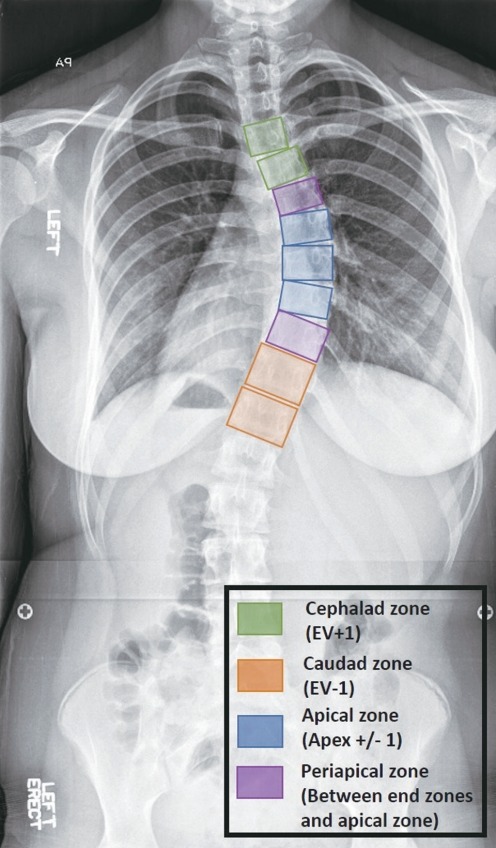
The study was a retrospective review of Lenke type 1 curves with minimum follow-up of at least 1 year. Cases were divided into two groups: constructs using apical/periapical sublaminar wires (SL group) versus PS only constructs (PS group). Percent Cobb correction and coronal balance were compared between the two groups at 1 year. A multivariable regression model was used to determine the impact of apical/periapical wires on percent Cobb correction and coronal balance at 1 year when accounting for additional variables.
The cohort included 71 patients who were predominantly female (80.2%), with average age of 14.2 years. Only 21 (29.5%) of constructs utilized apical/periapical sublaminar wires. There was a significant difference in percent Cobb correction at 1 year for the PS and SL groups (70.26% vs. 60.09%, p=0.05). No difference was observed in overall coronal balance. A multivariable model revealed that apical/periapical wires were negatively associated with percent Cobb correction at 1 year (coefficient=-8.49, p=0.023), while total implant density of the construct was positively associated with correction (coefficient=24.2, p<0.001).
Use of PSs in the apical and periapical zones resulted in improved percent Cobb correction at 1 year in patients with AIS Lenke type 1 curves. Sublaminar wires remain a useful surgical option and result in equivalent coronal balance compared to PSs.
回顾性研究。
本研究的目的是比较椎弓根螺钉(PS)的顶椎和根尖椎与椎板下钢丝结构在Cobb角矫正和冠状面平衡矫正方面的矫正百分比。
青少年特发性脊柱侧凸(AIS)畸形矫正的当前金标准是PS结构。当无法安全地进行PS固定时,椎板下钢丝提供了另一种固定方法。此前的两项研究比较了椎板下钢丝和PS之间的曲线矫正百分比,得出了相互矛盾的结论。
该研究是对Lenke 1型曲线进行回顾性分析,最短随访时间至少为1年。病例分为两组:使用顶椎/根尖椎椎板下钢丝的结构(SL组)与仅使用PS的结构(PS组)。比较两组在1年时的Cobb角矫正百分比和冠状面平衡。使用多变量回归模型来确定在考虑其他变量时,顶椎/根尖椎钢丝对1年时Cobb角矫正百分比和冠状面平衡的影响。
该队列包括71例患者,其中大多数为女性(80.2%),平均年龄为14.2岁。仅21例(29.5%)的结构使用了顶椎/根尖椎椎板下钢丝。PS组和SL组在1年时的Cobb角矫正百分比存在显著差异(70.26%对60.09%,p=0.05)。在整体冠状面平衡方面未观察到差异。多变量模型显示,顶椎/根尖椎钢丝与1年时的Cobb角矫正百分比呈负相关(系数=-8.49,p=0.023),而结构的总植入物密度与矫正呈正相关(系数=24.