Department of Veterinary Clinical Sciences, The Ohio State University College of Veterinary Medicine, Columbus, Ohio.
Department of Veterinary Preventive Medicine, The Ohio State University, Columbus, Ohio.
J Vet Intern Med. 2019 Sep;33(5):2133-2137. doi: 10.1111/jvim.15592. Epub 2019 Aug 19.
Urine specific gravity (USG) is an integral part of the urinalysis and a key component of many clinical decisions, and fluctuations in USG have the potential to impact case management.
To determine the intraindividual variability of first morning USG results in healthy dogs.
One hundred three healthy client-owned dogs.
Dogs were deemed healthy based on clinical history and physical examination findings. Repeated USG measurements were performed over the course of 2 weeks. Three urine samples were collected each week for a total of 6 samples per dog. Sample collection was distributed evenly throughout the week. Urine samples were acquired immediately upon waking and before any ingestion of liquids, food, or exertion of physical activity in the dogs. All measurements were made using the same Misco digital refractometer.
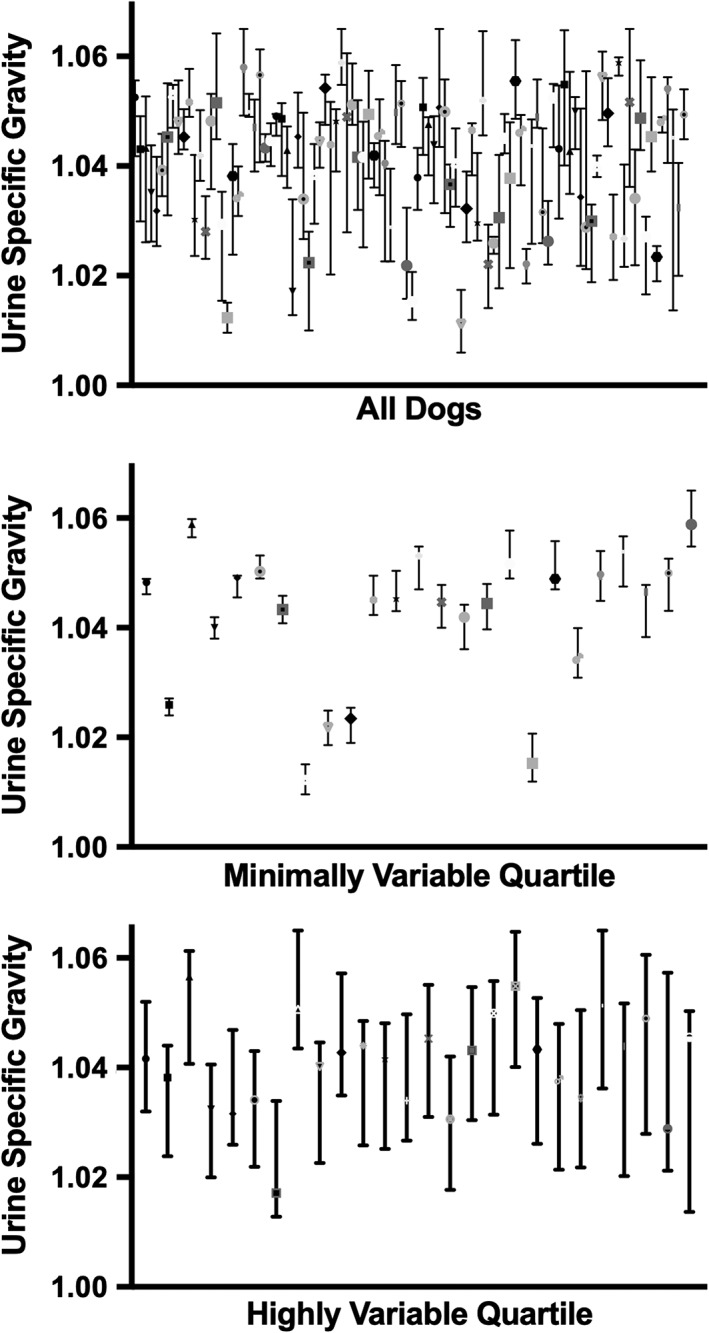
Intraindividual USG was variable over the course of the study. The mean difference between the minimum and maximum USG for each dog was 0.015 (SD, 0.007). The within-week difference between the minimum and maximum USG was less than over the complete 2-week study (0.009 [SD 0.006] for week 1 and 0.010 [SD 0.007] for week 2). The mean coefficient of variance across all 6 time points was 15.4% (SD 8.97%).
Clinically important variation occurs in USG in healthy animals and might impact clinical decision-making when diagnostic cutoff points are utilized. Clinicians should be aware of inherent variability in this clinical variable when analyzing results.
尿比重(USG)是尿液分析的一个组成部分,也是许多临床决策的关键组成部分,USG 的波动有可能影响病例管理。
确定健康犬首次晨尿 USG 结果的个体内可变性。
103 只健康的客户拥有的犬。
根据临床病史和体格检查结果,将犬认定为健康。在 2 周的时间内重复进行 USG 测量。每周采集 3 个尿液样本,每个犬共采集 6 个样本。样本采集在整个星期内均匀分布。在犬醒来后立即采集尿液样本,且在摄入任何液体、食物或进行任何体力活动之前采集。所有测量均使用同一台 Misco 数字折射计进行。
在研究过程中,个体内 USG 存在差异。每只犬的最小和最大 USG 之间的平均差异为 0.015(SD,0.007)。每周的最小和最大 USG 之间的差异小于整个 2 周研究期间的差异(第 1 周为 0.009[SD 0.006],第 2 周为 0.010[SD 0.007])。在所有 6 个时间点上,平均变异系数为 15.4%(SD 8.97%)。
在健康动物中,USG 会出现有临床意义的变化,当使用诊断临界值时,可能会影响临床决策。在分析结果时,临床医生应意识到该临床变量存在固有变异性。