Emerg Infect Dis. 2019 Oct;25(10):1868-1877. doi: 10.3201/eid2510.190051. Epub 2019 Oct 17.
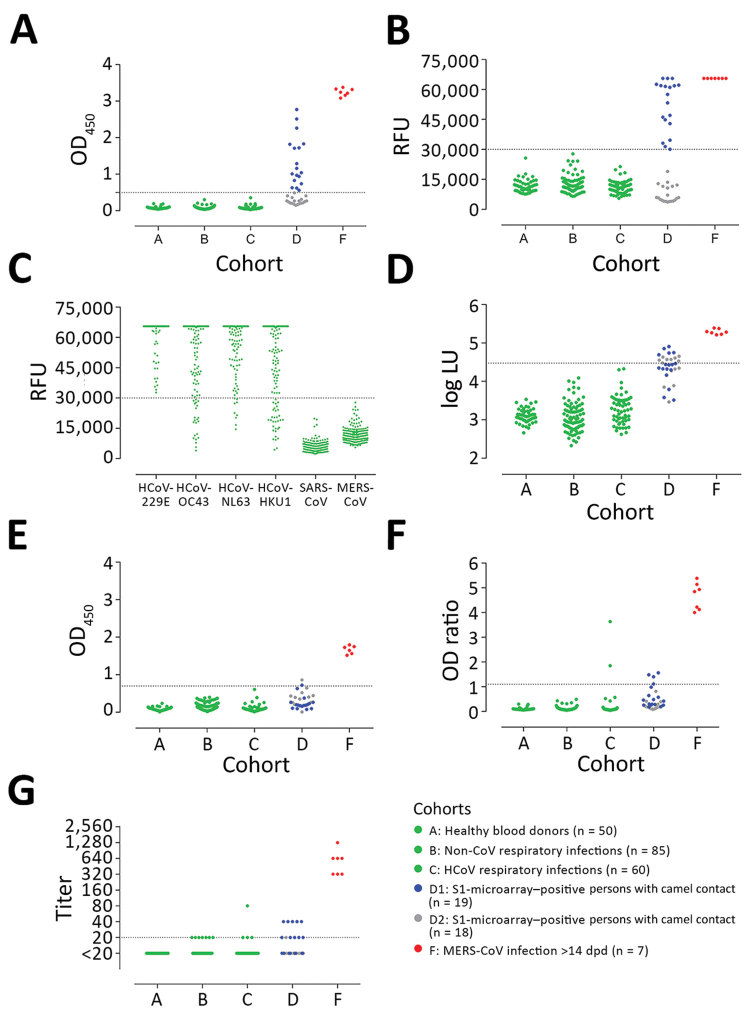
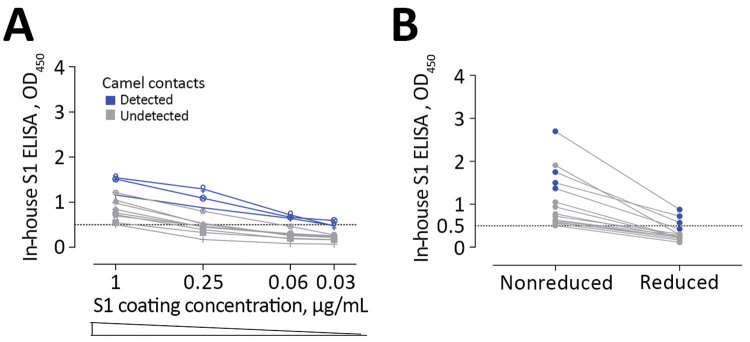
Middle East respiratory syndrome coronavirus (MERS-CoV) infections in humans can cause asymptomatic to fatal lower respiratory lung disease. Despite posing a probable risk for virus transmission, asymptomatic to mild infections can go unnoticed; a lack of seroconversion among some PCR-confirmed cases has been reported. We found that a MERS-CoV spike S1 protein-based ELISA, routinely used in surveillance studies, showed low sensitivity in detecting infections among PCR-confirmed patients with mild clinical symptoms and cross-reactivity of human coronavirus OC43-positive serum samples. Using in-house S1 ELISA and protein microarray, we demonstrate that most PCR-confirmed MERS-CoV case-patients with mild infections seroconverted; nonetheless, some of these samples did not have detectable levels of virus-neutralizing antibodies. The use of a sensitive and specific serologic S1-based assay can be instrumental in the accurate estimation of MERS-CoV prevalence.
中东呼吸综合征冠状病毒(MERS-CoV)感染人类可导致无症状至致命性的下呼吸道肺部疾病。尽管无症状至轻度感染可能未被察觉,但据报道,一些聚合酶链反应(PCR)确诊病例中并未出现血清转化。我们发现,一种基于 MERS-CoV 刺突 S1 蛋白的酶联免疫吸附试验(ELISA),通常用于监测研究,其在检测 PCR 确诊的轻度临床症状患者的感染方面灵敏度较低,且对人冠状病毒 OC43 阳性血清样本具有交叉反应性。使用内部 S1 ELISA 和蛋白质微阵列,我们证明了大多数 PCR 确诊的轻度感染 MERS-CoV 病例患者发生了血清转化;尽管如此,其中一些样本没有检测到病毒中和抗体。使用灵敏和特异的基于 S1 的血清学检测方法,有助于准确估计 MERS-CoV 的流行率。