Division of Infectious Diseases and Tropical Medicine, University Hospital, LMU Munich Germany.
National Institute for Medical Research (NIMR)-Mbeya Medical Research Center (MMRC), Mbeya, Tanzania.
PLoS Negl Trop Dis. 2019 Aug 19;13(8):e0007623. doi: 10.1371/journal.pntd.0007623. eCollection 2019 Aug.
Susceptibility to HIV has been linked to systemic CD4+ T cell activation in cohorts of seronegative individuals with high HIV-exposure risk. We recently described an increased risk of HIV transmission in individuals infected with Wuchereria bancrofti, the causative agent for lymphatic filariasis, in a prospective cohort study. However, the reason for this phenomenon needs further investigation.
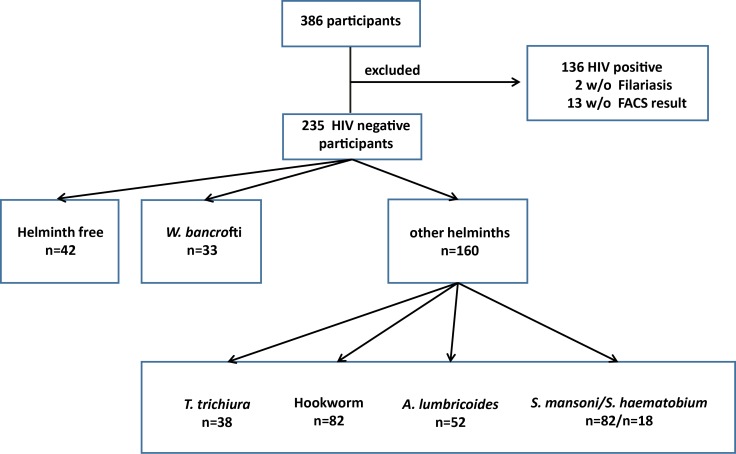
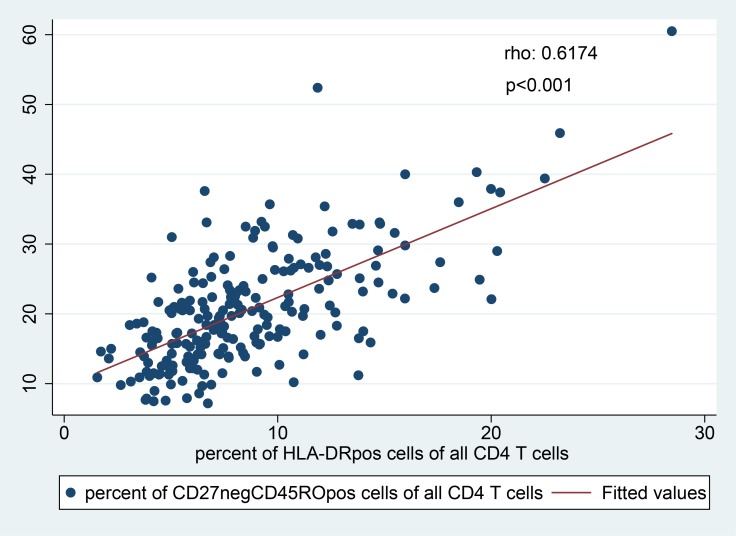
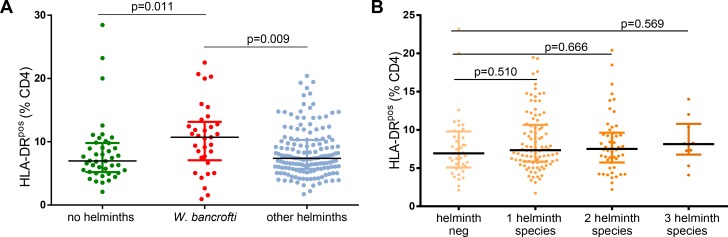
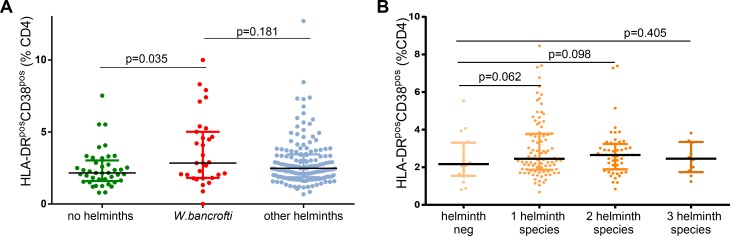
METHODOLOGY/PRINCIPAL FINDINGS: Two-hundred and thirty-five HIV negative adults were tested using Trop Bio ELISA for detection of W. bancrofti infection and Kato Katz urine filtration and stool based RT-PCR for detection of soil transmitted helminths and schistosomiasis. FACS analysis of the fresh peripheral whole blood was used to measure T cell activation markers (HLA-DR, CD38), differentiation markers (CD45, CD27), markers for regulatory T cells (FoxP3, CD25) and the HIV entry receptor CCR5. Frequencies of activated HLA-DRpos CD4 T cells were significantly increased in subjects with W. bancrofti infection (n = 33 median: 10.71%) compared to subjects without any helminth infection (n = 42, median 6.97%, p = 0.011) or those with other helminths (Schistosoma haematobium, S. mansoni, Trichuris trichiura, Ascaris lumbricoides, hookworm) (n = 151, median 7.38%, p = 0.009). Similarly, a significant increase in HLA-DRposCD38pos CD4 T cells and effector memory cells CD4 T cells (CD45ROposCD27neg) was observed in filarial infected participants. Multivariable analyses further confirmed a link between W. bancrofti infection and systemic activation of CD4 T cells independent of age, fever, gender or other helminth infections.
CONCLUSIONS/SIGNIFICANCE: W. bancrofti infection is linked to systemic CD4 T cell activation, which may contribute to the increased susceptibility of W. bancrofti infected individuals to HIV infection.
在高 HIV 暴露风险的血清阴性个体队列中,HIV 易感性与全身 CD4+T 细胞活化有关。我们最近在一项前瞻性队列研究中描述了感染班氏丝虫(引起淋巴丝虫病的病原体)的个体中 HIV 传播风险增加。然而,这种现象的原因需要进一步研究。
方法/主要发现:235 名 HIV 阴性成年人接受了 Trop Bio ELISA 检测,以检测是否存在班氏丝虫感染,并用加藤氏尿液过滤和粪便 RT-PCR 检测是否存在土壤传播的蠕虫和血吸虫病。使用新鲜外周全血的 FACS 分析来测量 T 细胞活化标志物(HLA-DR、CD38)、分化标志物(CD45、CD27)、调节性 T 细胞标志物(FoxP3、CD25)和 HIV 进入受体 CCR5。与无任何蠕虫感染(n=42,中位数 6.97%,p=0.011)或其他蠕虫(埃及血吸虫、曼氏血吸虫、鞭虫、蛔虫、钩虫)感染(n=151,中位数 7.38%,p=0.009)的个体相比,班氏丝虫感染者(n=33,中位数 10.71%)的 HLA-DRpos CD4 T 细胞的频率显著增加。同样,在感染丝虫的参与者中也观察到 HLA-DRpos CD38pos CD4 T 细胞和效应记忆细胞 CD4 T 细胞(CD45ROpos CD27neg)的显著增加。多变量分析进一步证实,班氏丝虫感染与 CD4 T 细胞的全身活化有关,而与年龄、发热、性别或其他蠕虫感染无关。
结论/意义:班氏丝虫感染与全身 CD4 T 细胞活化有关,这可能导致感染班氏丝虫的个体对 HIV 感染的易感性增加。