INRIA, F-69603, Villeurbanne, France.
Univ Lyon, LIRIS, UMR5205 CNRS, F-69621, Villeurbanne, France.
PLoS Comput Biol. 2019 Aug 19;15(8):e1006795. doi: 10.1371/journal.pcbi.1006795. eCollection 2019 Aug.
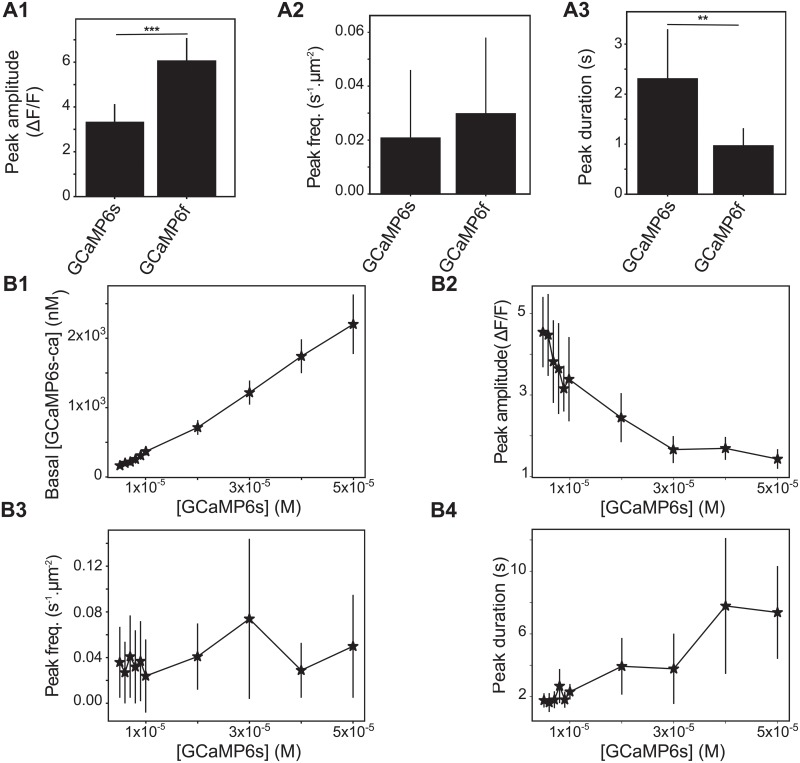
Astrocytes, a glial cell type of the central nervous system, have emerged as detectors and regulators of neuronal information processing. Astrocyte excitability resides in transient variations of free cytosolic calcium concentration over a range of temporal and spatial scales, from sub-microdomains to waves propagating throughout the cell. Despite extensive experimental approaches, it is not clear how these signals are transmitted to and integrated within an astrocyte. The localization of the main molecular actors and the geometry of the system, including the spatial organization of calcium channels IP3R, are deemed essential. However, as most calcium signals occur in astrocytic ramifications that are too fine to be resolved by conventional light microscopy, most of those spatial data are unknown and computational modeling remains the only methodology to study this issue. Here, we propose an IP3R-mediated calcium signaling model for dynamics in such small sub-cellular volumes. To account for the expected stochasticity and low copy numbers, our model is both spatially explicit and particle-based. Extensive simulations show that spontaneous calcium signals arise in the model via the interplay between excitability and stochasticity. The model reproduces the main forms of calcium signals and indicates that their frequency crucially depends on the spatial organization of the IP3R channels. Importantly, we show that two processes expressing exactly the same calcium channels can display different types of calcium signals depending on the spatial organization of the channels. Our model with realistic process volume and calcium concentrations successfully reproduces spontaneous calcium signals that we measured in calcium micro-domains with confocal microscopy and predicts that local variations of calcium indicators might contribute to the diversity of calcium signals observed in astrocytes. To our knowledge, this model is the first model suited to investigate calcium dynamics in fine astrocytic processes and to propose plausible mechanisms responsible for their variability.
星形胶质细胞是中枢神经系统的一种神经胶质细胞,它已成为神经元信息处理的检测和调节者。星形胶质细胞的兴奋性存在于细胞内游离细胞溶质钙离子浓度的短暂变化中,时间和空间范围从亚微域到整个细胞传播的波。尽管进行了广泛的实验研究,但尚不清楚这些信号如何在星形胶质细胞内传输和整合。主要分子因子的定位和系统的几何形状,包括钙通道 IP3R 的空间组织,被认为是至关重要的。然而,由于大多数钙信号发生在星形胶质细胞的分支中,这些分支太细,无法通过传统的光学显微镜分辨,因此大多数空间数据都未知,计算建模仍然是研究这一问题的唯一方法。在这里,我们提出了一个基于 IP3R 的钙信号转导模型,用于研究这种小亚细胞体积中的动力学。为了考虑到预期的随机性和低拷贝数,我们的模型既具有空间显式性,又具有基于粒子的特性。广泛的模拟表明,通过兴奋性和随机性的相互作用,自发钙信号在模型中产生。该模型再现了主要的钙信号形式,并表明其频率主要取决于 IP3R 通道的空间组织。重要的是,我们表明,两种表达完全相同的钙通道的过程可以根据通道的空间组织显示出不同类型的钙信号。我们的模型具有真实的过程体积和钙浓度,可以成功地再现我们用共聚焦显微镜在钙微域中测量的自发钙信号,并预测钙指示剂的局部变化可能有助于解释星形胶质细胞中观察到的钙信号多样性。据我们所知,该模型是第一个适合研究精细星形胶质细胞过程中钙动力学并提出可能导致其变异性的机制的模型。