Center for Epigenomics and Department of Genetics, Albert Einstein College of Medicine, Bronx, NY 10461 USA.
Commun Biol. 2019 Aug 14;2:312. doi: 10.1038/s42003-019-0559-3. eCollection 2019.
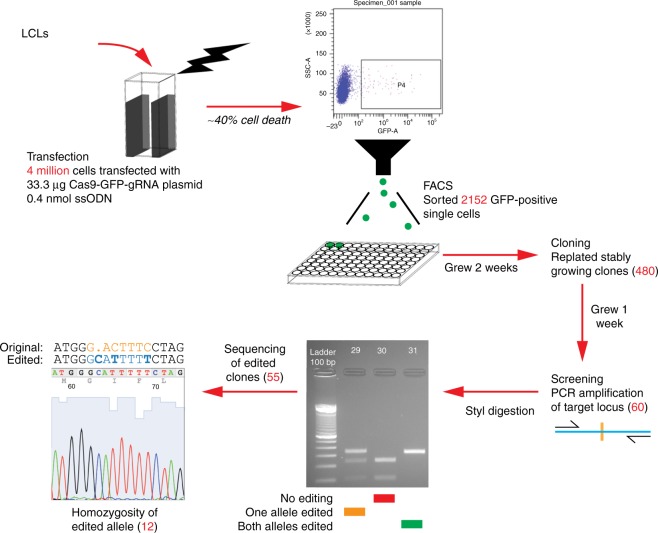
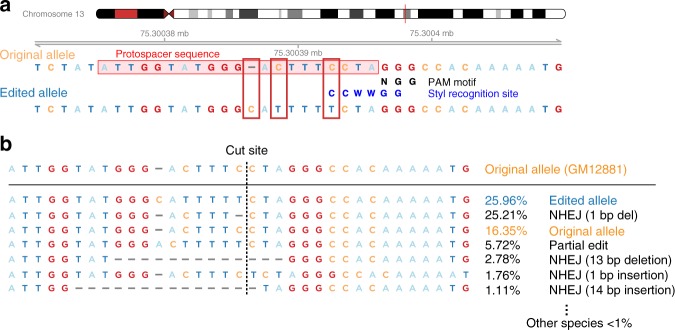
While human lymphoblastoid cell lines represent a valuable resource for population genetic studies, they have usually been regarded as difficult for CRISPR-mediated genomic editing because of very inefficient DNA transfection and retroviral or lentiviral transduction in these cells, which becomes a substantial problem when multiple constructs need to be co-expressed. Here we describe a protocol using a single-stranded donor oligonucleotide strategy for 'scarless' editing in lymphoblastoid cells, yielding 12/60 (20%) of clones with homology-directed recombination, when rates of <5-10% are frequently typical for many other cell types. The protocol does not require the use of lentiviruses or stable transfection, permitting lymphoblastoid cell lines to be used for CRISPR-mediated genomic targeting and screening in population genetic studies.
虽然人类淋巴母细胞系是群体遗传学研究的宝贵资源,但由于这些细胞中 DNA 转染和逆转录病毒或慢病毒转导的效率非常低,因此通常被认为不适合 CRISPR 介导的基因组编辑,当需要共表达多个构建体时,这就成了一个实质性的问题。在这里,我们描述了一种使用单链供体寡核苷酸策略在淋巴母细胞中进行“无疤痕”编辑的方案,当许多其他细胞类型的同源定向重组率通常典型为 <5-10%时,该方案可产生 12/60(20%)的克隆具有同源定向重组。该方案不需要使用慢病毒或稳定转染,从而允许淋巴母细胞系用于 CRISPR 介导的基因组靶向和群体遗传学研究中的筛选。